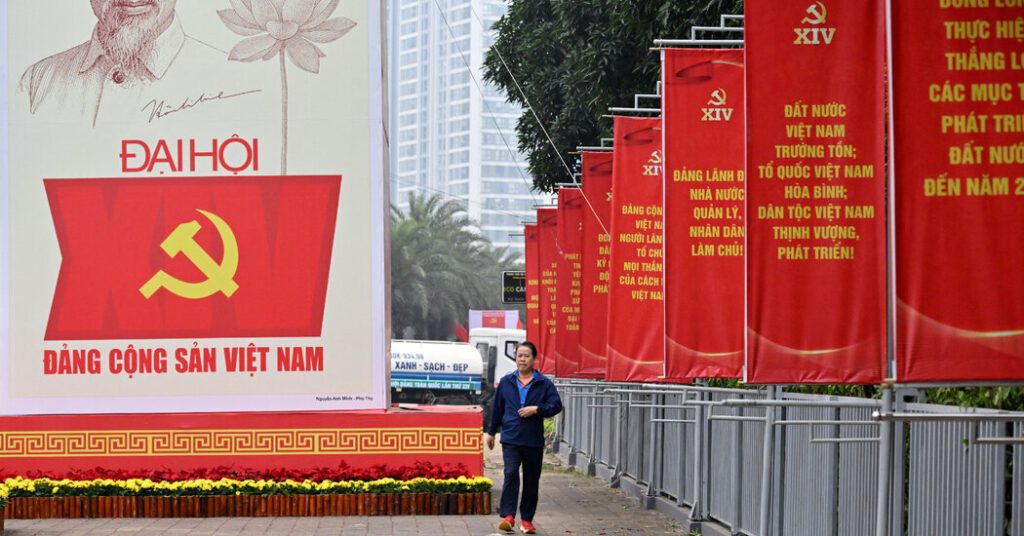
The Communist Party of Vietnam on Monday opened its most consequential party congress in decades, as the nation — an emerging middle power and one of Asia’s most dynamic countries — is facing its best and last chance to “get rich before getting old.”
After 40 years of reform and an extraordinary rise out of poverty, Vietnam is under mounting pressure to pursue bolder reforms to catch up with regional neighbors like South Korea and Taiwan.
Vietnam, a country of 102 million people, has a shrinking window in which the working-age population will still be large enough to drive rapid growth before society ages.
At the same time, shifting geopolitics offer a mix of pressure and opportunity.
Both China and the United States see Vietnam as strategically important. It has a long coastline along the contested sea routes of the South China Sea, as well as a rapidly growing manufacturing base that draws on Chinese supply chains and ships more of its exports to the United States than anywhere else.
Washington and Beijing, along with Moscow and much of Europe, are all pushing Vietnam to lean their way while trying to gauge where the country is heading.
The weeklong party congress in Hanoi ends Jan. 25.
Will there be leadership changes?
For decades, Vietnam’s one-party state has been governed by the top four members of the Communist Party’s Politburo — the so-called “Four Pillars” — the general secretary, the president, the prime minister and the chair of the National Assembly. The arrangement was designed to keep power from being concentrated in a single leader.
But the party is now rushing to reach ambitious targets set by the last congress: raising per capita gross domestic product by about 70 percent to $8,500 by 2030 and building enough of an industrial economy to become a high-income developed country by 2045.
“It is very important for the party to deliver on these goals,” said Nguyen Hong Hai, political scientist at VinUniversity in Hanoi. “The Communist Party’s legitimacy will be reinforced by its performance.”
In an era of uncertainty fueled by the United States and China, the party chief, To Lam, is likely to amass more power by also taking on the role of president. Cuba and China have similar structures with single leaders who head up the party and the state. According to several officials and diplomats, who declined to be named as they discussed party nominations, Mr. Lam, 68, is the only nominee for both posts.
The current president, Luong Cuong, 68, a military general, is expected to retire. If Mr. Lam’s dual role is approved, it would signal that the military, a powerful faction since the war, has been at least somewhat sidelined — as Mr. Lam consolidates power.
What has the party chief done so far?
Until recently, Mr. Lam was mostly known as an enforcer. A former head of public security, he rose to become Vietnam’s top leader in 2024 after the death of his predecessor, Nguyen Phu Trong.
Since then, Mr. Lam’s party leadership has delivered a whirlwind of change, starting with a huge administrative overhaul that consolidated provinces and put tens of thousands of officials out of work. A lover of soccer, jazz and classical music, he has also promoted a building spree for stadiums and opera houses, along with new roads, train lines and airports.
Behind the scenes, he has sought to elevate loyalists, strengthen ties to large quasi-state-run companies, and win over both the party establishment and prominent figures from southern Vietnam whom his predecessor treated as pariahs.
Among his methods: He has brought large entourages on trips overseas while speaking frequently about an “era of national rise” for Vietnam, with the private sector playing a bigger role.
Mr. Lam is seen as a potential transitional figure who could create more amenable conditions for a broader range of private enterprise. But critics stress that the party still prioritizes central control. Despite their low productivity, state-owned and state-favored companies still enjoy special treatment. New laws give greater power to authorities to find and crack down on “anti-state” commentary, with some worrying that could include accurate, unflattering information about the economy.
How are leaders selected?
The congress will draw together 1,586 delegates, representing the 5.6 million people who are registered party members. Most delegates are appointed by the party. Their job this week will entail discussing Communist Party promotions after shuttling from upscale Marriott and Lotte hotels to a convention center in Hanoi.
There, they will name around 200 officials to the Central Committee. That group picks the 17 to 19 members of the Politburo, the party’s most powerful body, from which the committee chooses the general secretary and other “pillars.”
Intraparty jockeying for power has been going on for months.
Leaks and internal discussion of the most significant choices suggest that the congress will produce a mix of continuity and a sharper tilt toward rapid economic reform.
Prime Minister Pham Minh Chinh, 67, a police general and former intelligence officer, is expected to retire and be replaced by Le Minh Hung, 55, the youngest member of the Politburo. He has a background in finance and is a former governor of the State Bank of Vietnam.
The last of the four “pillars,” Tran Thanh Man, 63, is expected to stay in his post as the chair of the National Assembly.
Many of those expecting promotion at the provincial and ministry levels have ties to Mr. Lam’s home province of Hung Yen.
What are Vietnam’s policy priorities?
The party plans to draw up a new model for economic growth, to rely less on low-skilled labor, and more on science and technology.
“Vietnam is still facing very major challenges, including the risk of falling further behind economically, failing to adapt quickly enough to climate change and environmental degradation,” according to a party report set to be presented at the congress.
That report said Vietnam would seek strategic projects with other countries because “with some important partners, trust remains low, uneven and not truly sustainable.”
That appeared to be a reference to the United States. A trade deal with Washington still hasn’t been finalized. Despite the strain of tariffs, Vietnam’s economic growth topped 8 percent last year, in large part because Chinese factories have moved into Vietnam at a rapid pace.
The country’s main challenge lies with implementing policies that build more openness, efficiency and competition, analysts say. Internally, an oligarchy of state-favored firms with low productivity represent one danger. U.S. trade tensions and a surge of Chinese factories — heavily subsidized by Beijing — also threaten to keep Vietnam from its goal of developing a strong domestic industrial economy.
In recent congresses, policy adjustments had often been incremental. This year, many Vietnamese are hoping for more decisive moves as the forces of stability and urgency compete.
Damien Cave leads The Times’s new bureau in Ho Chi Minh City, Vietnam, covering shifts in power across Asia and the wider world.
The post Can Vietnam’s Communist Party Supercharge Its Economy With Private Enterprise? appeared first on New York Times.