Season 1, Episode 1: ‘The Hedge Knight’
You don’t hear whistling in Westeros very often. The warring kings, the scheming viziers, the occasional incursion by angry dragons or ice zombies — there’s just not a whole lot to feel cheerful about in the Seven Kingdoms. It’s hard to whistle while you work when the work is a Hobbesian war of all against all, unless you’re being a real Joffrey about it.
But in “A Knight of the Seven Kingdoms,” the new HBO show set in the same world as “Game of Thrones” and “House of the Dragon,” there’s whistling on the soundtrack. Lots of it, in fact. Jaunty, carefree whistling, atop a bed of folksy acoustic guitar. The work that composer Dan Romer does here is a world removed from the dramatic, swirling score provided by Ramin Djawadi for this show’s predecessors. Only once does the music hint at that familiar, rousing theme song … and it is immediately cut off by a shot of the show’s hero violently moving his bowels.
In other words, you can literally hear that this is a different kind of show than the previous Westerosi epics. (The episodes are near-sitcom shortness, too.) “A Knight of the Seven Kingdoms” is adapted from the author George R.R. Martin’s novella “The Hedge Knight,” a far more compact and straightforward story of bravery and villainy than his epic “A Song of Ice and Fire” series of novels. Ira Parker, who created the series with Martin and oversees it as showrunner, is not telling a story that determines the fate of nations or the future of humanity in this fantasy world. (Not so far, anyway.) No wonder the music sounds less like “The Lord of the Rings” and more like “Harold and Maude.”
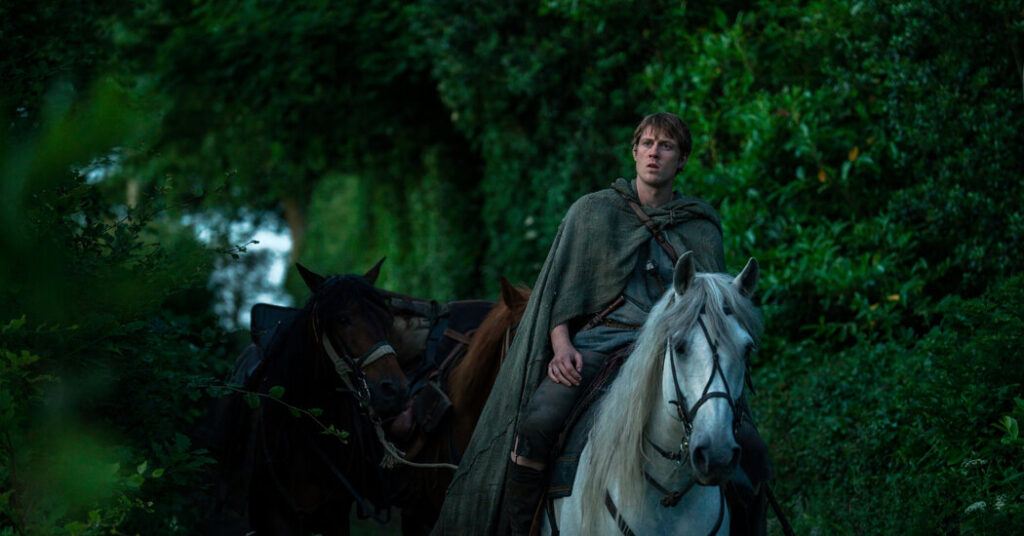
Peter Claffey stars as the title character, a towering young knight-in-training with the unlovely name Dunk. We join him in the pouring rain as he buries his mentor, Ser Arlan of Pennytree (Danny Webb). You can put the rich, powerful knights you know from “Thrones” or “House” out of your mind: Ser Arlan was a so-called hedge knight, a man who has sworn the vows and owns the weaponry but lacks steady employment or a home of his own. Such men travel the Seven Kingdoms, sleeping in the shrubbery for shelter when no lord will have them.
Hoping to make money by plying the only trade he (sort of) knows, he enters a great tourney of knights at Ashford, a lofty castle that Dunk can only see from a distance. In the meantime he makes his way through the bustling, impromptu village that has arisen near the tourney grounds. Here, lords and knights feast in their tented pavilions. Prostitutes keep busy thanks to the appetites of the aristocracy. There’s even an elaborate theatrical production for the entertainment of the tourney goers, featuring a massive dragon puppet that breathes real fire. Dunk, a strapping lad, only has eyes for the pretty puppeteer (Tanzyn Crawford).
But Dunk has more pressing problems than a crush on a trouper. With nothing to his name but Ser Arlan’s old sword and a trio of horses — which he can’t sell without becoming a horseless knight, little better than a bandit — Dunk must convince the tourney master (Tom Vaughan-Lawlor) to allow him to enter. In between yelling at his rambunctious kids and hocking gobs of phlegm into a spittoon, the man is kind enough to Dunk, but his message is clear. Unless a knight of well-known provenance vouches for him, he won’t be allowed to join the lists.
Dunk’s best hope is Ser Manfred Dondarrion (Daniel Monks), a womanizing creep whose father employed Ser Arlan in a conflict some years back. To Dondarrion, though, Ser Arlan, whom he has never heard of, is just one wounded warrior out of many, and that’s not counting the dead. Such men are easily forgotten.
Dunk has more luck making friends with some other nobles. He first meets Raymun Fossoway (Shaun Thomas), a young squire from an important family, while his cousin Steffon (Edward Ashley) knocks the stuffing out of him during practice. Raymun later whisks him into the grand tent of one of the most famous knights in the Seven Kingdoms: Ser Lyonel Baratheon (Daniel Ings), known as the Laughing Storm.
A garrulous warrior who possess the looks and charm of a dissolute George Clooney, Baratheon notices Dunk skulking around the party, acting shy while stuffing his face. (Living life on the road, it’s unlikely he has ever eaten food this fine before.) Wearing a magnificent antlered crown, Ser Lyonel demands to know why the young, clearly impoverished knight is in his tent.
“Supper,” Dunk replies, half a pastry in his hand.
It’s exactly the right answer for the Laughing Storm. Taken by Dunk’s honesty, Ser Lyonel spends the rest of the evening partying down with the towering young man, whom he bedecks with his own antlered crown and regales with tales of his bravery in battle. But this is just shop talk, not bragging. Ser Lyonel doesn’t think much of his own derring-do: When faced with peril, he simply reminds himself that others have faced it as well so that he can, too. Still, he has to be honest when Dunk asks for an honest opinion about his chances in the tourney: “You have no chance.”
One person at Ashford, however, really seems to believe in Dunk. That would be Egg (Dexter Sol Ansell), the appropriately named bald orphan boy who attaches himself to Dunk after they meet at a nearby inn. His posh accent and brash manner make for a study in contrast with Dunk, whose accent is Irish and whose imposing size makes him only more awkward around others, not less.
But for all his insolence and skepticism regarding Dunk’s attire and prowess, Egg makes a heck of a squire. By the time Dunk returns to his camp, which is to say before he even hires the kid, Egg has started a campfire, brushed the horses and caught and cooked a fish. He even points out that Dunk’s lack of a tent enables him to see a shooting star in the sky overhead as they lay down to sleep — a sign of good luck that all the rich lords in their cozy tents won’t see at all. Dunk ends the episode smiling, a grown man imbued by the confidence of a child.
Working from a script by Parker, the director Owen Harris uses both the environment and smart editing choices to convey the kind of person Dunk is and the kind of life he has led, before the first scene is out. Here’s a guy so determined to do right by his master that he’ll stand in the pouring rain to dig the man’s grave. He does this despite a rapid-fire montage that shows Ser Arlan beating Dunk again and again and again, as both a child and a young man.
Whatever lessons he learned from the older hedge knight, though, this is one he notably does not pass on. Keep track of how many times Dunk threatens Egg with “a clout in the ear” or the like; now think of how many times he actually follows through. The big man never lays a hand on the bald boy, no matter how rude the kid gets. Dunk may have loved Ser Arlan, but he clearly didn’t love the beatings and has no desire to perpetuate that cycle of violence with his own squire.
Of course, it seems unlikely Dunk would be able to articulate why he’s doing what he’s doing in such a fashion. Barely educated and lacking in the Westeros equivalent of street smarts, he is the kind of person you can tell other people make fun of. This guy bumps his head on every ceiling he encounters; with a skull that thick, the insults write themselves.
Indeed, he is perpetually put down throughout the episode — Westeros is not a friendly place, and one knight’s loss is another knight’s gain. That’s literally true in the tournament, where you forfeit your possessions to your opponent if you lose and must ransom them back.
But even from the little we’ve seen of him, Dunk seems to possess a different kind of intelligence — empathy. He naturally sides with the littler Fossoway against his arrogant older cousin. He understands there’s an inherent injustice when lords forget the men who suffer and die in their service. He recognizes that Egg is a child who needs guidance, and despite feeling lost himself, he offers it without a single clout in the ear. In a world full of Targaryens and Lannisters, we need a Ser Duncan the Tall. He’s worth whistling about.
The post ‘A Knight of the Seven Kingdoms’ Season 1 Premiere Recap: A Tall Tale appeared first on New York Times.