A protester detained, her bra removed and wedding ring cut off, and some of her clothes never returned. The “gratuitous deployment” of pepper spray. A couple’s car surrounded by agents, who pointed semiautomatic weapons at them at close range.
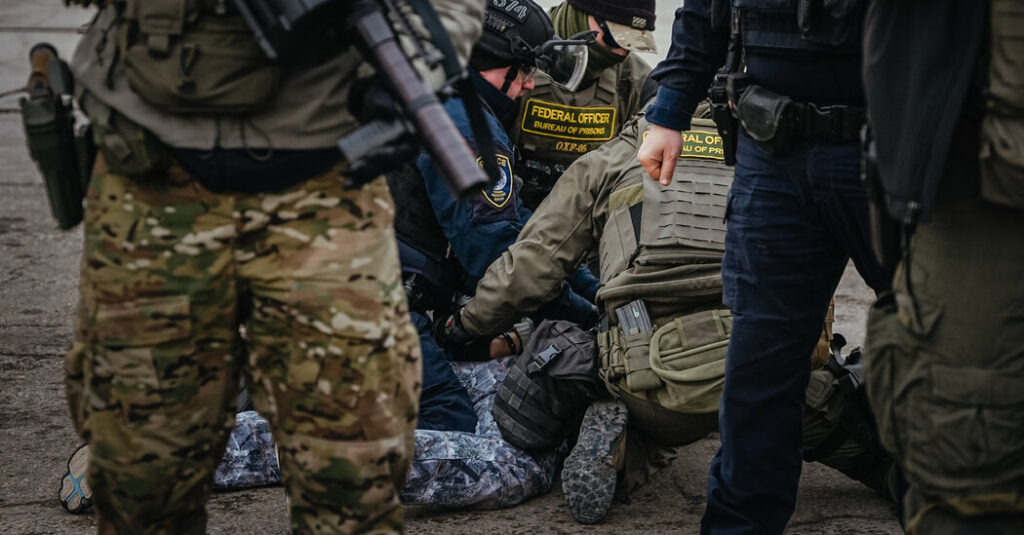
A federal judge in Minneapolis cited the episodes in an unusually detailed ruling on Friday that found a pattern of misconduct by Immigration and Customs Enforcement officers and ordered them and other immigration agents to stop using excessive force against protesters while conducting their operations in the city.
In some ways, legal experts said, the judge’s order was fairly mundane because it merely ordered the federal agents to follow established constitutional law, permitting peaceful protests.
In other ways, it stood out.
“Extraordinary,” Michele Goodwin, a law professor at Georgetown University, said of the decision. The judge, she said, reviewed dozens of witness declarations and video evidence and found conduct “alarming enough, dangerous enough that the court has imposed a preliminary injunction.”
Protesters and state officials have for weeks been calling on the federal government to withdraw its immigration agents from Minneapolis, a movement that has only intensified since Renee Good was shot and killed on Jan. 7 by Jonathan Ross, an ICE officer.
In late December, the American Civil Liberties Union, on behalf of several protesters, filed a complaint against the federal government and its agents seeking to protect the protesters’ rights to speech, assembly and unlawful search and seizure.
The court order was based on earlier interactions that immigration agents had with protesters that did not gain as much attention as the killing of Ms. Good. The accounts described in the order were submitted to the court from declarations and video submissions from both parties.
Ms. Goodwin was one of several legal scholars and criminal justice experts who said the conduct of ICE agents during Operation Metro Surge, the government’s name for its immigration crackdown in Minneapolis, evoked the attacks by police officers in Birmingham, Ala., on civil rights protesters in 1963.
David Rudovsky, a University of Pennsylvania law professor, also noted the similarities. “I think about the civil rights movement in the South and how Southern law enforcement reacted with hoses, dogs and lynchings,” he said.
Images of Birmingham’s police dogs sinking their teeth into protesters shocked the world. The aggressive conduct of federal agents in Minneapolis has also raised alarm, particularly following the shooting death of Ms. Good.
The constitutional principles at risk are the same.
Kristi Noem, the secretary of homeland security, called the judge’s findings “ridiculous” on Sunday in an interview with CBS’s Face the Nation and then blamed the protesters.
“We only use those chemical agents when there’s violence happening and perpetuating and you need to be able to establish law in order to keep people safe,” she said, adding that the judge’s order will not change the agency’s operations on the ground. “It’s basically telling us to do what we’ve already been doing,” she said.
Her agency was expected to appeal the ruling.
The case is the latest in a series of legal challenges across the country, including in California, Illinois and Washington, D.C., where civil and immigrant rights organizations have sought to curb the tactics of federal agents.
In Illinois, where immigration agents massed for several weeks last year, a federal judge issued a sweeping injunction that placed several limits on how agents could use force and interact with protesters. An appellate court later blocked that ruling, calling it too broad and too prescriptive.
The legal moves have come as the Trump administration pursues its deportation agenda, a cornerstone of the campaign that helped get Mr. Trump elected to a second term. For many, including in Minnesota, the immigration crackdown is the welcome fulfillment of that promise and should not be impeded by protesters.
The 83-page ruling found that “the record adequately illustrates that the defendants have made, and will continue to make, a common practice of conduct that chills observers’ and protesters’ First Amendment rights.”
Judge Katherine Menendez, who was appointed to the U.S. District Court for the District of Minnesota by President Joseph R. Biden, said that neither party requested an evidentiary hearing, even though the court made that available.
She also stated that she gave “substantial weight” to the sworn statements from the plaintiffs and noted that immigration agents involved in the interactions with protesters did not provide sworn declarations.
Rather, the defense depended on testimony from David Easterwood, who directs the Minneapolis field office for ICE Enforcement and Removal Operations. Mr. Easterwood said he was not present at the encounters, but rather relied on “personal knowledge, reasonable inquiry and information made available to me.” Judge Menendez said because of that, she gave “considerably less weight” to the testimony of Mr. Easterwood.
In one episode described in the order, Judge Menendez concluded that federal agents likely were “simply fed up with the protesters generally” when they decided to violently arrest a man who was involved in peaceful activity.
“‘Let’s get this guy,’ one of the agents said, before they grabbed Abdikadir Noor, and threw him to the ground,” the ruling said.
While ICE contended in court papers that Mr. Noor was leading an agitated crowd of protesters as agents attempted to make an arrest, videos showed that he had pushed another protester away from the officers and held his arm up to urge other protesters to stay back, the court ruling said.
He was detained by ICE agents, taken to a federal building, shackled and put in a cell, and later released, according to the decision.
Mr. Noor, 43, a U.S. citizen of Somali descent, was one of six named plaintiffs in the lawsuit, filed by the A.C.L.U. and private attorneys who are volunteering their time. A call to the A.C.L.U was not returned.
Geoffrey Alpert, a professor of criminology at the University of South Carolina, said the ICE behavior described in the ruling sets a new level of misconduct.
“In the last 45 years I’ve been studying these events, I’ve seen nothing like what we’re experiencing today,” he said.
Dr. Alpert cited the case of Susan Tincher, one of the plaintiffs in the lawsuit against ICE, as egregious behavior.
Ms. Tincher woke to learn that ICE agents had arrived in her Near North neighborhood in Minneapolis. She drove to a nearby home that was surrounded by agents to find out what was happening.
Standing about six feet from agents who had encircled the home, she said, she heard officers say, “Get back,” and “Take her down.”
Within about 15 seconds, she said, several agents had grabbed her and pulled her to the ground, then handcuffed her while she was face down in the snow. Witnesses said she did not physically resist agents or taunt or threaten them.
ICE agents took Ms. Tincher to the federal building where they removed some of her clothes, cut off her wedding ring, and shackled her. Before releasing her, they told her she would be charged with obstructing a federal officer. She was never charged.
In court papers, Mr. Easterwood said that Ms. Tincher had attempted to cross into the perimeter of the house and tried to push an ICE officer out of the way.
But Judge Menendez disagreed.
She also cited a number of incidents of ICE agents “gratuitously deploying chemical irritants at observers and protesters.”
Alan Crenshaw, 35, a Minneapolis resident involved in the protests, said he entered a restaurant and witnessed two agents “violently slamming a young Black man against the wall” even though the man was yelling in pain and telling them he was a U.S. citizen.
Outside, he said, he saw the agents push the young man into the snow for no apparent reason, handcuff him and place him in a car.
As a crowd gathered, Mr. Crenshaw said multiple people were being pepper sprayed with no warning. Agents drove slowly past, opened the car door and sprayed a bystander on the side of the road. Then, another ICE car without lights drove past and sprayed Mr. Crenshaw right in the face.
“Arresting people who are engaged in peaceful protest, using chemical spray against people engaged in protest activity, these are all very obvious. These are things that no police officer should do,” said Dr. Alpert, who has advised police forces.
On another point of contention — the behavior of ICE officers toward vehicles that seem to be tailing federal agents — Judge Menendez wrote that about a dozen incidents showed that “federal immigration agents are stopping residents’ vehicles without sufficient cause to justify detention.”
ICE agents had positioned their vehicles to block the road, braked abruptly in front of residents and activated emergency lights to initiate a stop.
In court documents, ICE did not specifically address detailed allegations about vehicular stops. Generally, though, the agency responded by saying that when protesters follow government vehicles, there have been cases in which the behavior “is not safe and impedes ICE officers from effecting arrests.”
In one incident described in the documents, a married couple, John Biestman, 69, and Janet Lee, 67, followed an ICE vehicle, making sure to keep their distance.
But when they turned into a park, the couple said, they were surrounded by four unmarked sport utility vehicles. ICE agents emerged from the vehicles, surrounded the couple’s car and demanded that they roll down the windows.
The agents were pointing semiautomatic weapons at them, at close range, the couple said. At one point, one of the agents reached into their car through the driver’s side window.
Judge Menendez concluded that the couple, Minneapolis residents who are both retired, had shown a “likelihood of success” on their claims that the officer violated their rights.
Another expert interviewed by The New York Times, Michael Mannheimer of Northern Kentucky University, said “there’s no law against following someone if you’re not breaking any traffic laws.”
When they told the agents they were U.S. citizens, the couple said, one responded, “It doesn’t matter.” Another offered, “What you’re doing is illegal. This is like Germany 1938,” the court papers said.
Stephanie Saul reports on colleges and universities, with a recent focus on the dramatic changes in college admissions and the debate around diversity, equity and inclusion in higher education.
The post In Minneapolis, a Pattern of Misconduct Toward Protesters appeared first on New York Times.