Faced with the threat of punishing tariffs by President Trump if he does not get his way over acquiring Greenland, European Union leaders began to coalesce around a negotiation strategy on Sunday, without ruling out retaliatory taxes of their own.
Mr. Trump on Saturday had demanded a deal to buy Greenland, saying on social media that otherwise he would slap tariffs on a group of European nations, starting with 10 percent in February, then ramping up to 25 percent in June.
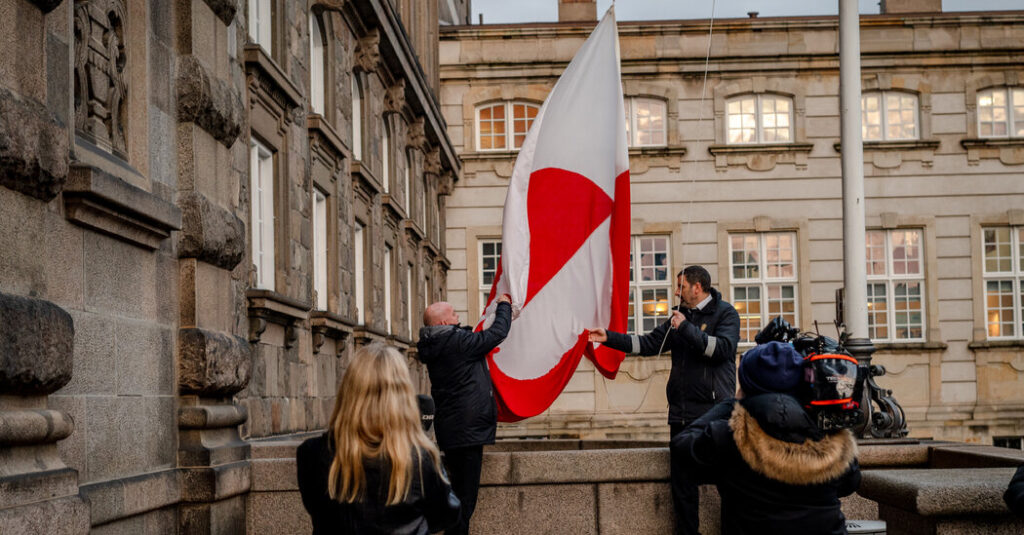
On Sunday, ambassadors from across the 27-nation bloc met in Brussels to take stock of the situation. While those were just preliminary talks, they made a few things clear. Officials would rather negotiate than retaliate, for one. But they are also committed to protecting Greenland, an autonomous territory of Denmark, from being bought or taken over if that is not what its people want.
The Trump administration showed no signs of backing down. In an interview on NBC’s “Meet the Press,” Treasury Secretary Scott Bessent said that European leaders would eventually understand that American control of Greenland would be “best for Greenland, best for Europe and best for the United States.”
“The European leaders will come around,” Mr. Bessent said.
If Washington continues to escalate its efforts, European officials could also consider hitting back, two diplomats familiar with the discussions said.
Officials are entertaining the possibility of allowing a list of retaliatory tariffs worth 93 billion euros, or $107 billion — drawn up during last year’s trade war — to take effect in February.
And some members of the European Parliament and Emmanuel Macron, the French president, have suggested that the European Union should activate an even more drastic tool: A never-used weapon intended to combat economic coercion.
That option — officially called the “anti-coercion instrument,” and unofficially referred to as Europe’s trade “bazooka” — could be used to slap restrictions on big American technology companies or other service providers that conduct large amounts of business on the continent.
It would not be a first resort, the diplomats said, because it would risk escalating the conflict.
All the European Union’s options are likely to be up for discussion later this week, when leaders gather in Brussels. António Costa, the president of the European Council, which gives the European Union political direction, announced on Sunday that he had “decided to convene an extraordinary meeting” of European leaders in the coming days. An E.U. official added that the meeting might be in person, and that it could take place on Thursday.
Such a session would allow prime ministers and presidents from across the bloc to discuss how they might respond to Mr. Trump. It would also come just as, or before, many European policymakers head to Davos, Switzerland, for the annual World Economic Forum. Mr. Trump is also planning to attend, creating a chance for conversation.
While many European leaders are still hoping they might be able to talk things out, discussions have essentially been futile so far.
Europe has been hesitant to retaliate against the United States, in part because it relies on America for military technologies and support for NATO.
But Brando Benifei, a member of the European Parliament and the chair of its delegation for U.S. relations, said that calculus may be shifting, in part because popular opinion in Europe has turned more critical of the U.S.
“A lot of people are saying that we are clearly over a red line,” he said in an interview.
Prime Minister Keir Starmer of Britain spoke to Mr. Trump on Sunday and told him that “applying tariffs on allies for pursuing the collective security of NATO allies is wrong,” a Downing Street spokesman said.
Italy’s prime minister, Giorgia Meloni, told reporters on Sunday that she had also spoken to Mr. Trump and called the proposed tariffs a “mistake.”
Mark Rutte, the secretary-general of NATO, said on social media that he, too, had spoken with Mr. Trump about Greenland, but provided few details, saying only that “we will continue working on this” and that he looked forward to seeing Mr. Trump at Davos this week.
The White House did not immediately comment on the spate of calls, which come a day after Mr. Trump’s announcement of new tariffs was met with unified outrage by U.S. allies. Several of those allies, including Britain, France and Germany, released a forceful joint statement with Denmark on Sunday that decried the tariff threats, saying that they “undermine transatlantic relations and risk a dangerous downward spiral.”
The co-signers of the statement, all NATO countries, said they would continue to stand in solidarity with Greenland and vowed to remain “united and coordinated in our response.” The statement was later endorsed by several other European countries, including Iceland, Latvia and Lithuania.
Jeanna Smialek is the Brussels bureau chief for The Times.
The post European Union Officials Lean Toward Negotiating, Not Retaliating, Over Trump Tariff Threat appeared first on New York Times.