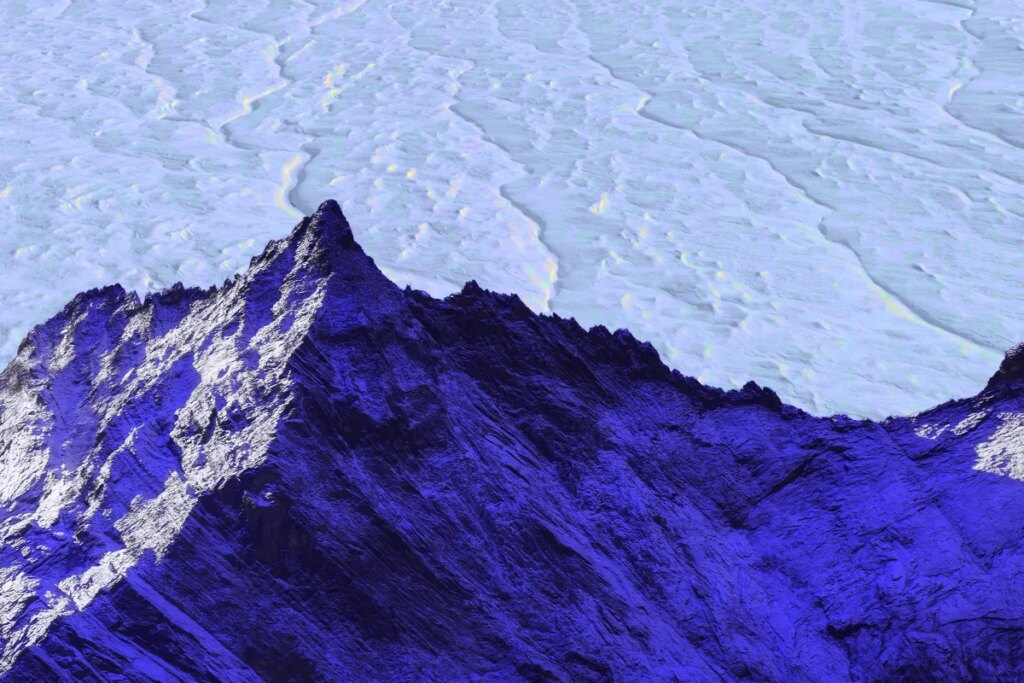
By creating a new map of Antarctica’s subterranean landscape, researchers have uncovered a vast topography of previously hidden hills, ridges, and even entire mountain ranges lurking miles beneath its frozen exterior.
The findings, detailed in a new study published in the journal Science, could represent a novel method of probing the Antarctic ice that could be instrumental in predicting the frigid continent’s fate amid rapid climate change.
“It’s like before you had a grainy pixel film camera, and now you’ve got a properly zoomed-in digital image of what’s really going on,” lead author Helen Ockenden, a researcher at the University of Grenoble-Alpes in France, told the BBC.
Previous approaches have relied on on-the-ground and aerial missions to use radar to sound out the continent’s subsurface features. But the barren landscape is intimidatingly vast, and these missions can be separated by dozens of miles, leaving scientists with an incomplete picture, which itself can only really guess at what’s trapped below all those miles of ice.
According to an editor’s summary of the study, the Antarctic’s subsurface landscape is so mysterious that we know less about it than we do Mercury. Study coauthor Robert Bingham, a glaciologist at the University of Edinburg, provided an analogy.
“If you imagined the Scottish Highlands or the European Alps were covered by ice and the only way to understand their shape was the occasional flight several kilometers apart,” he told the BBC, “there’s no way that you would see all these sharp mountains and valleys that we know to be there.”
Space provides an alternative. Using a combination of optical images and radar data taken by satellites, and then combining this with models on how subsurface ice flows, Ockenden and her team teased out the undulations in the bedrock underneath the ice, according to Science.
“It’s a little bit like if you’re kayaking in a river, and there’s rocks underneath the water, sometimes there’s eddies in the surface, which can tell you about the rocks under the water,” Ockenden told the BBC. When the ice flows over a ridge or hill the bedrock, “that manifests in the topography of the surface, but also in the velocity as well.”
The novel approach uncovered a far more interesting and heterogeneous landscape than what was suspected before: alpine valleys, eroded lowlands, and a vast network of channels formed by flowing water spanning hundreds of miles.
It isn’t perfect, according to University of Texas at Austin glaciologist Duncan Young, who wasn’t involved in the study. He told Science that the approach can’t pick up features smaller than a few meters across, for which traditional radar approaches will still be the best to uncover.
Still, it provides a good guide for where radar surveys should look.
“We’re not so blind now,” Bingham told Science. “We have a really good impression of where the bed’s quite rough, where you would need to survey closely if you really want to see the details of the features.”
Understanding Antarctica’s buried geography and fluvial networks will be crucial to understanding how its immense reserves of ice will be affected by climate change. Already, scientists predict that the potential collapse of just one of the continent’s ice sheets — connected to the infamous Thwaites or “Doomsday” glacier — could raise sea levels by dozens of feet in the coming centuries. Subterranean happenings turned out to be an alarming development in our understanding of the the Thwaites’ health, when scientists discovered that its bottom side, once thought to be protected by the seabed, was actually being exposed to warming seawater. Similar revelations, with new imaging techniques, could come to bear on our understanding of the continent at large.
More on Antarctica: Ship of Scientists Headed to Doomsday Glacier
The post Scientists Uncover Secret Landscape Hiding Miles Below Antarctica’s Ice appeared first on Futurism.