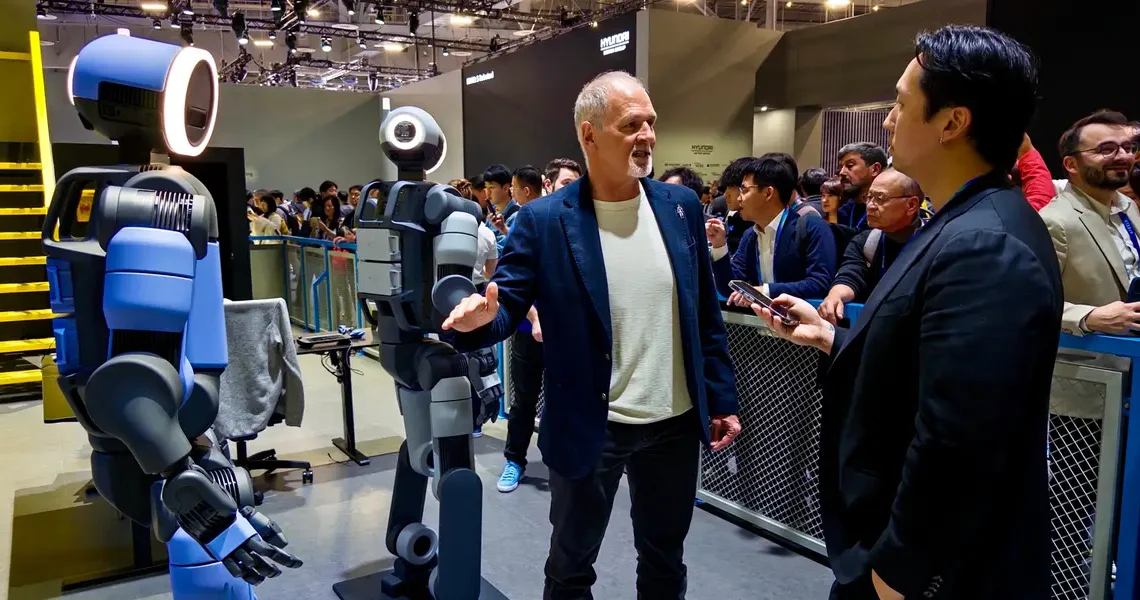
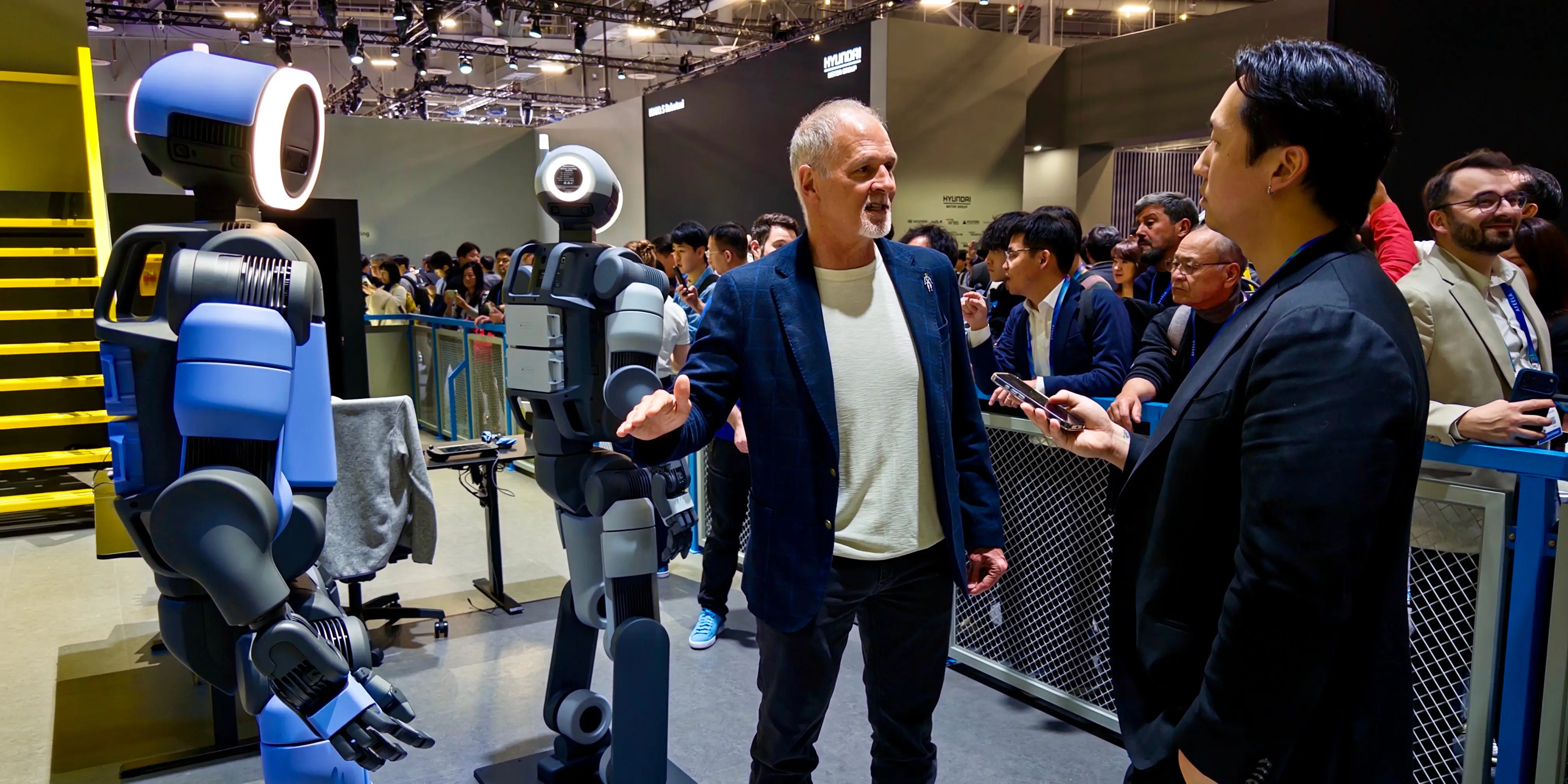
In a few years, factory employees at Hyundai’s massive Georgia plant could be getting a new coworker.
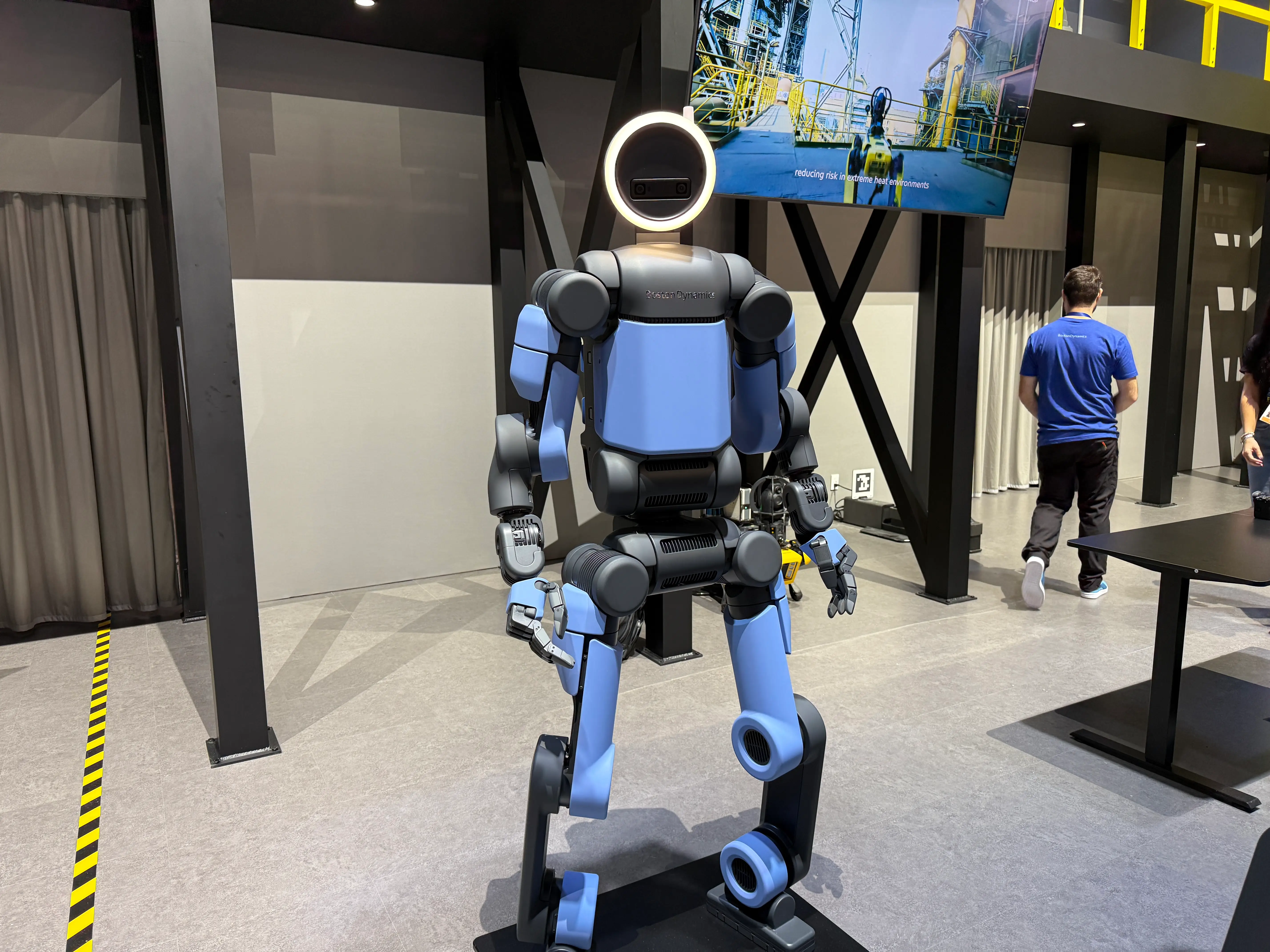
It’s about 200 pounds, six-feet, two-inches tall, has a four-hour battery life, and a face inspired by Disney’s Pixar lamp, Luxor Jr.
Its name is Atlas, an all-electric humanoid robot from Boston Dynamics, the Massachusetts-based company and maker of the four-legged inspection robot, Spot, and the mobile warehouse robot, Stretch.
Hyundai, which owns Boston Dynamics, unveiled the latest version of Atlas at the Consumer Electronics Show in Las Vegas on January 5. During live demonstrations, Atlas was seen waving hello to its audience before moving car parts from one rack to another.
This is how the humanoid robot revolution starts, according to Boston Dynamics CEO Robert Playter.
“We’re starting with the simpler stuff, which is parts sequencing,” Playter said in an interview with Business Insider. Eventually, the tasks get more complex, and Atlas will be on the assembly line. Then, the CEO said, perhaps in five to 10 years’ time, the robots will enter our homes.
Playter, an MIT alumn and aerospace engineer by training, has been at Boston Dynamics for more than 30 years and has seen the company change hands multiple times — first to Google, then to SoftBank, and now to Hyundai after the South Korean automaker acquired a majority stake in the robotics company five years ago.
Playter was appointed CEO in 2019. Since then, he has steered the company through its commercial launch of Spot, Atlas’ transition from a hydraulics platform to an all-electric platform, and more recently, Boston Dynamics’ partnership with Google DeepMind, Alphabet’s AI research lab, to help build Atlas’ “brain.”
The CEO spoke to Business Insider on the Atlas demonstration floor about how humanoid robots will transform the workplace before they take over our homes, the problems still to be solved before humanoids can work, and why Atlas looks like a Disney-inspired character.
The interview was edited for length and clarity.
Is there a story behind Atlas’ face?
Absolutely. A lot of the humanoid producers create what I would call scary, dystopian robot faces. It’s like, oh my god, there’s this black face. Is that a human shape? Why can’t I see it? It’s just scary.
So we tried to go the other way, and the shape is really driven from the Pixar lamp, the original friendly mechanism. We wanted to forecast that this is not a human. It is a machine — it’s a friendly machine.
Is this what you imagined the robot takeover looking like when you were at MIT about 40 years ago?
I think it’s what we dreamed about. But we’ve been doing humanoids since 2008. We’ve been doing this for a long time. But for us to be approaching a point where we’re really thinking about commercializing the humanoid, I don’t know that we expected that years ago. The turning point has been AI. It’s really the enabler that lets a robot like this do a huge variety of tasks, which is what’s needed to really make these generalizable.
Is AI the main technological advancement that’s transformed the robot?
There’s a lot of hardware advancements as well. The early robots were hydraulic. These are all electric. This is our newest version that is going to be mass-produced. And it’s designed for simplicity and cost. If you notice, there’s a lot of similar joints and shapes on this robot — it’s really built to be modular. There’s only three different types of motors, which means we’re going to be able to mass-produce them at scale and get the cost down. The joints all have 360-degree rotation, which is why you see these crazy inside-out yoga motion. And it’s strong. This robot’s going to be able to pick up 110 pounds.
A few years ago, Aaron Saunders, the former CTO, talked about the bipedal form factor and how it’s not the best for every task. That’s why you have Stretch, for example, to carry boxes. Has that mentality shifted at Boston?
I think we’re still going to see lots of different morphologies for different applications. But one of the great things about humanoids is people are just fascinated by them, and they could be truly general-purpose. With two manipulators, you could basically pick up and put down almost anything that a person could do. You can go to almost any place that a person can go to.
Is the tradeoff of tackling the technical challenges of doing a humanoid worth it compared to sticking with a robot like Stretch that can perform limited tasks but is already deployed?
Definitely, there’s more complexity. This has 56 degrees of freedom. Stretch is going to work in warehouses. Humanoids could potentially work anywhere and eventually in our homes. So the generality of this shape is really what lends it power. It’s the best robot we’ve ever built. It’s the one we’ve built to be mass-producible right out of the gate. But there’s still complexity that has to get solved. Part of that’s in the AI. We’ve solved a lot of the hardware parts; now we need to go solve the AI problems.
So there’s still something to solve between now and 2028 deployment.
Absolutely. What we’ve seen is that AI techniques allow us to get an unprecedented diversity of skills onto the robots quickly, but we really need to generalize that. If you’re going to have a robot that’s actually useful in the factory, it’s got to do a hundred different tasks, not just one or two. And it’s really the AI that’s going to enable that. We also have to make that unprecedented reliability — 99.9% reliable. The AI is not quite there yet, but it’s very promising.
Is there a specific number of tasks Atlas needs to achieve that will make it ready to be shipped out?
We need to be able to bring a new task to bear in a day or two. And that’s because, I think in a factory, there’s literally hundreds of tasks, and the tasks evolve. So yeah, every 24 or 48 hours to get a new task onto a robot.
How do you imagine Atlas transforming the workplace, starting with the factory?
There’s a lot of logistics work that has to be done in an automotive factory — a huge variety of pick-and-place tasks to get all the pieces of the car to the line. Atlas is going to start in that sequencing — it’s called parts sequencing. It’s really a logistics task. And as the capabilities get more sophisticated, we’re going to eventually start entering assembly tasks. We’re going to deal with heavy lifting, repeatable tasks that tend to wear people out. That’s kind of what we’re doing with Stretch, which is unloading trailing. The people who used to unload trailers now operate the robot. We see the same thing happening in factories. Factory workers are going to be the trainers of these new technologies.
Can the workers interact with the robots and talk to them?
Yes. We have demonstrations of some of these behaviors where we just tell the robot, “Empty out this bin of parts,” and it’ll go do that. That is all part of the package, and we really want to just make it a seamless interaction.
Is there a list of tasks you believe Atlas will be best for and ones that Atlas will avoid?
We’ve analyzed all the jobs that have to occur in an automotive factory. We’re starting with the simpler stuff, which is parts sequencing. And then above that, you have gradations of complexity. Do you have to get inside the car to fit something? Do you have to do a close-tolerant fit? Do you have to deal with flexible wiring harness? Those things are more complex, and it’s going to take more time to bring to bear. So, we’re starting with the simple stuff, and then it’ll grow over time.
There’s a lot of ambivalence around robots taking over our jobs. Has Boston Dynamics done an analysis of how many jobs one Atlas can actually replace or take on?
Let me get to the ambivalence. There’s a feeling of a little anxiety around robots in general. What we’re actually finding when we bring robots into the workplace is that people end up enjoying interacting with the robots.
Some of the people who used to unload trailers now operate Stretch. They just got upskilled. They like their job more now that Stretch is doing the heavy-lifting. And I think there’s a great potential with AI-powered robots that anybody can interact with them and train them. It will not require an advanced engineering degree, and that essentially opens up the productivity enhancements to regular workers. I think it’s going to be a symbiosis.
So, less about human replacement?
I think so. We’re going to build a whole new industry. There’s going to be a lot of jobs created just building, maintaining, deploying, and training robots.
And if you’ve paid attention to demographic trends worldwide, population has decreased everywhere. If we’re going to bring manufacturing back to the United States, we have to increase productivity. And I think robotics is a way to increase the productivity of our workforce.
So Boston Dynamics doesn’t have a metric or ratio — like, one Atlas robot can do the job of five humans?
I think it depends totally on the task. And so we don’t have that metric yet. The way we measure that in the Stretch is it’s all about case pick rate: How many boxes can you pick per hour, and how does that compare to the humans that did that job? And we pretty much have to at least match that. In some cases, we can exceed it, but in some cases, people are still better because the robots aren’t quite smarter.
How do you pitch companies on Atlas? Do you tell them they can save X amount of money?
We have experience doing this with Spot. Companies typically want to see a return on investment in around two to three years.
We talk a lot about AI talent wars. Is it competitive for Boston Dynamics?
Holy, it’s crazy. We need the same AI talent that Meta and Google and Nvidia are all hiring, so it’s extremely competitive. The thing we have that nobody else has, which is important for the top talent, is really exciting robots.
Do you have Atlas running around in your home right now for testing?
No, we have it in the lab. We had Spots at home. During COVID, everybody had to go home, and our developers just took the robots home with them. We probably paid for the damage to the house when they ran into the walls.
Ha, the real test case. Well, the goal with Atlas is to bring them home, too, right?
Eventually. We see industrial as the first stepping stone for three reasons.
Cost. These first robots are going to be a little bit too expensive for consumer level. Safety. Factories are a safer environment. You can control it a little bit more than the home. And then capabilities.
At home, you’ve got the worst of all worlds. It has to be the cheapest, it has to be the most safe, and it’s the most complex environment.
We’re going to get to home, I’d say, in five to 10 years. The next five years we’re really focusing on industrial applications.
Is there something your competitors don’t understand about deploying humanoid robots?
I think they understand it just fine. They’re just playing a slightly different game.
This is a very expensive business to be in. It takes billions of dollars of investment to sort of get this technology to where it needs to be. If you’re going to play that game, you got to have the largest possible market. So, of course, they’re saying they’re going to go home. It’s the large end market, but I just think that’s a mistake.
Read the original article on Business Insider
The post Boston Dynamics CEO told us how the humanoid robot revolution begins appeared first on Business Insider.