NEW YORK — The hatred of transgender people, now a rhetorical reflex of the nation’s ruling party and President Donald Trump (who has called trans athletes “sick” and “deranged”), is presented almost like a religious syllogism: God made man and woman; therefore only men and women exist. Never mind the biological fact of intersex people, abundant cross-cultural evidence of gender fluidity on nearly every continent or the long history in Western culture of gender ambiguity. And, of course, pay no attention to the testimony of trans people, who speak in voices neither sick nor deranged of the incongruity between biological sex and gender.
“Spectrum of Desire: Love, Sex, and Gender in the Middle Ages” is a small but potent exhibition at the Metropolitan Museum of Art’s annex of medieval art, the Cloisters, in Fort Tryon Park on the north end of Manhattan. The curators use art from the 13th to the 16th centuries to muster a set of corollary questions: If God made man and woman, didn’t he/she/it also make angels, who have no gender? What do we make of these celestial androgynes? And if God made woman from man, extracting the feminine Eve from the rib of masculine Adam, what gender were they before the twain were separated?
These are not contemporary curatorial questions, but issues of theological urgency for medieval scholars and Christians generally interested in the inconsistencies of their religious texts. The late Middle Ages were a period of growing oppression on sexual grounds, the imposition of more rigid gender categories and more explicit policing of sexual practices. It was also a period of resistance to these changes, and the art on view is ambiguously caught in the middle, registering the wide range of sexual diversity often with the amusement of a benign narrator rather than the moralist fervor of a religious scold. The “Streisand effect” was fully in operation (long before Streisand), making visible the very things that church authorities would suppress.
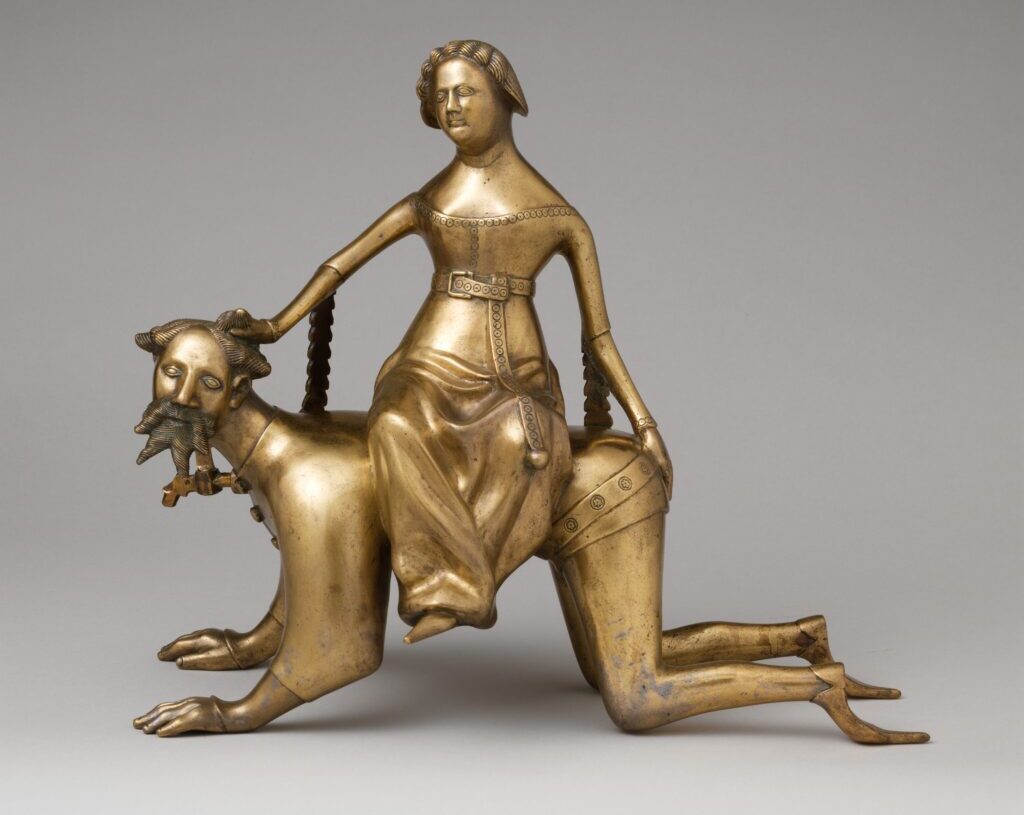
That suppression, nonetheless, has been remarkably effective across the sexual spectrum. The story of Aristotle and Phyllis, a popular medieval fable little known today, is depicted in two works on view. A small copper alloy sculpture from the late 14th or early 15th century shows Phyllis, the supposed lover of Alexander the Great, riding Alexander’s tutor, Aristotle, like a dominatrix. Aristotle had berated his pupil for indulging too much time and energy on the distractions of Phyllis, who avenges herself by tempting the old philosopher into a bit of sex play that includes her riding him like a horse. In the statue, and in a similar scene on a 14th-century ivory box, she spanks his rump to add to the humiliation.
Anyone who has struggled through the tedium of Aristotle’s “Posterior Analytics” will envy Phyllis her upper hand. But this is probably more than just a bit of sexual or narrative exotica. Aristotle was the fount of medieval thinking, the master of categories and distinctions, and an essential inspiration for natural law, which used putatively Aristotelian methods to divine the supposed proper ends of all things, which religious ideologues still invoke today — as if it was just common sense — to impose their values on LGBTQ+ people.
A religious moralist of the 14th or 15th century, surveying the delicious range of sexual variety on view in this exhibition, would probably despair of ever bringing order to the confusion. John the Evangelist, the favorite of Jesus, was depicted as a sexually desirable young man, sometimes clasping with his right hand the right hand of Jesus, a commonplace symbol of marriage. The metaphor of marriage was used in a range of religious contexts, of Jesus to his church, for celibate nuns to Jesus, and in some cases explicitly for John to Jesus, as in a curious legend of the Wedding at Cana, in which John abandons his earthly bride for a mystical union to the son of God.
The side wound of Jesus was sometimes depicted as a vulva, a point of entry, a portal for birth or rebirth. Resurrection, fundamental to Christian thought, established the body as a thing that changes form, extending ancient ideas of metamorphosis. The beauty of Jesus’ body, especially after his death, was deemed so powerful that some religious leaders warned against using it for sexual self-pleasuring. Dozens of Christian saints were born female but lived as male. Misogyny, deeply ingrained in the church, was an avenue to homoeroticism, as in the comment by Saint Jerome that women “should stop being women and become men, because everything that is perfect is in men.”
Like the homophobia directed at gay and lesbian people during the 1970s and ’80s, contemporary bigotry against trans people often invokes the idea of protecting children. Trans people and advocates for fair treatment of trans people are accused of grooming or indoctrination, and, according to ridiculous claims made repeatedly by Trump, of “sex change” surgeries without parental consent: “Your kid goes to school and comes home a few days later with an operation.” This is a scurrilous falsehood.
In fact, the vast majority of “gender-affirming” or gender-related surgery, including breast reduction in men and augmentation in women, is done to cisgender people, which suggests that we are in the middle of a complex moral panic about gender categories. Not only are trans people vilified, but straight, cisgender people are also going to extraordinary lengths to affirm or exaggerate their gender presentation. The problem now seems to lie in the fragility of straight, non-queer people, especially men who feel insufficiently masculine and impose toxic standards of beauty onto women, including what is now called “Mar-a-Lago face.”
The curators of this revealing exhibition, Melanie Holcomb and Nancy Thebaut, are careful not to suggest that the categories of medieval sexual thinking can be mapped onto contemporary ideas about gender and sexuality. Nor is this period presented as a lost golden age of sexual variety and license.
But they muster a fascinating range of narratives, voices and gestures of desire embedded in art. Some of this lingered into the Renaissance, including depictions of John as an epicene young man. But one can’t visit this show without feeling haunted by the threat and power of erasure and the renewed effort to erase trans people today.
The modern civil rights movement for LGBTQ+ people began with an assertion of presence: We are here. And it developed into narrative movement, people telling their stories: Hear us out. “Spectrum of Desire” not only animates voices that the church tried to erase, but it also demands we listen to our contemporaries, who are telling us about their bodies, their desires, and their innermost sense of identity and well-being.
If anyone would know the truth of what it means to be trans, it would be trans people, not politicians looking to exploit age-old and arbitrary anxieties.
Spectrum of Desire: Love, Sex, and Gender in the Middle Ages, through March 29 at the Cloisters, the Metropolitan Museum of Art. metmuseum.org.
The post In ‘Spectrum of Desire,’ the Met takes a nuanced look at gender fluidity appeared first on Washington Post.