My first boyfriend once told me he loved me, and, at that moment, I realized I didn’t love him.
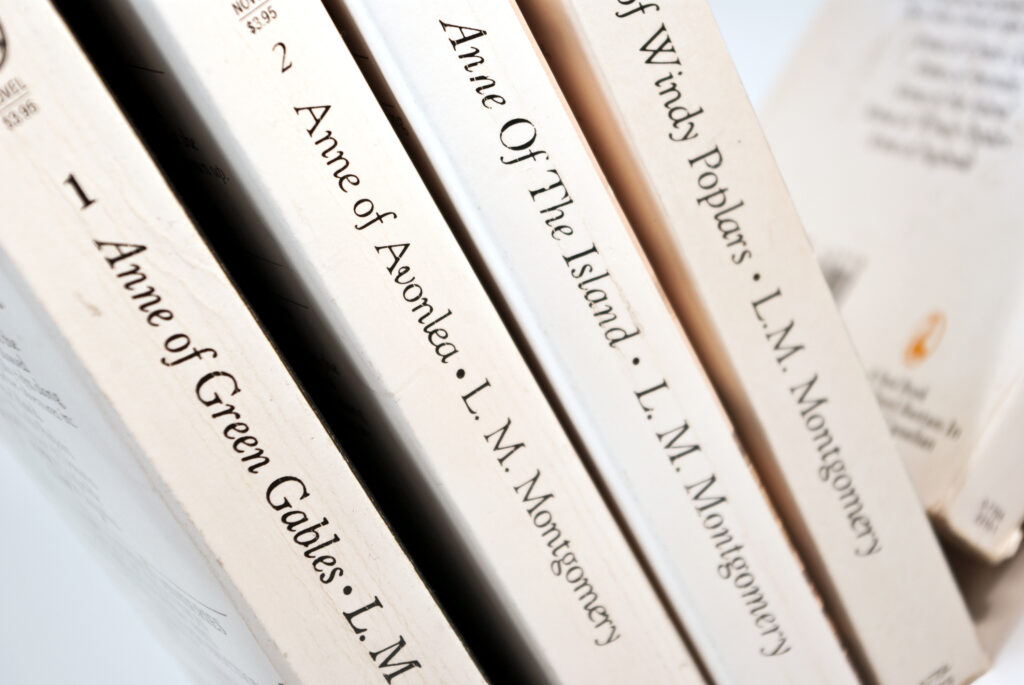
I was 23, lying next to him in my D.C. apartment. He said those three words. I sat bolt upright, then cried. And for the rest of that long night, I tossed and turned, wanting just one thing: L.M. Montgomery’s “Anne of the Island,” the third book in her much-loved Anne of Green Gables series.
I first read the Canadian author’s books when I was 8, and for years they had served as a guide for me. Starting at 12, I wrote letters to my future self on my birthday once a decade, inspired by Montgomery’s “Emily of New Moon.” I reread “Anne of Green Gables” again and again, crying every time I got to the page when Matthew calls his adopted daughter Anne “my girl that I’m proud of.”
That night in D.C. when I told a sweet man I did not love him, I kept thinking of one scene. Anne has been having fun with her beau Roy Gardner, until Roy proposes. Suddenly the whirlwind stops, and Anne knows he has been all wrong for her all along. That was what I needed to read that night.
Years later and several states north, I found myself in another bed, in a New York hospital. The man I had married, the man who proposed to me in the rain by reciting paragraphs he memorized from Montgomery’s romance “The Blue Castle,” gripped my arm as we heard the doctor’s words shatter our lives.
Three words: “He passed away.”
Our son Ezra had died inside me, two weeks before I was due to give birth to him.
Again, I bolted upright in bed, and I choked and I cried.
And this sounds crazy. It is crazy. Of course I didn’t need a century-old novel to tell me that babies die. I remember picking out a condolence card for a high school teacher. I had wept at the funeral of a colleague’s stillborn daughter.
But in that moment, as my husband held me in the hospital, one of the absolute first clear thoughts that rang through my head was: Anne’s first baby died.
Twenty-seven hours later — after I had learned what it is to go through labor and childbirth; after I had watched my husband kiss our curly-haired boy as he mournfully danced Ezra’s seven-pound body around the room — my parents asked what they could bring to the hospital for me. I told them to bring my childhood boxed set of the Anne of Green Gables books.
My 32nd birthday came four days later, and I had a letter from myself to open, written a decade before. “I want babies. Badly. I want lots of children,” I had written, in words whose echo of a certain blunt moment in “The Blue Castle” probably was not coincidental. At 22, I also had the awareness to add: “I fervently hope that reading that sentence does not make you sad.”
I read those words in a silent house on that dazed postpartum birthday morning, and then I curled up under a blanket with “Anne’s House of Dreams.” I found the page when Anne’s daughter Joy dies.
“It doesn’t seem fair,” Anne said. “Babies are born and live where they are not wanted — where they will be neglected — where they will have no chance. I would have loved my baby so.” Only after my son’s death did I learn those bitter words echoed Montgomery’s own diary. In 1914, her second son Hugh was stillborn like my son.
For Anne, Montgomery changed the story. She gave Anne one day with her daughter alive.
Over a lifetime of reading, books teach us how a whole wide catalogue of heartbreaks unfold before we live any of them. In one of my favorite episodes of “This American Life,” a therapist describes how “Little Women” guided her, whether she needed to know about ambition or sisterhood or marriage. “When she’s having a hard time or making a decision, she asks the question, opens the book, and whatever passage she reads, it’s her answer from the March sisters,” the radio producer said, and the therapist answered, “It’s like my Bible.”
Vanessa Zoltan suggested using secular texts like personal Scriptures in her book “Praying with Jane Eyre.” When I once brought up the guidance I get from Montgomery, a lesbian mom I know said that for her, it’s Alison Bechdel. “I already know what will happen in my life because it’s happened in ‘Dykes to Watch Out for,’” she said.
For me, on the morning that I read about how Anne crumbled after baby Joy’s death, and then put herself together again, I started to dimly sense what the years ahead might feel like.
Our firstborn, the boy who danced in my womb to Elvis and Matchbox 20, was meant to be in our family. But the loss could get smaller. With Ezra’s death, we had lost childhood: water parks and campfires and kindergarten. If we were someday lucky enough to conceive again (and it hadn’t been easy the first time), we would never stop missing Ezra, but we wouldn’t have to lose all of that forever.
“Anne found that she could go on living,” Montgomery wrote. “But there was something in the smile that had never been in Anne’s smile before and would never be absent from it again.” Blurred by pain, I wrote my next letter that day, to open in my 40s.
We have no promise that the stories of our lives will unfold with the structure imposed on novels. Poetic justice is rare. Still, throughout the long months after Ezra’s death, many people around me seemed to assume that another baby would be the next step in the plot.
I knew there was no plot.
For all her storytelling, Montgomery knew this too. She gave her characters the rapturous love stories and contented homes. In her own life, she didn’t marry the one man she loved. She ended up unhappily wed to a minister whose severe depression slowly led her into mental illness and addiction. She died of what her granddaughter believed was an intentional overdose, after writing privately of the contrast between the exquisite stories that she gave the world’s girls and the one that she herself was living.
When the first round of fertility drugs failed me, and then the second, and then the seventh, I knew there was no narrative power in the universe that would make the eighth round any more likely to give me a living child.
And yet. Those words that have guided me since I first read them as a third-grader more than 25 years ago — somehow, somehow, this is the story I get to tell.
I look down at my daughter, who has hints of Ezra’s curls and his precise nose and a radiant giggle all her own. I whisper: “My Anne. My girl that I’m proud of.”
The post How the Anne of Green Gables books guided me through grief appeared first on Washington Post.