Taylor Sheridan’s hit West Texas oil show “Landman” (the second season ends on Sunday) opens with an oil industry crisis manager, played by Billy Bob Thornton, tied to a chair as he negotiates with a Mexican drug cartel. To save his life, he describes the scale of his business. Oil, he says, is as addictive to the world order as drugs are to people: “You sell a product that your customers are dependent on. It’s the same, ours is just bigger.”
At first glance, the show makes the case that anyone unable to comprehend that this dependence is inescapable is, at best, naïve. Its leading men argue for the inevitability of their industry and their own manliness, while overseeing those whose job it is to do the hard, dirty work of drilling for oil. A similar set of ideas now drives American geopolitics. President Trump has launched an unpopular and illegal military assault against Venezuela, pledging to take control of its oil and threatening to take oil and gas-rich Greenland, too. Over the last year, the administration has abandoned climate protection and implemented an industry wish list of deregulation. The idea is that the only way to ensure American dominance is by enacting a relentless policy of, as Mr. Trump says, “Drill, baby, drill.”
However, America’s fossil fuel dependency is not an inevitability or a lost cause. The obstacles to transitioning off fossil fuels are political, not technical. “Landman” cannot weave a fantasy of oil-field roughnecks as romantic Yellowstone-esque cowboys while also depicting the reality of the oil business — a far-too-dangerous and destructive industry that most people in the U.S. and around the globe want their countries to move away from, including many of those who work in the industry itself. And so, consistently, the show acts less as a vehicle for pro-oil propaganda than an indictment of the entire industry.
As “Landman” unfolds, a slew of gruesome oil field deaths mount from fiery explosions, stacks of loose pipes, hydrogen sulfide poisoning and suicide. Incidents like these are de-tangled by Tommy Norris (Thornton), a grizzled, bitter, chain-smoking oil fixer. He spends a good deal of the show cleaning up oil field disasters or trying to convince those he loves and cares about the most, including his son, to run from a business that is likely to kill them. The job, he says, has left him, “a divorced alcoholic with $500,000 in debt … and I’m one of the lucky ones.”
Oil and gas extraction is the second most deadly job in the nation, with a workplace fatality rate almost five times the national average, according to the A.FL.-C.I.O. In just the first few months of 2025, Eduardo Rodriguez and Anthony Reyes were killed working at separate oil and gas sites in the Permian Basin, where “Landman” takes place. Mr. Rodriguez was decapitated by the rupture of a pressurized device at a fracking site. People gathered on Facebook to learn about and mourn Reyes’ death, with one using language familiar to those watching Mr. Sheridan’s show: “It was a rig hand and an experienced one, not a worm.” Then there were the 2015 deaths of three members of the same family, Arturo Martinez Sr., Arturo Martinez Jr. and Rogelio Salgado, who died together on the job in a fiery early morning rig explosion. A lone worker survived.
“Landman” appears to take these violent ends — and so much of the industry’s other ills — as direct inspiration. Every time an oil well explodes, a character dies, a woman is harassed, a drug cartel’s violence intermingles with that of the industry, and yet another worker describes how deadly the job is and how desperately he wants to get out, the show is mirroring reality to make compelling television. Despite Mr. Sheridan’s clumsy attempts to communicate that there is no alternative, the show does far more to criticize the industry than it does to bolster it.
The oil and gas industry recognizes the show’s implied critiques. The American Petroleum Institute, a major fossil fuel industry lobbying group, reportedly made a seven-figure ad buy for “Landman,” “to counter some of the negative depictions of the industry.” The ads are part of a larger P.R. campaign and have run through both seasons, highlighting safety, family and a female landman. The industry needs positive P.R. According to polling conducted last spring, 60 percent of Americans say expanding wind and solar is a more important priority than expanding fossil fuels. Many see skyrocketing electricity costs as a problem in search of a renewable energy solution. And many of the fossil fuel workers I’ve interviewed have told me they recognize that, despite record production, the industry has been shedding jobs for years, favoring automation, and that they increasingly see green energy jobs as the future and fossil fuels as the past.
Ultimately, the show cannot avoid a portrait of an industry with an uncertain future, with characters sharing the expectation that their industry is not long for this world. As a fellow oil and gas man tells the company executive Monty Miller: “The party’s not ending tomorrow, but it is ending.”
Like any good addict, Tommy takes a couple of hard shots in the industry’s defense, describing, in one memorable monologue, that there’s “nothing clean” about wind, solar and electric vehicles and that we’re more likely to run out of oil and gas than find their replacements. However, according to Mark Jacobsen, the director of Stanford University’s atmosphere and energy program, the world’s energy demand could be met with 100 percent renewable energy by 2035. Simply electrifying the energy sector itself would reduce overall energy demand by nearly 60 percent, because renewables are far more efficient than fossil fuels. Electric vehicles are less carbon-intensive and polluting than those using fossil fuels, and public transportation, biking and walking are even better.
And even if you were to believe Tommy that fossil fuels are so essential to needs beyond energy and transportation that we just can’t quit them, what is left unsaid is that these uses reflect the industry’s efforts to stay relevant by incentivizing us to make everything with plastic when the plastics are poisoning us; to buy socks and carpets filled with petroleum when cotton and wool will do just fine; and to ignore the death, destruction, and wars inherent in the industry rather than commit to rapidly implementing its replacements.
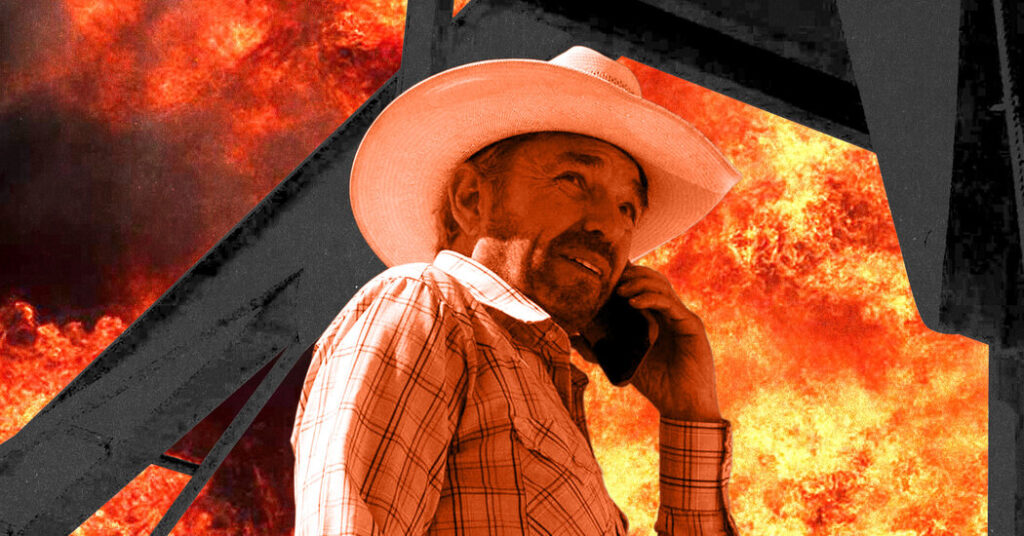
The show’s dominant imagery is not a rugged, antiheroic oilman or even the luxury or political prowess that oil money might buy; it is the polluting yellow and red gas flare from the fires that burn methane, an extremely potent greenhouse gas. The show’s poster features Norris with his head bent toward the ground surrounded by flares as if being engulfed into a hellscape. One roughneck calls Monty “Satan.” “You know what that makes us?” Tommy asks. “Demons,” a co-worker replies.
This is the reality that infuses “Landman” with its most poignant pathos: It is a hell of the industry’s own making.
Antonia Juhasz is an energy journalist and the author of “Black Tide: The Devastating Impact of the Gulf Oil Spill.”
Source photograph by James Minchin/Paramount+
The Times is committed to publishing a diversity of letters to the editor. We’d like to hear what you think about this or any of our articles. Here are some tips. And here’s our email: [email protected].
Follow the New York Times Opinion section on Facebook, Instagram, TikTok, Bluesky, WhatsApp and Threads.
The post ‘Landman’ Isn’t Just Oil Industry Propaganda appeared first on New York Times.