World leaders, corporate executives and figures from civil society are convening in Davos, Switzerland, this week for the World Economic Forum. All eyes are almost certain to be on one high-ranking guest: President Trump, who plans to attend with a large delegation including Treasury Secretary Scott Bessent and Steve Witkoff, the special envoy to the Middle East.
Topics of discussion at Davos — according to U.S. and European analysts and former policymakers interviewed ahead of the event — are likely to include Russia’s war with Ukraine; prospects for global trade and markets; the probability of China invading Taiwan; and the risks of a Middle East flare-up caused by the recent uprising in Iran.
Many of those issues may well hinge on one central question: What will Mr. Trump do next?
François Hollande, who was the president of France from 2012 to 2017, a period that briefly overlapped with Mr. Trump’s first term, offered his thoughts and predictions in a recent interview, as did former senior U.S. policymakers who are attending or who have regularly attended Davos over the years.
“Donald Trump is the president of the United States, and any U.S. president has influence over the world,” said Mr. Hollande in a video interview. And yet, he added, it was unlikely that Mr. Trump — whose administration recently orchestrated the capture and jailing of President Nicolás Maduro of Venezuela — would invade Greenland or engage the United States in a major military confrontation elsewhere.
“It’s important to note that Donald Trump does not wage war. He uses the threat of force, but he limits the actual use of force,” Mr. Hollande said, pointing to the U.S. president’s reluctance so far to launch a large-scale invasion of Venezuela or topple the regime, which is now being led by Mr. Maduro’s vice president, Delcy Rodríguez. “He has no intention of establishing multiple war zones,” Mr. Hollande continued. “His idea is to use conflicts to gain economic advantage.”
Mr. Hollande — who attended Davos as France’s president and is today a member of Parliament and a leading figure in the French Socialist Party — recalled his first exchange with Mr. Trump, who, shortly after winning the 2016 election, reached out to connect with allies and counterparts.
The telephone call began with Mr. Trump praising France’s beauty and its food and wine. He then complained that the United States was spending too much on troops stationed in Europe to ensure the continent’s defense, Mr. Hollande recalled.
When asked by Mr. Hollande if he would respect agreements that his predecessor had signed — the Paris climate-change accord, and the Iran nuclear accord — “Donald Trump let me know, very courteously, that he would not be taking a favorable stance toward those two accords,” as they were not economically beneficial, he said.
“Previous U.S. presidents presented themselves as the heads of the Atlantic alliance. Their principal argument was that they were the leaders of the free world,” Mr. Hollande explained, referring to the NATO alliance established by the United States and Europe after World War II. He noted that President George W. Bush’s interventions in Iraq and Afghanistan had been conducted in the name of “establishing a democracy.”
“Donald Trump does not base his policies on values or principles,” he said. “Economic imperatives are the engine and the motive behind U.S. action.”
Global Risks
Some experts go a lot further.
In a new report, the U.S.-based Eurasia Group identifies the United States as “the principal source of global risk in 2026.”
Why? “The United States is by far the most powerful and consequential country in the world, so when big things happen in the United States, they have outsized impact,” said Ian Bremmer, the president and founder of Eurasia Group, a leading global political risk research and consulting firm, who will be at Davos.
Since the start of Mr. Trump’s first term in 2016, the United States has been increasingly unwilling to “continue to lead on the values and on the policies that it had in the postwar order,” Mr. Bremmer said. It is far less keen, he said, to act as “the global policeman” or “the principal architect of free trade” or “the promoter of rule of law or democracy, even though it did those things sometimes hypocritically and not always well.”
Mr. Bremmer added that “no other country or group of countries would be able and willing to replace the United States for a period of time.”
President Trump is “not the cause of this: he’s a symptom” and “a meaningful accelerant,” he said, adding that it all amounts to a political revolution in the United States as the country prepares to celebrate the 250th anniversary of the Declaration of Independence.
Mr. Bremmer and others predict that Mr. Trump’s Republican Party will lose its majority in the House of Representatives in November, because of the president’s low popularity (the latest polls from The Economist show a 40 percent approval rating), and that the “guardrails” against his policies within the U.S. judiciary and the federal system, and among governors and mayors, will hamper his actions.
Tariffs and Trade
On the trade front, Mr. Trump will most likely continue to wage trade wars using his preferred instrument: tariffs, predicted Robert Zoellick, the former president of the World Bank and a U.S. trade representative under George W. Bush who was the architect of major trade initiatives and attended Davos on many occasions. He is now a senior fellow at Harvard University’s Belfer Center for Science and International Affairs.
Last year, the president used emergency powers to impose tariffs on imports from more than 100 countries — raising them in many cases to levels not seen in roughly a century — as he set out to slash the U.S. trade deficit and boost manufacturing at home. The U.S. Supreme Court is scheduled to rule soon on the legality of those sweeping global tariffs.
“Trump sees tariffs as a handy club, and he doesn’t see the costs of tariffs: He only sees them as a form of leverage,” Mr. Zoellick said. “He has no interest in institutions or rules. Obviously, it’s an easier club than military action, and it’s more than words, so that’s why I expect that he’s going to continue to use it.
“He’s a disrupter and a dealmaker,” he said. In the year ahead, “that will be the context, and then the rest of the world will have to adapt, because the U.S. is a powerful place.”
Mr. Zoellick noted that the United States represents only about 14 percent of world trade, so its trading partners, big and small, are likely to trade with other countries. (Earlier this month, the European Union formed a sweeping free-trade pact with four South American countries.)
For Davos attendees, one of the biggest themes will be the outlook for global markets, initial public offerings and deals, and who will be selected as the next U.S. Federal Reserve chairman, Mr. Zoellick said.
Mr. Trump has repeatedly indicated his desire to remove and replace the current chairman, Jerome H. Powell, whose term ends in May and who has recently been targeted in a federal investigation. Mr. Trump told The New York Times in an interview this month that he had decided on Mr. Powell’s replacement, but did not say who it was.
Markets made “very big gains around the world” in 2025, Mr. Zoellick said. Global stock markets reported double-digit gains for a third consecutive year, with the S&P 500 rising 16.4 percent, and the MSCI All Country World index surging by more than 20 percent.
“People are expecting the economy to power through,” Mr. Zoellick said, and at Davos, “a lot of the discussion on the side will be, ‘Where are the opportunities and where are the danger points?’”
Oil and Fossil Fuels
One danger point is the supply and cost of energy. “We’re still in a world where more than 80 percent of global energy needs are met by fossil fuels,” said Meghan L. O’Sullivan, a professor at Harvard University’s Kennedy School who has advised national security officials in Republican and Democratic administrations and who will attend this year’s Davos meetings.
After the collapse of the Soviet Union, oil and gas producers integrated into a global market, and many countries, including the United States and China, felt confident that they could buy energy affordably, “so energy was not seen as a highly geopolitical tool.”
Following the Russian invasion of Ukraine in 2022, oil and gasoline prices shot up everywhere, including in the United States, pushing up inflation.
Today, “we’re in a world where great power competition and even potential conflict is very real,” said Ms. O’Sullivan, a co-writer of a recent essay on the subject in Foreign Affairs magazine.
“So the use of energy to advance those objectives suddenly is not only conceivable, it’s prevalent,” she added. In Venezuela, for example, “oil seems absolutely central to the president’s determination to remain involved,” she said.
China
What about China? What will it do in 2026?
“A continuation of what it’s been doing in the past few years under Xi Jinping,” predicted Prof. David Shambaugh, a leading China specialist at George Washington University and the Hoover Institution.
He said China’s top priority was to become “a tech innovation superpower,” as set out in the country’s recently published 15th Five-Year Plan. “They’re going to continue to pour enormous resources into everything from robotics to bio, and from nanotech to A.I.”
Another priority is to continue to dominate world trade. China recently announced the world’s largest trade surplus ever: $1.19 trillion, up 20 percent from 2024. Mr. Shambaugh said China would continue to export goods at low prices to markets all over the world, particularly and increasingly in the global south — Africa, Latin America and Southeast Asia.
Geopolitically, China is “sitting in a very good place,” Mr. Shambaugh said. Mr. Trump is “the first American president who has not said anything about or cared about the nature of the Chinese regime and human rights.”
As a result, “Xi Jinping could not ask for more,” said the professor. China is preparing to host Mr. Trump for a state visit in April, and “they’re just going to roll out the red carpet, proverbially, in ways they’ve never done before.”
Iran
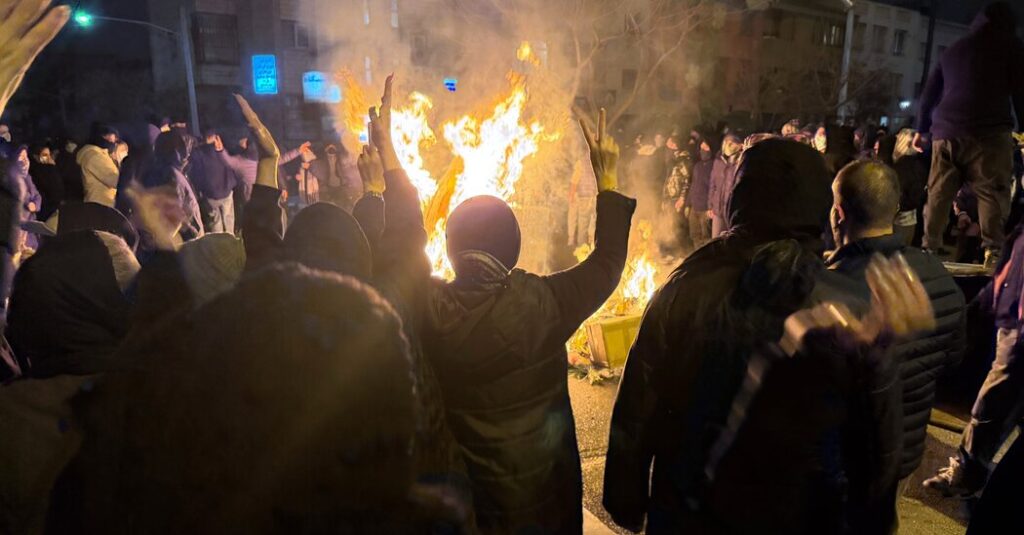
The year 2026 started with a major uprising in Iran — 47 years after the Islamic Revolution toppled the monarchy and replaced it with a brutal theocracy that has crushed successive waves of protest.
In the latest wave, ignited by the collapse of the currency and soaring inflation, tens of thousands of Iranians have taken to the streets, and hundreds, perhaps thousands, have been killed. Many protesters are calling for the return of Iran’s former crown prince, Reza Pahlavi, who lives in exile in the United States.
What would be the consequences of regime change in Iran for the Middle East?
“If Iran were to become a secure and democratic country, that would change everything in the region,” said Mr. Hollande, the former French president. “There would be a return to a form of stability.”
Davos: Pluses and Minuses
Founded in 1971 in a Swiss ski resort as a gathering of business leaders, the World Economic Forum has turned into a global get-together for heads of state and government, civil society representatives, academics and experts, and journalists. It has also come to symbolize the world’s richest and most powerful.
“On paper, the Forum is just another multiday seminar devoted to steadfastly tackling the problems of the day, with earnest discussions on climate change, gender imbalance, and the digital future,” wrote Peter S. Goodman of The New York Times in his 2022 book “Davos Man: How the Billionaires Devoured the World.”
“Behind the scenes,” he added, “the Forum is a staging ground for business deals and strategic networking, a schmooze fest underwritten by financial behemoths and consulting firms, and an opportunity for everyone present to congratulate themselves on making it to the right side of the human divide.”
Ms. O’Sullivan of Harvard listed the logistical drawbacks of Davos: “The cold, the slippery streets, and the utter lack of sufficient space or hotel rooms for those who gather.”
At the same time, “in an era of geopolitical fragmentation and deep distrust of institutions, Davos remains one of the few places where rival powers and sectors still talk to one another,” she said — with one important caveat: “At Davos, it is easy to mistake access for impact,” and “translating elite conversation into action remains a challenge.”
The post Global Leaders Gather in Switzerland to Ponder the Future of a Messy World appeared first on New York Times.