BIRMINGHAM, England — Spoiler alert: Something bad is about to happen on “The Archers.”
Something bad — or harrowing or heartwarming — is always about to happen on “The Archers,” a preposterously popular daily BBC radio soap opera that marks its 75th anniversary this month. People fall off roofs, roofs fall on people, tractors overturn, young women get pregnant (sometimes by accident) and young men get married (sometimes to other men).
There are stabbings and affairs and bar fights and barn burnings. But there are also pie contests, cow milkings, pints at the pub, and lots and lots of tea around kitchen tables. Life, death and dairy all unfold in 13-minute episodes, six days a week, in the fictional farm village of Ambridge, somewhere in anywhere Middle England.
And for three-quarters of a century, Britain has been hanging on every twist.
“The Archers,” recognized by Guinness World Records as the longest-running serial drama on the planet, is steaming, strong as ever, into the streaming age. After more than 28,000 episodes, the show, which began as semi-instructional infotainment for struggling postwar farmers, endures as a real-time chronicle of ever-evolving, never-changing modern Britain.
“It’s part of the fabric of our national life,” said Sybil Ruscoe, a former BBC agriculture reporter who grew up listening to “The Archers” in Shropshire and joined the show four years ago as its farming and countryside adviser. “It’s universal human drama that takes place in a rural setting, with the hedgerows, the horses, the wellies, the thermal vests.”
All the pastoral pathos makes the show a surprisingly enduring star in the BBC’s vast lineup, attracting more than 5 million weekly listeners on the air and hovering routinely at or near the top of shows streamed online.
Cliff-hanger episodes still become national happenings, with media coverage and mentions in Parliament, as in 2016 when a verdict was reached in the case of organic cheesemaker Helen Archer, on trial for plunging a knife into her psychologically abusive husband.
The legions who listened on smart speakers to that nail-biter may be nothing like the 20 million (about 40 percent of the United Kingdom’s population) who were glued to their Philcos in 1955 when newlywed Grace Archer was killed in a stable fire, but it is still a striking level of relevance for a Churchill-era radio drama at a time of atomized, digital media and hegemonic video.
“It has remained contemporary for 75 years,” said Emma Freud, a British journalist and commentator (and, yes, great-granddaughter of Sigmund) who hosts a weekly “Archers” podcast. “It’s always been this mirror of what Britain is doing.”
She ticked off the show’s topical march from rationing in the 1950s to unwed mothers in the 1960s and onward to sperm donors, gay marriage, modern slavery, domestic violence and immigration — societal shifts that never stop churning amid mossy stone walls that never budge.
The mix has created a diverse and devoted fan base, populating countless Facebook groups, subreddits and message boards. Ian McKellen is known to be a listener, as is Stephen Fry. Judi Dench appeared on the 10,000th episode, and when Queen Camilla hosted a party for the show, she dazzled the cast and crew with her encyclopedic command of Archer-cana.
“She could be one of our continuity researchers,” Jeremy Howe, the show’s senior editor, said.
That a horsey-set royal would follow along may be less surprising than the number of young Britons (along with Americans, Romanians and Russians) checking in on Ambridge at 7 o’clock, six evenings a week (or Sundays for a 70-minute compilation of the week’s episodes). “The Archers” is one of the BBC’s most popular downloadsby 18-to-35-year-olds.
“It’s stunning the people I meet who listen to this program,” Ruscoe said. “And every single one of them has an opinion to share.”
Physical Ambridge, such as it is, exists in a cluttered suite of rooms the size of a two-bedroom apartment in the center of Birmingham.
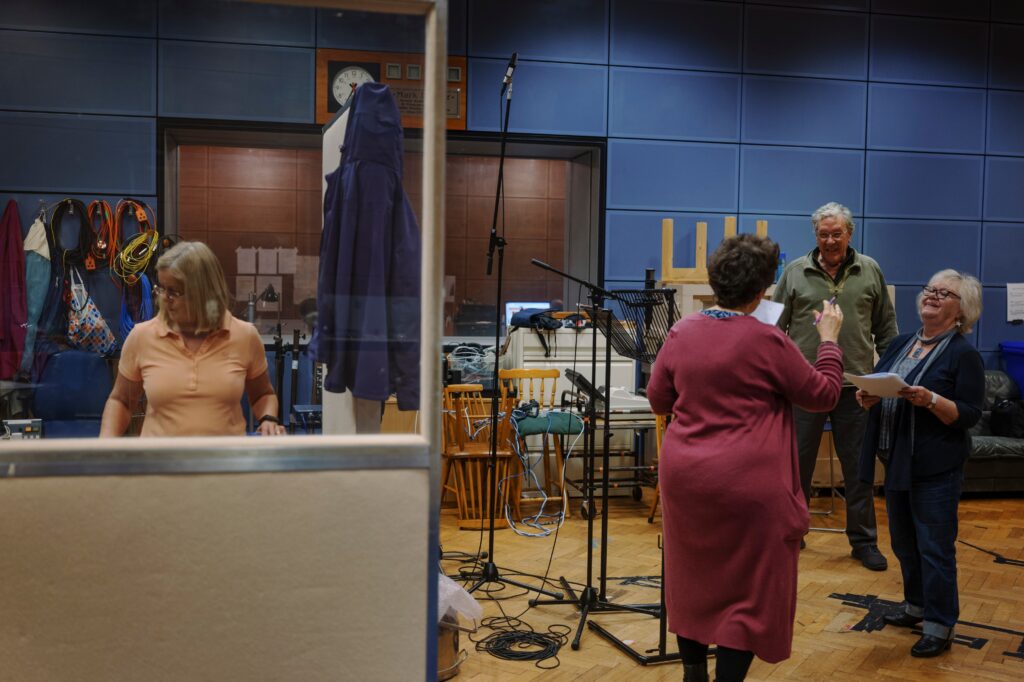
Eight days a month, actors, producers and sound effects wizards gather in this dedicated BBC studio piled with all the objects that fill the fictional county of Borsetshire with noise: ironing boards as rusty gates, portable doors and windows that slam, a staircase to nowhere equipped with metal, carpet and wood treads. There’s a full kitchen with running water, a classic AGA stove, and lots of cups and cutlery for clinking on cue.
A “live room,” the most open space with the least soundproofing, suffices for any capacious setting, such as a church or village hall or the Bull, the Ambridge pub and social hub. An adjacent “dead room” is lined with foam panels playing, ironically, the great outdoors, with birdsong and traffic, and the ineffable whoosh of open sky layered on digitally as scenes are recorded.
On a cold January Tuesday — cold in Birmingham and cold in Ambridge, which is always seasonally on track — Vanessa Nutall set a plate of brioche cubes on the kitchen table. The bread would portray the beans and bacon of an English breakfast, in the mouths of the chatty Horrobin family. Nutall stood behind them, tinking a fork on an empty saucer.
“Ryan, could I have talking with your mouth full for one line but not for every line, please,” director Kim Greengrass asks Ryan Kelly, playing tamed rebel Jazzer McCreary, between two of several takes.
“I’m going to end up eating five brioches,” laughs Madeleine Leslay, portraying headstrong hairdresser Chelsea Horrobin.
The show makes use of prerecorded doorbells and sheep bleats but relies on old-school studio “spot” effects as much as possible. It’s faster than postproduction, which is critical to the show’s nonstop schedule, and it lends verisimilitude to the theater-of-the-mind radio performance.
“It’s all about the actors’ reactions,” Nutall said.
It was Nutall who smashed a bottle into the head of Gen Z ne’er-do-well George Grundy on New Year’s Eve, another peak-audience episode. The broken glass was digital, but the near-fatal thunk was live. “That was a red cabbage. And a bottle of vermouth,” she said. (The identity of the real, er, fictional, attacker is the storyline currently consuming Archerdom.)
Three of the 60-odd actors who populate the show sat around the table for the breakfast scene. A fourth, Charlotte Martin, who has played Susan Carter for 43 years, stood a few yards away, ready to walk in for a good morning chin-wag with the Horrobins.
“I think a real key part of the success of the program is that it does normal stuff,” said Martin, whose radio character, Susan, is a village busybody but one who has also been in prison for harboring a fugitive (her lowlife brother Clive). “It’s those lovely inconsequential conversations about nothing that people have in a shop,” she said. “But they’re equally adored by the listeners, and I equally adore playing them as the dramatic stuff.”
This breakfast, which won’t air until late February, isn’t full of plot points or exposition. But the gossip laid down today — for example, Susan’s catty complaints about a lazy co-worker (The Washington Post is sworn to secrecy as to whom) — could end up feeding a storyline that emerges in weeks and continues for years, or even generations.
George’s ongoing troubles with the law, for example, were foreshadowed in vague concerns about the boy years ago, Freud noted. Not even the writers know where he will end up.
“Bad-boy George is in his 20s,” Howe said. “I don’t know exactly what’s going to happen to him, but I know it’s going to be a gold mine of stories.”
Characters and actors age together on the show, which progresses at the pace of a maturing oak tree. Martin, 61, has portrayed Susan since both were teenagers. Stage actor June Spencer, who appeared as Peggy Archer in the very first episode, played the role almost continuously until she retired 71 years later, in 2022, at age 103.
“Stories can go on for years. It’s not encapsulated like it would be in a novel or a TV series,” said Tim Bentinck, who has played David Archer since 1982. “You don’t get that in any other format.”
Bentinck recalled a recent scene involving David’s family around a table discussing a weighty farm issue. “I could remember almost exactly this same conversation happening between me and my radio father about 22 years ago,” he said. “And here we’re having it with the next generation.”
Bentinck was next up in the live room, now serving as a barn, as it has countless times before. A cow was ready to give birth, as its innumerable Ambridge ancestors have done for decades. (“Cow in labor on [channel] D,” a sound tech called to the panel operator in the control room.)
Britain will have to tune in to learn what happens to that calf, not to mention its children and grandchildren. “The Archers,” at 75, has no end in sight.
Listeners don’t know what bad thing is about to happen. But they know it’s going to be good.
The post After 75 years, a radio soap opera still has Britain on edge of its seat appeared first on Washington Post.