In November 2002, President George W. Bush signed a bill creating a federal agency devoted to protecting the United States. The country was still reeling from the Sept. 11 attacks on New York and Washington, and the threat of international terrorism permeated public life.
Among the agencies that would be included in the Department of Homeland Security, as it would be called, would be Immigration and Customs Enforcement and Customs and Border Protection — the parts of the government most responsible for enforcing federal immigration laws.
“The new department will analyze threats, will guard our borders and airports, protect our critical infrastructure, and coordinate the response of our nation for future emergencies,” Mr. Bush said at the time, adding that the department would “focus the full resources of the American government on the safety of the American people.”
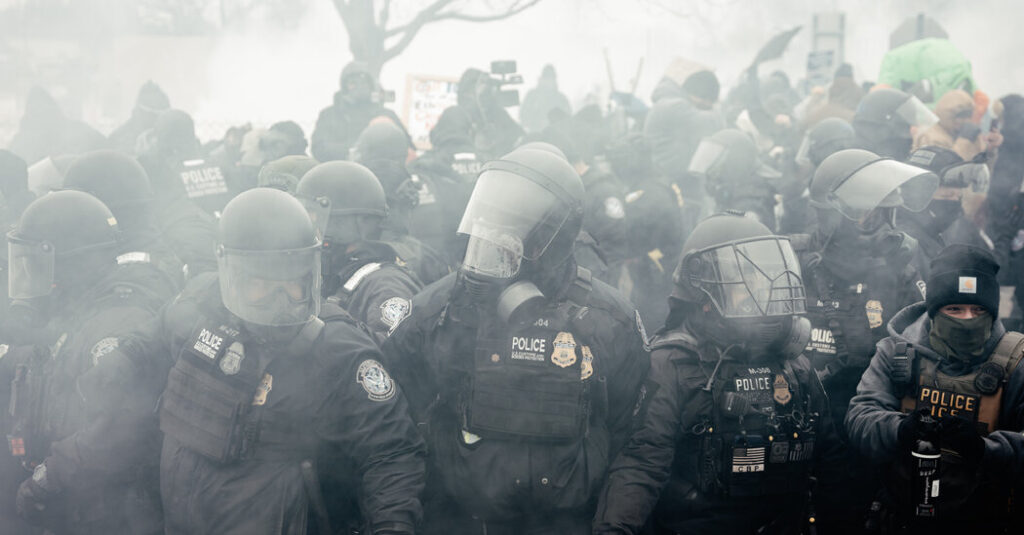
But more than two decades later, as thousands of ICE and Border Patrol officers flood Minneapolis, some Democratic leaders say the department’s role appears to have strayed far from its original purpose, turning its tools of enforcement away from external threats and toward President Trump’s domestic critics.
They say enforcement has looked more like an occupation, as officers in helmets and tactical gear have faced off against hostile residents and left-wing protesters in Los Angeles, Portland, Chicago and Washington. The interactions, broadcast to the world through social media videos filmed by protesters and federal agents alike, have given the impression of a government at war with the country’s own cities.
The Department of Homeland Security “was designed to protect Americans from threats, and what we’ve essentially done is, in some cases, we’ve turned that agency on Americans,” said Mayor Keith Wilson of Portland, Ore., a Democrat. “It’s deeply unsettling.”
Mr. Wilson said he was concerned that federal immigration enforcement activities could lead to a shooting like the one in Minneapolis that took the life of Renee Good, a 37-year-old protester fatally shot by an ICE officer. Hours after his comments, Border Patrol agents shot two Venezuelan nationals who had rammed their vehicle, the department said. The Venezuelans survived their injuries, and one was charged in connection with the incident.
More than two decades after its formation, the Department of Homeland Security is the government’s largest law enforcement agency, with around 250,000 employees. It includes many functions that are not directly part of the turmoil on the ground, such as the Federal Emergency Management Agency and the agency that oversees airport security.
Yet even those agencies have come under pressure to meet Mr. Trump’s political objectives, with the airport security agency providing information to immigration agents and Mr. Trump trying to redirect disaster funding away from states not cooperating with his deportation goals.
ICE’s budget increased dramatically because of the sweeping domestic policy bill the president signed into law last July, making it the highest funded law enforcement agency in the federal government.
Under Mr. Trump, the department also redirected thousands of agents from their normal duties to focus on arresting undocumented immigrants, a New York Times investigation found last year.
The Trump administration and officials in some of the targeted cities have used militaristic language to describe the conflict unfolding on the ground.
A lawsuit filed this week by Minnesota described the recent deployment of thousands of immigration agents and officers as “a federal invasion of the Twin Cities.”
“I see it as a personal militarized police force for the president to do his bidding against people who don’t see the world through the lens of the ultra rich,” said Mayor Brandon Johnson of Chicago, a Democrat.
Mr. Trump has recently raised the possibility of invoking the Insurrection Act, which would allow him to deploy the military to suppress rebellions and enforce federal laws. On Tuesday, he said on social media that Minnesotans should expect more action in their state, and that the “DAY OF RECKONING & RETRIBUTION IS COMING.”
Kristi Noem, the homeland security secretary, has called Chicago a “war zone,” and said the agency had made parts of the city “much more free.” In recent weeks, the department has described Minnesota as a place where there was “rampant fraud and criminality happening.”
“We would love to have the cooperation of these politicians to remove the worst of the worst from their cities,” Tricia McLaughlin, a Department of Homeland Security spokeswoman, said in a statement. “Instead, they refuse to protect their own citizens and let these criminals roam free on their streets.”
It is a starkly different environment than the one in which the department was created.
In the wake of the Sept. 11 attacks, there was a bipartisan consensus that the United States needed to do more to fend off terrorist threats and protect its citizens. The Department of Homeland Security was created the following year, when Mr. Bush signed the Homeland Security Act of 2002.
Mr. Bush at the time said that the United States would be better equipped to “reduce our vulnerability and, most important, prevent the terrorists from taking innocent American lives.”
Building the agency was a big task, with all or portions of 22 federal agencies, including the Coast Guard and what was then the Immigration and Naturalization Service, to be folded into a single department. Some politicians in Washington initially resisted the creation of a new cabinet-level agency, including Mr. Bush.
Supporters of the department’s stepped-up role on immigration enforcement this year say the surge of officers in cities has made the country safer by rounding up violent criminals. They say voters endorsed decisive action on immigration when they elected Mr. Trump, who has repeatedly criticized “sanctuary cities” that limit cooperation with federal immigration authorities. He has pledged to be more aggressive.
“What these mayors are asking D.H.S. to do is not really an option,” said Chad Wolf, an acting homeland security secretary during the first Trump administration. “The majority of American people said, ‘We don’t want that America. We actually want criminal illegal aliens arrested and removed, as well as others.’”
Some law enforcement officials who have had productive relationships with federal authorities in the past have watched the new D.H.S. approach with concern.
“The biggest question that I’ve been receiving is: How will we intercede if there’s a conflict between community members and D.H.S.?” Shon Barnes, Seattle’s chief of police, said in an interview last fall. “Who will we side with? What will we do?”
The answer, Chief Barnes said, was that the department would “keep the peace.”
Jim McDonnell, the chief of the Los Angeles Police Department, said the city had long had close ties to D.H.S., in particular the agencies focused on criminal matters. But that cooperation became harder last summer, he said, when the agency launched a regionwide immigration operation that ensnared thousands of immigrants.
“This has been something very different — unprecedented — that we’ve seen here,” he said last year.
In many ways, Los Angeles was on the front line of the agency’s incursion into large, Democratic-led cities. Last June, following protests of an ICE operation in downtown Los Angeles, the agency empowered Border Patrol agents to lead immigration enforcement in the area.
Soon, agents were seen raiding carwashes, Home Depot parking lots and other locations. At one point, border agents traveled through a city park as a show of force. It was also the first time the National Guard had showed up to protect the Department of Homeland Security in its immigration work.
“The federal government invaded, intervened and created a problem, and then patted themselves on the back for so-called saving the city, when the city was never at risk of anything,” said Karen Bass, the city’s Democratic mayor.
The recent conflicts with local officials have alarmed some former leaders of the Department of Homeland Security.
When it was created, the agency was not just supposed to connect different parts of the federal government, but also expand its outreach to local and state entities.
“We must open lines of communication and support like never before, between agencies and departments, between federal and state and local entities, and between the public and private sectors,” Tom Ridge, who led the White House Office of Homeland Security, a precursor of the Department of Homeland Security, said when he was sworn in.
Janet Napolitano, who served as homeland security secretary in the Obama administration, has watched recent events with concern.
“Federal law enforcement in general, and D.H.S. in particular, work best and most effectively when they’re in coordination with local and state authorities,” she said, noting that local police know their communities better than anyone. “And when you have a federal force come in, like the recent ICE deployment in Minneapolis, and then just kind of overlay, without coordination, you have all kinds of problems.”
Ms. Napolitano added that “this kind of a disruption and kind of a dissing of the role of state and local law enforcement — it doesn’t help anyone, and it makes overall for a more dangerous situation.”
Andrea Fuller and Madeleine Ngo contributed reporting.
Hamed Aleaziz covers the Department of Homeland Security and immigration policy for The Times.
The post D.H.S.’s Role Questioned as Immigration Officers Flood U.S. Cities appeared first on New York Times.