When the World Economic Forum’s annual meeting begins in Davos, Switzerland, on Monday, sustainability will again be at the forefront. Last year, “Safeguarding the Planet” was one of the five pillars of the gathering, and the topic continues to be top of mind at this year’s event. One of the five key global challenges under the meeting’s headlining theme, “A Spirit of Dialogue,” asks: “How can we build prosperity within planetary boundaries?”
But the focus on sustainability extends beyond panel discussions and speeches, influencing how the event itself is designed and operated, according to Mirek Dusek, a managing board member, chief business officer and head of global programming for the World Economic Forum.
“Sustainability has always been a core operational principle because we believe in the long-term value of society, and overall, it is a smart thing to include sustainability in how we plan and run the event,” he said. To that end, the broader goal of sustainability globally is to meet the needs of people now, in the short term, without damaging the future of the planet.
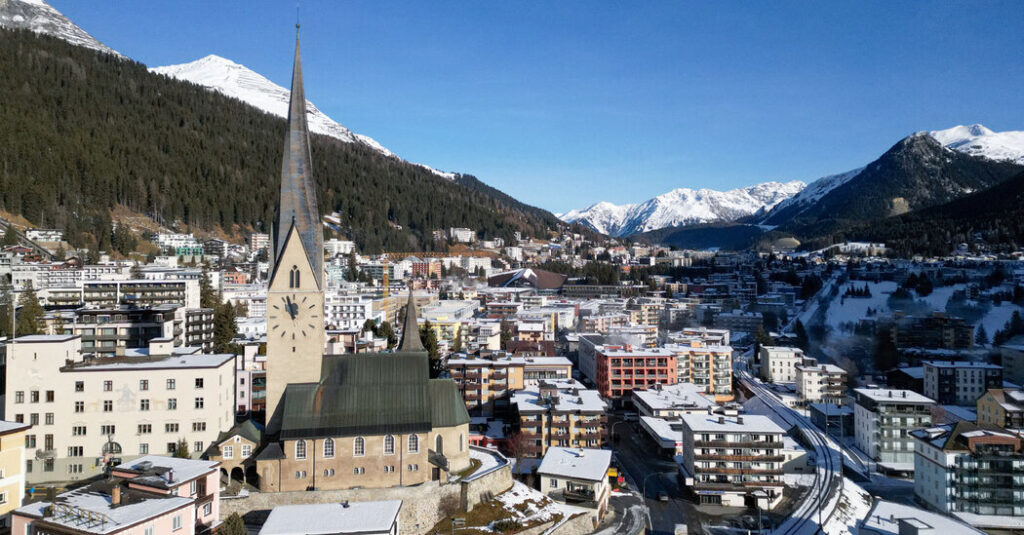
Davos, the Forum’s largest meeting, brings together some 3,000 global leaders from business, politics and civil society. The gathering unfolds across three primary venues: the Congress Centre; Kurpark Village, a nearly 65,000-square-foot temporary wooden chalet that debuted in 2024, which gets assembled and disassembled each year; and the Zondacrypto-Arena, the home stadium of the local hockey team. Collectively, the sites form the Secured Zone and are within a five-minute walk of one another. “All have sustainable aspects in different ways,” Mr. Dusek said
In his role as head of global programming, a position he has had since June 2022, Mr. Dusek also oversees the program design, logistics and operations of the meeting. With respect to sustainability and planning, Mr. Dusek is responsible for the way that venues are constructed and powered, along with transportation, food sourcing and waste management throughout the weeklong gathering.
“It’s an exciting job because advances in technology allow us to modernize our sustainable initiatives every year,” he said. Before joining the World Economic Forum, he worked on public diplomacy at the U.S. embassies in Baghdad and Prague.
In an interview ahead of the meeting, Mr. Dusek, who lives and works in Geneva, discussed the ways in which the Forum defines sustainability when it comes to planning and running the event, the progress it has made in reducing the meeting’s environmental footprint and the challenges that remain.
This interview, conducted by video and email, has been edited and condensed.
How do the event’s organizers define sustainability with respect to planning and execution, and how do you accomplish that goal?
We look at sustainability from a big picture, holistic perspective. It is not a stand-alone objective or a box to be ticked, but something that sits at the heart of how we plan and deliver the annual meeting.
This is very much a learning journey, but one informed by 55 years of hosting the meeting in Davos. Over that time, sustainability has become a core operational principle. We draw on best practices, but we also focus strongly on lean design, smart procurement and the practical use of technology, including A.I., to improve efficiency and reduce environmental impact.
Context matters greatly. Davos is a small alpine town that depends on an intact natural environment to remain viable as a destination in both summer and winter. Sustainability, therefore, cannot be approached as something that only matters during one week of meetings. You need to be part of the place, not just treat it as a venue. That means thinking not only about outcomes, but about how those outcomes are achieved.
We work closely with local suppliers, prioritize local procurement wherever possible, collaborate year-round with the municipality and other stakeholders and aim to leave behind a legacy that the town and its residents can benefit from long after the meeting has ended.
Travel, particularly air travel, accounts for the largest share of Davos’s carbon footprint. What steps has the Forum taken to reduce those emissions?
Participants and media traveling from Europe to Davos receive 100 percent reimbursement for train travel, a benefit we began offering a few years ago. We also built a dedicated train stop at the Congress Centre [which operates during the event], making it easy to get there by public transportation.
For people flying in, we spearheaded several initiatives to help offset carbon emissions. One is Airports of Tomorrow, where we bring together experts, people working in the airline industry and policymakers on how to increase the use of sustainable fuel in aviation and other solutions for aviation to be at net-zero emissions.
During Davos, we provide free shuttles and public buses for attendees to get around. The majority of our shuttles are electric or hybrid, as well as the majority of the cars used by the Forum. We continue to increase the number of both each year.
Davos relies heavily on temporary structures, including pavilions, as spaces. How does sustainability figure into how they are designed, built and dismantled?
The Congress Centre, our first and main structure, has had a heat pump since 2020. This technology reduces emissions from heating and electricity by moving existing heat, thereby generating fewer emissions. Also, the Centre roof has solar panels. In the Kurpark Village, we have 100 percent pellet heating [pellet heating uses renewable, recycled wood waste for fuel]. The structure is highly insulated, which means it requires less heating.
At every venue, we reuse materials for several years, but eventually, when we need to invest in new furniture, we donate what we have through a green-share program, which distributes it to various entities within the Davos community. Most of our temporary structures are stored in Davos, so we don’t expend energy transporting them in and out.
And we use only LED lighting throughout.
At the Congress Centre and core venues under our responsibility, we have cut fuel consumption by 50 percent since 2023 and expect to reduce it by a further 45 percent by 2027. We achieved this through investments in better-insulated temporary structures that can be heated with renewable energy, upgrades to the heating system and the introduction of smarter energy concepts and energy-saving measures.
How does the Forum approach food sourcing, waste reduction and recycling during the week?
With A.I., we monitor how we use food and what goes to waste.
This technology continues to improve and enables us to plan for subsequent years, including how many ingredients to purchase and in what quantities.
We donate any extra ingredients to our pop-up restaurant, 4Reasons, which is open to the public during Davos. There’s no cost to dine, but diners can make a [voluntary] donation.
In addition, over the past few years, we have reduced bottled drinks by 50 percent. We also haven’t had PET (polyethylene terephthalate) plastic bottles [which are not biodegradable] at the Congress Centre since 2016.
How important is collaboration with local Swiss suppliers and municipalities in making Davos more sustainable?
Very important. Without their cooperation, we wouldn’t be able to make our sustainability initiatives as effective. They’re our partners on the train stop at the Congress Centre, 4Reasons and the Congress Centre heat pump, which are all joint projects with the local municipality, along with other initiatives. We also collaborate with local suppliers for our ingredients, such as nearby bakeries and farms, cheese producers, and hunters, who supply meat that is not farmed but comes from animals living in the natural environment.
The Congress Centre is fully supplied by a local caterer, and our food sourcing reflects a strong focus on local and seasonal products. We primarily purchase seasonal fruit, typically Swiss apples, of which we consume more than 1.2 metric tons [roughly 2,645 pounds] during the meeting. All fish served is 100 percent Swiss, and more than 70 percent of our ingredients are local and seasonal.
What sustainability goals have proven hardest to achieve at Davos?
Many of the challenges are not about intent, but about time, scale and influence. Davos is a small town, the meeting is temporary and a lot depends on partners, suppliers and systems that cannot be changed overnight.
We try to go beyond our own operations and influence the wider environment, for example, by working with local chefs and caterers and offering training on more sustainable kitchen and catering practices. That kind of change is important, but it takes time and trust, and results tend to build gradually rather than happen immediately.
There are always further improvements that could be made. The trade-off is often between pushing for small changes everywhere and focusing our efforts on measures that deliver real impact and can be sustained year after year. In practice, sustainability means making choices, setting priorities and accepting that progress is sometimes incremental rather than instant.
As climate concerns intensify, do you foresee changes to the scale or format of the annual meeting in the years ahead?
In addition to in-person participation, we encourage people to tune in online so they don’t incur travel-related emissions. We livestream 200 sessions [of some 270 total] and aim to improve the online experience every year with the latest technology.
The post Can a Global Gathering in Davos Help Protect the Planet? appeared first on New York Times.