NOTHING RANDOM: Bennett Cerf and the Publishing House He Built, by Gayle Feldman
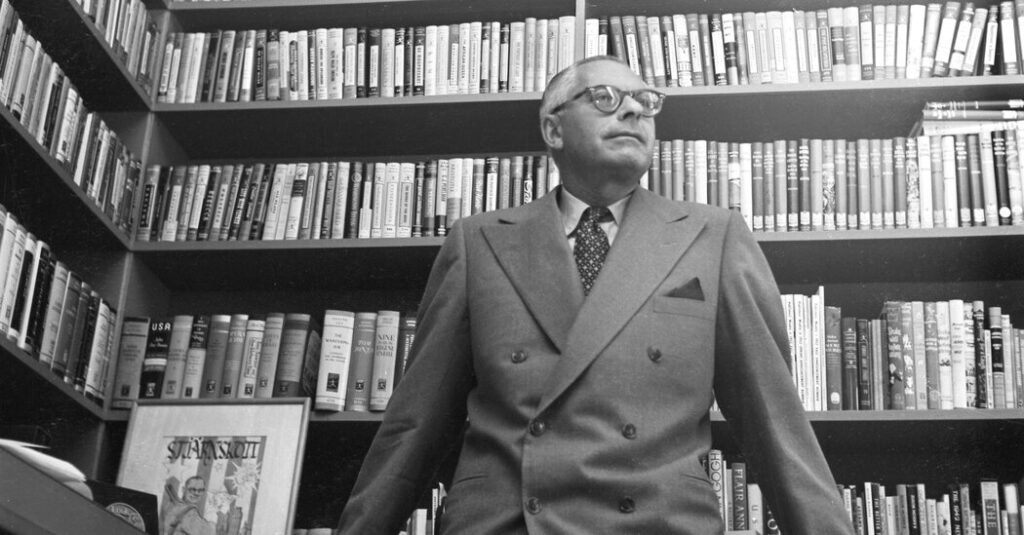
Swing open the saloon doors: There’s a new “Power Broker” in town. For surely the story of the publishing behemoth Random House, told through its charismatic co-founder Bennett Cerf, is as worthy of crossing the thousand-page mark as the story of how Robert Moses bulldozed New York. Books are just as much part of the city’s infrastructure as highways and housing developments.
And this one, “Nothing Random,” by the veteran Publishers Weekly reporter Gayle Feldman, is as delightful as it is hefty. You don’t want to stick the chronicles of the pipe-twiddling, Cheshire cat-grinning Cerf and his circle on a shelf for clout during Zoom calls, but plonk them on plates for dinner at eight.
Bonus: Doubles as booster cushion!
Cerf, an inveterate prankster and consummate promoter, would probably be tickled by the idea of this big, beautiful biography — long enough in the making that its distinguished acquiring editor died of old age — under guests’ rumps.
Yes, Random House pushed the first authorized U.S. edition of “Ulysses” through court; nabbed Ralph Ellison’s “Invisible Man,” which won the National Book Award; oversaw Gertrude Stein’s uproarious American lecture tour and William Faulkner’s shaky trip to the Nobel Prize. It was built on the classic backlist of the Modern Library, bankrolled by the best sellers ofJames Michener and Ayn Rand and burnished by some of the 20th century’s greatest playwrights and poets.
Cerf chafed at losing “Lolita” (a prudish deputy had threatened to quit); charmed authors (escorting Eugene O’Neill to a Yankees game right after the birth of his own second son); and took principled stands on the bonkers politics of Rand and Ezra Pound.
But he was famous himself for appearing as one of the evening-clothed panelists, “Sunday night royalty,” on the popular CBS game show “What’s My Line?,” a household name back when a man’s home was his castle and Nielsen and Gallup the imperial cavalry.
Along with dictating his own reminiscences he wrote, or compiled, many popular humor books now yellowing in the carpeted rec rooms of suburban in-laws across the country (or worse, next to their carpeted toilets), with titles like “Try and Stop Me” or “The Life of the Party,” which he was. “A 60-year-old giggling public man,” W.H. Auden called him, riffing off a Yeats poem.
After dating Anna May Wong and a brief marriage to the movie star Sylvia Sidney, Cerf settled down with Phyllis Fraser, a cousin of Ginger Rogers, and sired two somewhat neglected sons, who treasured time in the car sorting water towers into “mushrooms” and “toadstools” en route to their bucolic Westchester country house. One wag dubbed their father “the Count of Monte Kisco.”
In the city, there were marathon parties at the couple’s East 62nd Street townhouse, often hosted with their BFFs Moss and Kitty Carlisle Hart. And the publisher nightcrawled like a very hungry caterpillar, gathering material for his own scribblings and eventually provoking plagiarism accusations from Leonard Lyons, whose entire living was gossip. For Cerf it was just a side gig.
“The need to see his name in print was like an itch,” Feldman writes of her subject. He filed prolifically under the rubrics Trade Winds and Cerfboard — the country house was dubbed The Columns — and took feature assignments, including a profile of Marilyn Monroe, for Esquire. When the magazine mapped the American literary establishment in 1963, he and Random House were placed in the “red-hot center” (New York Times reviewers were relegated to Squaresville).
Sometimes scratching this itch yielded an ugly rash, as when Jessica Mitford exposed one of his shadier concerns, the Famous Writers School mail-order course, in The Atlantic in 1970.
Cerf died a year later, at 73, and his star faded quickly as Random House’s habitual mergers and acquisitions — including of the higher-browed rival, Knopf — swelled to its current state of mega-conglomeration. It long ago left its “palazzo” offices on Madison Avenue, and after a pit stop on dingier Third, now more aptly occupies a tower on Broadway.
Feldman thus had a biographer’s dream task: to reconstruct the life of someone who was both very important and largely forgotten, a prolific correspondent who kept copious action-oriented diaries and scrapbooks. Was Cerf a lightweight — “a dentist,” as Norman Mailer once spat — or so kinetic he could not be fixed? Was he a fool or wiser than us all at the project of living?
Born Benoît at home in Harlem in 1898, Jewish and squeamish about it until a 1934 trip to Palestine, Bennett was a coddled only child whose mother died young. His formidable maternal grandfather made a decent fortune in land speculation and tobacco; his own father, beloved, was more of a beta male; and there was a helpful gay uncle.
Bennett was mentored by the publisher and theater producer Horace Liveright, to whom he was introduced by his Columbia classmate Dick Simon (a future competitor, with Max Schuster).
Cerf was an enthusiastic reader — but again, more night crawler than bookworm. “No disquisitions, just gut reactions,” Feldman notes of his literary education. One of Random House’s biggest authors, nurtured by Phyllis, was Theodor Geisel, a.k.a. Dr. Seuss, and much about Cerf’s life (mushrooms! toadstools!) seems ripped from his PlayDoh-colored pages. Like Bartholomew Cubbins, he wore 500 hats. Socialite friends had names like Leonora “Bubbles” Hornblow,
Though his top lieutenants are men, women in these pages shimmer with glamour and opportunity, even when belittled. Cerf referred to his longtime secretary as Jezebel, and regularly teased a junior staffer who had been inspiration for Philip Roth with the salutations “Hello, Columbus” and “Goodbye, Columbus.”
But you can take the measure of a man by the nicknames he is given as well as the ones he dishes out. Bennett was Sonny to his pops, Beans (as in “full of”) to college chums, Cerfie to his co-founder and closest friend, Donald S. Klopfer. S.J. Perelman lampooned him in The New Yorker as Barnaby Chirp. Truman Capote adoringly called him Big Daddy; Frank Sinatra, Bennett the Bookie. Sylvia Fine Kaye, the composer and wife of Danny, dubbed him “Vitamin B. Cerf.”
“The important thing was never to be bored,” Feldman writes, perhaps unwittingly paraphrasing Eloise at the Plaza, another blockbuster franchise from which Random swiped a sugarplum.
Gloriously, even when its author is examining balance sheets or citation slips, there is no such danger in “Nothing Random.” If Moses envisioned a world of gray concrete overpasses, Cerf’s was a fountain-spouting Imagination Playground.
NOTHING RANDOM: Bennett Cerf and the Publishing House He Built | By Gayle Feldman | Random House | 1,072 pp. | $40
Alexandra Jacobs is a Times book critic and occasional features writer. She joined The Times in 2010.
The post He Put Dr. Seuss, Ayn Rand and ‘Ulysses’ on Your Bookshelves appeared first on New York Times.