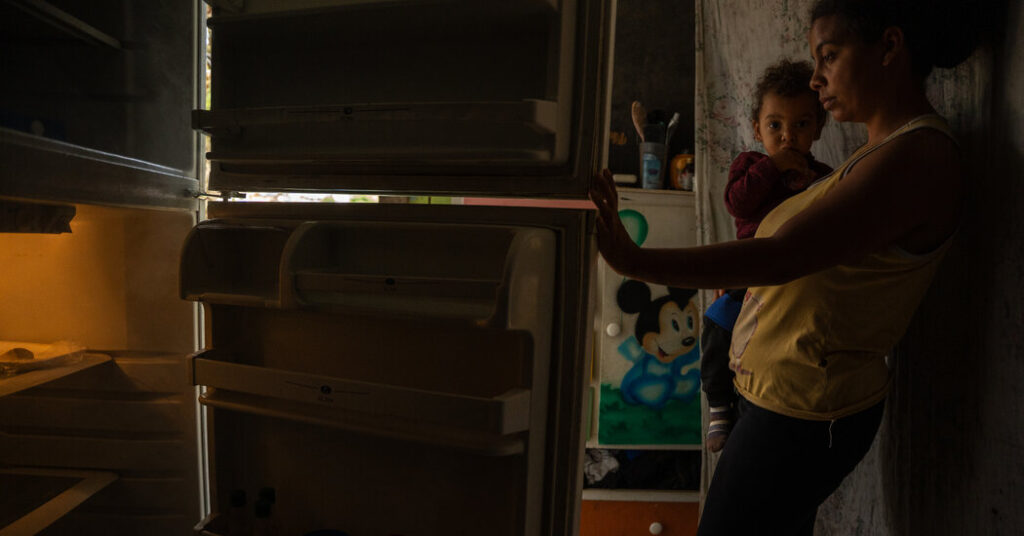
Nair Granado rushed to buy groceries as soon as she got her $60 paycheck.
She knew it wouldn’t be enough to fill the pantry in her home on the eastern fringes of Caracas, Venezuela’s capital. Still, she worried that, before long, her earnings would not be enough to cover even the basics.
“Prices are rising every day,” said Ms. Granado, 33, a lab receptionist living in a sprawling working-class neighborhood with her two children. “It’s completely out of control.”
After more than a decade in crisis, Venezuela is no stranger to food shortages, high prices and economic pain.
But the U.S. military raid that removed Venezuela’s leader, Nicolás Maduro, has plunged the South American nation into a chaotic new chapter of political and economic uncertainty, setting off a new wave of inflation and currency woes pushing basic grocery items out of the reach of many Venezuelans.
Ms. Granado, on a recent weekday, could still afford to buy flour and half a carton of eggs. But she did not even dream of buying meat — at more than $9 per pound, the price had nearly doubled in only a few days.
“You really have to find ways to be frugal, to make your salary stretch,” Ms. Granado said. “It’s getting harder to buy things.”
The economic turmoil is now threatening to deepen a yearslong humanitarian crisis in Venezuela, where more than 70 percent of people already live in poverty, according to a survey by a group of leading universities in the country.
The new affordability crisis is hitting Venezuelans especially hard because many have already been living on the edge of hunger for years, said Phil Gunson, a senior analyst with the International Crisis Group, a research organization, who has lived in Venezuela for over two decades.
“They’ve sold everything they could, they’ve tightened their belts until there are no more holes left,” Mr. Gunson said. “So there’s nothing left to fall back on.”
At the core of the sharp rise in food costs is Venezuela’s dependence on the U.S. dollar, widely used in everyday transactions because it is typically less volatile than the country’s own currency, the bolívar. When Venezuela’s economy, once Latin America’s richest, spiraled deeper into crisis in 2019, driven by government mismanagement and exacerbated by U.S. sanctions, many people began to save, spend and charge in U.S. dollars.
As a result, even though the country’s economy is not formally “dollarized,” Venezuelans today rely on U.S. dollars for their daily spending. Vendors often buy from suppliers in dollars, so they peg prices to the currency. And they typically charge higher prices if buyers want to pay in Venezuelan bolívars.
New U.S. sanctions over the past year have also forced Venezuela to sell less oil on the global market, which has reduced the volume of dollars circulating in its economy and made the currency more valuable. Now, anxiety about Venezuela’s economic future has sent the value of the dollar soaring, effectively doubling local prices of staples like meat, cheese and milk.
The Central Bank of Venezuela sets an official exchange rate, but most people rely on an unofficial rate called the “parallel dollar,” which reflects what dollars actually sell for on the street. This past week, the unofficial value of the dollar peaked at twice the official rate. It has since stabilized, but remains well above the official rate — and grocery store prices have not fallen in step.
At the same time, the incomes of Venezuelans, who are mostly paid in bolívars, “have gone up in smoke” as the value of the bolívar has dropped, said José Guerra, an economist and professor at the Central University of Venezuela.
“So we have a case of an economy that is experiencing extremely high inflation and, at the same time, may be entering an economic recession,” he added, estimating inflation could reach 2,000 percent this year. (The Venezuelan government does not publish official economic statistics and has persecuted economists tracking inflation.)
Venezuela’s minimum monthly wage, eroded by a decade of inflation and not adjusted in years, is now equivalent to roughly 50 cents. The government has tried to plug the gap, in part, by paying public-sector workers bonuses, though these have also diminished in value as the currency continues to wither.
There are signs the United States is already brokering deals for the sale of Venezuelan oil, which could help stave off an economic disaster in the country and inject critical dollars into its economy. But, in the short term, this potential economic lifeline is a long way from helping ordinary Venezuelans.
A survey by Gallup showed that last year, three in five Venezuelans struggled at times to afford food, among the highest rates in Latin America and the Caribbean. Even among the wealthiest 20 percent of Venezuela’s population, more than half said they were finding it difficult to pay for groceries.
Over the past year, soup kitchens and other community projects that once fed those in need have also been forced to close, as Mr. Maduro targeted nongovernmental groups with restrictive new rules. The government does deliver basic food baskets to the poor, but this welfare program is plagued by frequent and lengthy delays that can leave families without provisions for months.
While Venezuela’s interim government is focused on its new client-like relationship with the Trump administration, many Venezuelans are simply trying to figure out ways to stretch their dwindling purchasing power.
Johana Paredes, 30, said she was used to rationing the month’s groceries for her family of four. But the new sharp increase in food prices has made it difficult to buy even essential items that were, until recently, within reach.
“This past week, we couldn’t do any grocery shopping,” Ms. Paredes said, showing the scant supplies in her tin-roofed home in Los Teques, an hour outside Caracas. “That’s why there aren’t even potatoes,” she added. “Before, we were rich and we didn’t even know it.”
In Caracas, shoppers toured the stalls of the city’s most iconic municipal market hunting for a bargain, as vendors shouted prices in dollars and inflated them in bolívars. Leaning on the counter of the butcher shop where he works, Jesús Balza, 50, said customers were buying less.
“People are only spending on necessities,” he said. “Whoever used to buy a kilo of cheese is now buying half.”
This was on full display in Valencia, a city in central Venezuela, as shoppers walked out of supermarkets with half-empty bags. Marilsa Mendoza spent her budget of 13,000 bolívars, the equivalent of $35, on only a few necessities: flour, rice, pasta, oil and butter. Until a few weeks ago, she was able to buy far more for the same amount. “Everything is terrible, more or less double the price,” said Ms. Mendoza, 52, a hot dog vendor.
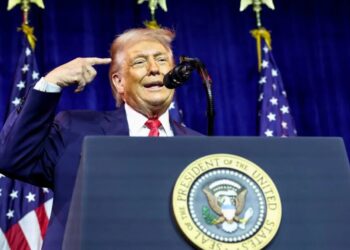
President Trump has outlined grand plans to revive Venezuela’s oil industry, vowing to strike a series of deals that would bring American investment into the sector. The main engine of the economy has decayed after years of mismanagement.
And while there are early signs that these plans may be taking shape, it is not yet clear whether this financial lifeline will ultimately materialize and fix Venezuela’s broken economy over the long-term.
Many Venezuelans long ago lost faith in their government’s ability to improve their lives.
Will whatever oil deals are in the works “actually benefit Venezuela,” asked Mr. Gunson, the analyst. “Only time will tell,” he added. “Right now, all we have is Trump saying that he’s taking the oil and he’s going to sell it.”
As leaders in Caracas and Washington wrestle over Venezuela’s future, Ms. Paredes said she was holding out hope that real transformation would soon begin to reach people like her.
“We try to stay positive, believing that things will really change,” she said. “Because honestly, we don’t see any improvement. Everything just keeps getting worse.”
Reporting was contributed by Tibisay Romero, María Victoria Fermín, Maria Ramírez and Patricia Sulbarán.
Ana Ionova is a contributor to The Times based in Rio de Janeiro, covering Brazil and neighboring countries.
The post The Biggest Challenge in Venezuela? Forget the Oil, It’s Stocking the Fridge. appeared first on New York Times.