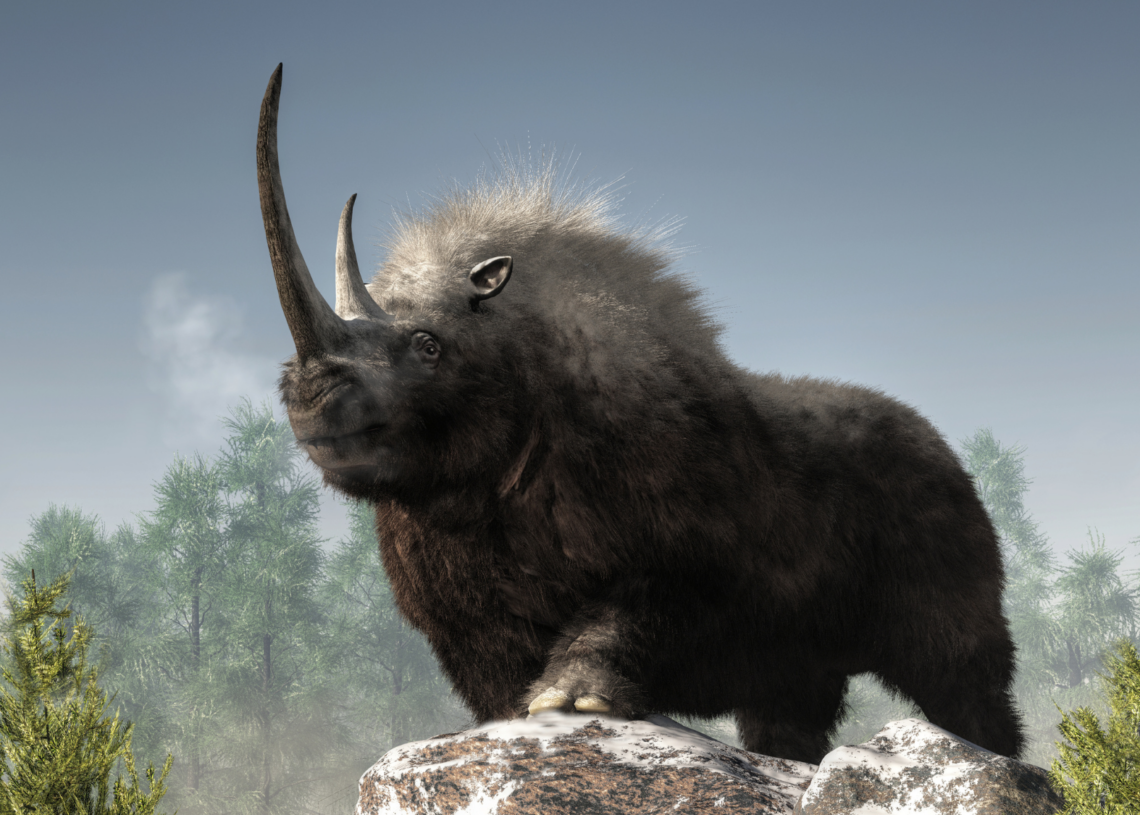
A frozen wolf pup that died more than 14,000 years ago has become an unlikely archivist of extinction. Inside its stomach, scientists found preserved flesh from a woolly rhino, and that grisly detail has now helped answer a long-running question about how one of the Ice Age’s giants disappeared.
The wolf pup was uncovered in Siberian permafrost in 2011. When researchers later examined its remains, they discovered the animal’s final meal. It had eaten part of a woolly rhino, a species that vanished near the end of the last Ice Age. The muscle tissue stayed intact long enough for scientists to do something unprecedented. They sequenced the rhino’s entire genome directly from the undigested meat.
“Sequencing the entire genome of an Ice Age animal found in the stomach of another animal has never been done before,” Camilo Chacón-Duque, a bioinformatician at Uppsala University and co-author of the study, said in a statement. The research was published in Genome Biology and Evolution.
The woolly rhino tissue was radiocarbon dated to about 14,400 years ago. That places the animal among the last known members of its species. Researchers compared its genome with two older woolly rhino genomes, dated to 18,000 and 49,000 years ago. The comparison revealed something unexpected. Genetic diversity and inbreeding levels stayed relatively stable across all three animals.
That’s important because many Ice Age extinctions show clear genetic warning signs. Small populations usually shrink into isolated pockets, which leads to inbreeding and long-term decline. Woolly mammoths offer a classic example, with late-surviving island populations showing severe genetic stress. Woolly rhinos didn’t follow that pattern.
“Our results show that the woolly rhinos had a viable population for 15,000 years after the first humans arrived in northeastern Siberia, which suggests that climate warming, rather than human hunting, caused the extinction,” said Love Dalén, an evolutionary genomics professor at the Centre for Palaeogenetics in Sweden.
The timing lines up with a sharp climate shift known as the Bølling-Allerød interstadial, when temperatures across the Northern Hemisphere rose rapidly. For cold-adapted grazers like the woolly rhino, that warming likely changed vegetation faster than the species could adjust. Food sources dwindled. Habitats changed. Extinction followed swiftly rather than gradually.
Beyond the fate of one species, the study opens a strange new window into ancient life. “It was really exciting, but also very challenging, to extract a complete genome from such an unusual sample,” said lead author Sólveig Guðjónsdóttir of Stockholm University.
The wolf pup never grew up. Its last meal never digested. Fourteen millennia later, that unfinished dinner helped explain how an Ice Age heavyweight met its end.
The post A Wolf Pup’s Last Meal Changed What We Know About Woolly Rhino Extinction appeared first on VICE.