The Arctic is warming around four times faster than the rest of the globe, exposing natural resources, opening up potential shipping routes and prompting an increase in activity among military powers. The changing landscape has created a region ripe for opportunity and potential conflict — factors that may play a role in President Donald Trump’s sudden quest to obtain Greenland.
Though he has called climate change a “hoax,” part of the value Trump has described in the Danish autonomous territory’s location is a result of the environmental shifts.
“It’s partly the melting of sea ice making it more attractive for the economic development that he’d pursue in Greenland,” said Sherri Goodman, a distinguished fellow at the Atlantic Council and the former deputy undersecretary of defense for environmental security.
Trump has said he wants the territory because of its strategic location and untapped natural resources, including diamonds, lithium and copper.
The president announced tariffs Saturday on countries that have sent troops to Greenland in recent days. Talks in recent days between the foreign ministers of Greenland and Denmark, and U.S. officials JD Vance and Marco Rubio. The meeting ended in “fundamental disagreement” according to Denmark’s top diplomat, Lars Lokke Rasmussen.
The prospect of the United States using military force against the NATO ally, as Trump has floated, could end the decades-old defense pact. His bid for the territory is one of the most concrete examples of how climate change is influencing geopolitics. As the northernmost parts of our planet continue to warm, the effects could change the ways the international community operates.
“The freeing of the Arctic from sea ice, at least seasonally, will create an entirely new theater for economic and security competition,” said Joseph Majkut, the director of the Energy Security and Climate Change Program at the Center for Strategic and International Studies. “And while we’ve known that is going to be the case for some time, it seems we’re at an inflection point.”
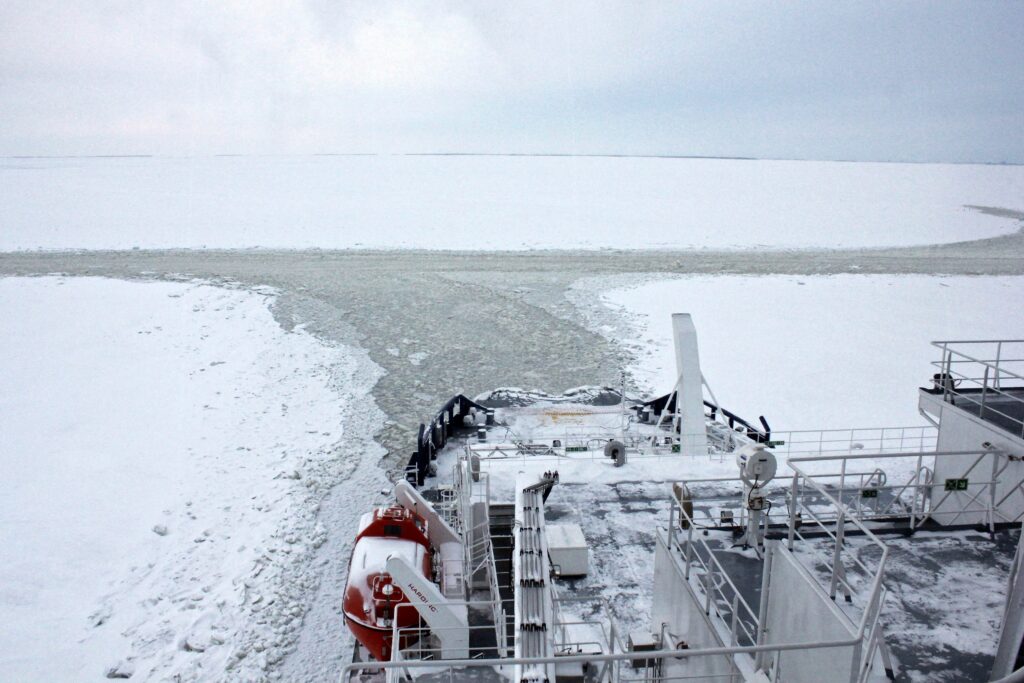
Arctic sea ice typically peaks in March, as ice forms and spreads through the depth of winter, before beginning to melt to its lowest extent, usually in September. Over approximately the past five decades, changes in Arctic ice cover have revealed pathways for shipping and commerce, as parts of the region stay ice-free for longer. There’s the northern sea route along Russia’s coast, and the northwest passage along northern Canada. Analysts note icebreakers, or vessels with the capability to chomp through thinning ice, have begun passing through a “central route,” over the top of the Arctic.
In October, a Chinese container ship used the northern sea route to shave about 20 days off its typical journey through the Suez Canal to Europe.
If the region becomes ice-free in future summers, it could reshape global trade. That reality is mere decades away, though exact predictions depend on whom you ask and how quickly the planet warms.
A 2021 study in Nature modeled future open-water periods based off different warming thresholds. It found that if the planet warms 2 degrees Celsius above the 1850-1900 average, that period lengthens by 63 days, while if the planet warms 3.5 degrees above the average, nearly the entire Arctic would have at least three months of open water each year.
But it’s hard to predict the exact timeline of the rate of melting, and either way, continued escalations or jockeying won’t really depend on the pace of warming, Majkut said.
They also may be underestimating the hazards of a melting Arctic, scientists warn. Regardless of when an ice-free summer comes, it will remain an extreme environment.
“It’s going to be a long time before we’re arguing over beachfront property or protecting people from crocodiles up there,” Majkut said.
Without sea ice, communities could lose crucial protection, said Zack Labe, a climate scientist who studies regional climate risks.
“Typically, the ice would act as a buffer for high wind and waves,” he said, especially in the fall when the region experiences typhoons in the Pacific that bring huge swells. That ice protects people against erosion and flooding.
The melting arctic could produce unpredictable ocean conditions, like changes in the wind and the waves. And if there is an emergency, there are few accessible ports.
“It could become more hazardous for ships to go into these areas rather than less,” said Labe.
While Trump is pursuing Greenland, he hasn’t publicly acknowledged climate change’s role in what he perceives to be its value. A staunch climate change denier, the president has moved to cut fundingto many climate initiatives including Arctic research.
But to some, that could be bad geopolitical strategy.
“Climate change is a significant national security risk,” said Goodman. “The openings of sea lanes, the changing ice conditions, are contributing to the intense geopolitical situations we’re experiencing.”
The post How a melting Arctic makes Greenland more appealing to Trump appeared first on Washington Post.