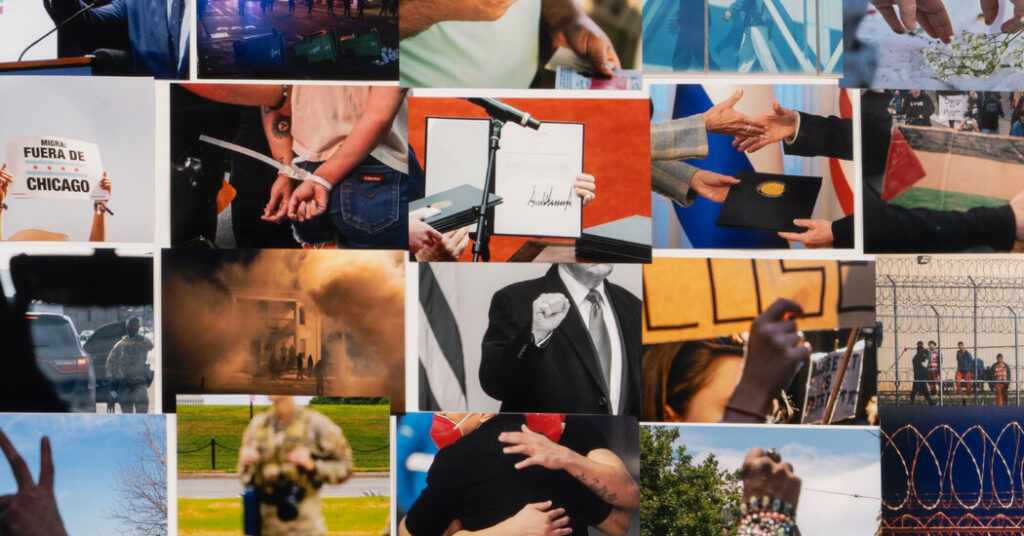
A year into Donald Trump’s second term, friends who live outside the United States continue to express shock at the news that comes from this country, often mixed with concern for my safety. I shrug. Even those of us in the United States who oppose this administration’s actions have a way of normalizing them. On Tuesday, I saw a news release in my inbox: A new filing in the legal case against the construction of the giant immigrant detention facility in Florida. I — like many other Americans, it seems — had almost forgotten about Alligator Alcatraz.
In Europe, attention has been unwavering. Journalists are writing articles and making documentaries about America building a concentration camp. On these shores, we have simply become a country that builds concentration camps. It’s only one of the changes we have absorbed in the last year.
We have become a country where people are disappeared by a paramilitary force that hunts them down in their apartments, on city streets and country roads, and even in the courts. Less than a year ago, videos of ICE arrests would go viral and social media posts about ICE sightings would send chills down our spines. Now even the most high-profile detentions have faded from view: Who has been released? Who has been deported? Who is still missing?
Who can keep track?
We have become a country where a person can be summarily executed in public for protesting that paramilitary force. After an ICE agent killed Renee Good by shooting her three times at point-blank range in Minneapolis on Jan. 7, President Trump, Vice President JD Vance and other federal officials said the shooting was justified as an act of self-defense (the video shows otherwise) and pointed to Good’s ostensible affiliation with left-wing groups — apparently affirming that protest is now punishable by death in America.
We have become a country whose federal government deploys military and paramilitary forces in the streets of its major cities, terrorizing the residents in the guise of protecting them. A foreign observer taking stock of the United States could describe us as a nation on the brink of civil war. But we can barely keep current the list of cities where troops have been or still are in the streets: Washington, D.C.; Los Angeles; Chicago; Portland, Ore.; Memphis; New Orleans. The number of armed federal agents deployed to Minneapolis may now be five times the size of the city’s police force.
We have become a country whose government is attacking its universities, defunding research, reversing scientific advances, assaulting museums and hollowing out cultural institutions. Few of these attacks — carried out in broad daylight, announced in executive orders, extolled in speeches and put on display in giant metal letters — meet meaningful resistance. We are making ourselves stupider.
We have become a country that demonstratively tramples on international laws. Our military bombs a different nation every few weeks, commits murder on the high seas and removes foreign political leaders by force. Our government threatens the world, including our allies, with its imperial ambitions.
We are a country ruled by a megalomaniac whose views are openly hateful and proudly ignorant, whose avarice knows no bounds and whose claim to power is absolute. Foreign leaders try to appease him with flattery and curry his favor with gifts. It rarely works to temper his appetite or even catch his attention, but it’s seemingly all they can do.
To be sure, some elements of our current condition predate Trump. This country has long maintained the world’s largest carceral system, and one of the least humane in the Western world; it formed the foundation for the concentration camps. Police executions of Black people have long been a pattern. The origins of ICE and its parent agency, the Department of Homeland Security, conceived as a secret police force, go back to 9/11. The culture wars date to at least the 1980s. And disregarding international law, playing the world’s heavily armed policeman, has been a longstanding bipartisan tradition — as have increasingly hostile, restrictive immigration policies. The presidency itself has been growing less transparent and more powerful for at least a couple of decades.
I am not arguing that what we have become this year is just more of the same. Few people would make this argument anymore. But the truth is, even though we are taught to think of history as a series of definitive turning points with specific dates — wars, revolutions, assassinations, declarations of independence and decrees announcing martial law — no transformation is instant or total. This Trump administration has moved at breakneck speed. And still, it hasn’t broken everything yet.
.op-aside { display: none; border-top: 1px solid var(–color-stroke-tertiary,#C7C7C7); border-bottom: 1px solid var(–color-stroke-tertiary,#C7C7C7); font-family: nyt-franklin, helvetica, sans-serif; flex-direction: row; justify-content: space-between; padding-top: 1.25rem; padding-bottom: 1.25rem; position: relative; max-width: 600px; margin: 2rem 20px; }
.op-aside p { margin: 0; font-family: nyt-franklin, helvetica, sans-serif; font-size: 1rem; line-height: 1.3rem; margin-top: 0.4rem; margin-right: 2rem; font-weight: 600; flex-grow: 1; }
.SHA_opinionPrompt_0325_1_Prompt .op-aside { display: flex; }
@media (min-width: 640px) { .op-aside { margin: 2rem auto; } }
.op-buttonWrap { visibility: hidden; display: flex; right: 42px; position: absolute; background: var(–color-background-inverseSecondary, hsla(0,0%,21.18%,1)); border-radius: 3px; height: 25px; padding: 0 10px; align-items: center; justify-content: center; top: calc((100% – 25px) / 2); }
.op-copiedText { font-size: 0.75rem; line-height: 0.75rem; color: var(–color-content-inversePrimary, #fff); white-space: pre; margin-top: 1px; }
.op-button { display: flex; border: 1px solid var(–color-stroke-tertiary, #C7C7C7); height: 2rem; width: 2rem; background: transparent; border-radius: 50%; cursor: pointer; margin: auto; padding-inline: 6px; flex-direction: column; justify-content: center; flex-shrink: 0; }
.op-button:hover { background-color: var(–color-background-tertiary, #EBEBEB); }
.op-button path { fill: var(–color-content-primary,#121212); }
Know someone who would want to read this? Share the column.
We are still a country with a robust civil society. The lawyers have fought the administration in court. The people have rallied against Trump’s usurpation of power and have organized to protect their neighbors from ICE. But Trump’s attacks on universities, his assault on the judiciary, and his threats against nonprofits and philanthropies have already altered the way civil society functions. The universities and the foundations aren’t what they were a year ago, and neither is the judiciary, where so much civil-society work is concentrated. And the execution of Renee Good has surely affected every potential protester’s mental calculus.
We still have independent media. But taking stock of how much the media landscape has changed is sobering. Even before the 2024 election, the owners of The Washington Post and The Los Angeles Times curtailed the independence of their editorial pages. Soon after the election, ABC News and then the parent company of CBS News paid millions of dollars to settle what certainly appeared to be frivolous lawsuits filed by Trump. (He has filed several more, including one against The New York Times, and another against 20 individual members of the Pulitzer Prize Board, which includes Times journalists.) Now, under new ownership, CBS is rapidly transforming itself into a Trump-friendly network.
Autocrats destroy the free press in at least two ways: by cracking down, as Trump has done through lawsuits and regulatory pressure, and by reapportioning access to information. In October, the Trump administration effectively kicked legacy media outlets out of the Pentagon, replacing them with loyal journalists and influencers. The media, like civil society, is much diminished compared with what it was a year ago.
We still have elections. But how free and fair will the 2026 elections be? Trump doesn’t just carry a grudge against the election authorities of many states; he made that grudge a centerpiece of his 2024 campaign. Since he returned to office, his administration has taken a series of executive actions and filed a series of lawsuits aimed at restricting access to the polls, purging voter rolls, limiting the independence of local election authorities, and generally laying the groundwork for the systematic intimidation of both voters and election officials. States have joined this effort. Florida is cracking down on voter registration drives. Ohio and other states have introduced restrictive voter ID laws. Georgia has limited poll hours and banned providing food or water to people standing in line to vote. Texas has gerrymandered a map that threatens to disenfranchise Black and Latino voters and may wipe five Democratic congressional seats out of existence, and the Supreme Court has allowed this controversial new map to be used in the 2026 midterms. Add to this Trump’s threat to deploy the military to deal with the “enemy from within” during the elections on the one hand and his promise to send Americans what amounts to a bribe — $2,000 checks “toward the end of the year” — and you have the prospect of elections that are far less free and a lot less fair than the last ones.
As for the next presidential election, Trump has made his intentions clear: He is not planning to leave his throne. He may look for a pretext to cancel the vote. (When President Volodymyr Zelensky told him that Ukraine can’t have an election during the war, Trump visibly lit up: “So you mean if we happen to be in a war with somebody, no more elections? Oh, that’s good.”) He may find a way to invalidate the vote after the election — he has been laying the groundwork for such a move since his first term. Even if he doesn’t, it is foolish to think that this iteration of our national nightmare will end in three years.
One term for regimes that maintain the trappings of democracy, such as legislatures, courts and elections, but use them primarily as decoration is “electoral authoritarianism.” This is what we are becoming.
It matters what we call things — what we call ourselves. It matters for wonky reasons like reading the polls: Public opinion functions differently in democratic and nondemocratic societies. But it matters more for how we think about the future. We can’t count on change being brought about by elections when we can’t count on elections. We can’t count on the freedoms and resources we enjoy today to still be available to us tomorrow.
Ask anyone who has lived in a country that became an autocracy, and they will tell you some version of a story about walls closing in on them, about space getting smaller and smaller. The space they are talking about is freedom. In Russia, mass protest used to be possible. (The first time people got prison terms for peaceful protest, in 2012, I wrote a whole book about it.) Then mass protest became impossible and the only option was what we called the one-person picket: a person standing alone with a sign. Then people started getting arrested for standing alone with a blank piece of paper, then for “liking” something on social media. Russian journalists used to know that they could write freely as long as they stuck to culture and avoided politics; now a person can get arrested for performing a tune by a banned songwriter.
Of course, the United States is not Russia — or Hungary or Venezuela or Israel or any of the many other democracies that have turned or are turning themselves into autocracies. But now is the time to focus on the similarities and try to learn from the ways other countries have cracked down on protest, eviscerated their electoral systems, limited their media freedom and built concentration camps. The only way to keep the space from imploding is to fill it, to prop up the walls: to claim all the room there still is for speaking, writing, publishing, protesting, voting. It’s what the people of Minnesota appear to be doing, and it’s something each of us needs to do — right now, while we still can.
M. Gessen is an Opinion columnist for The Times. They won a George Polk award for opinion writing in 2024. They are the author of 11 books, including “The Future Is History: How Totalitarianism Reclaimed Russia,” which won the National Book Award in 2017.
Photo Credits: Tom Baker/AP; Victor J. Blue for The New York Times; Alex Brandon/AP; Pool photo by Alex Brandon; Daniel Cole/Reuters; Ariana Cubillos/AP; Ben Curtis/AP; Jamie Kelter Davis for The New York Times; Graham Dickie/The New York Times; Kevin Dietsch/Getty Images; Loren Elliott for The New York Times; Tim Evans/Reuters; Elizabeth Frantz/Reuters; Nikos Frazier/Omaha World-Herald, via AP; Jen Golbeck/AP; David Goldman/AP; Adam Gray/Reuters; David Guttenfelder/The New York Times; Andrew Harnik/Getty Images; Todd Heisler/ The New York Times; Haiyun Jiang for The New York Times; Kaya & Blank for The New York Times; Pedro Mattey/AFP — Getty Images; Stephen Maturen/Getty Images; Doug Mills/The New York Times; Leah Millis/Reuters; Ryan Murphy/Reuters; Brian Otieno for The New York Times; Federico Parra/AFP — Getty Images; Spencer Platt/Getty Images; Joe Raedle/Getty Images; Jesse Rieser for The New York Times; Michael M. Santiago/Getty Images; Ritesh Shukla/Getty Images; Alon Skuy/Getty Images; Chip Somodevilla/Getty Images; Fernando Vergara/AP; Leonardo Fernandez Viloria/Reuters; Damon Winter/The New York Times; Alex Wong/Getty Images; Kerem Yucel/AFP — Getty Images
The Times is committed to publishing a diversity of letters to the editor. We’d like to hear what you think about this or any of our articles. Here are some tips. And here’s our email: [email protected].
Follow the New York Times Opinion section on Facebook, Instagram, TikTok, Bluesky, WhatsApp and Threads.
The post One Year Later, What Kind of Country Have We Become? appeared first on New York Times.