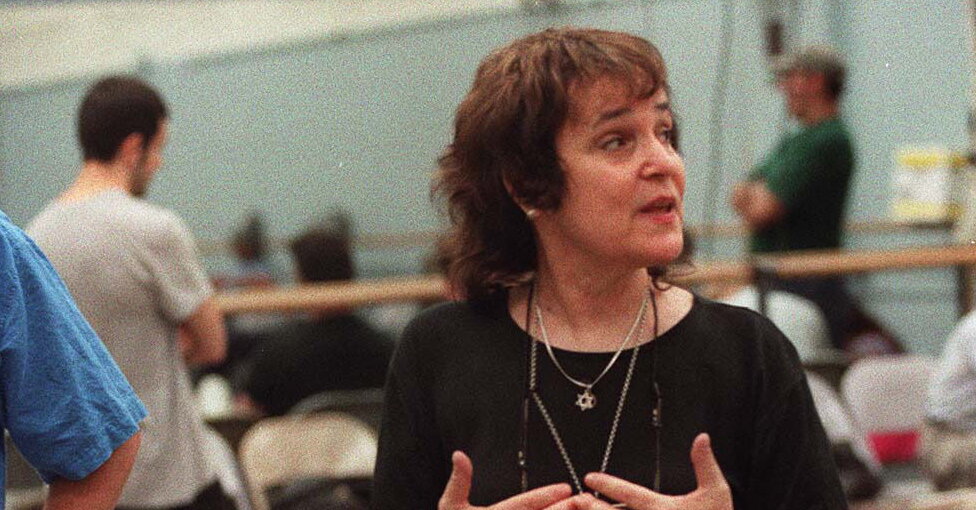
Rhoda Levine, one of the rare female opera directors to work steadily starting in the 1970s, at a time when the field was dominated by men, and who was acclaimed for clear, straightforward interpretations of the classics as well as striking world premieres, died on Jan. 6 at her home in Manhattan. She was 93.
Her death was announced by her nephew, Jonathan Levine.
Part of the first generation of American directors who brought true theatrical acting into opera, Ms. Levine insisted on directing singers as actors and demanded a kind of realism in an often stylized art form.
“She broke so much new ground, in so many ways, that if we today have opera as a vibrant 21st-century art form, I think it has a great deal to do with Rhoda’s groundbreaking work,” Marc Scorca, the former president of the trade organization Opera America, said in “An Uncommon Woman,” a not-yet-released documentary about Ms. Levine.
At New York City Opera, Netherlands Opera and other companies, she directed works stretching from Mozart’s “The Marriage of Figaro” to Alban Berg’s “Lulu,” along with plenty of contemporary operas like Mark Adamo’s “Little Women.”
Perhaps Ms. Levine’s most significant contributions to the repertoire were the premiere productions of two intense works, both of which came to be considered landmarks of 20th-century opera: Viktor Ullmann’s “Der Kaiser von Atlantis,” an anti-Hitler allegory composed in the Theresienstadt concentration camp before Mr. Ullmann was murdered at Auschwitz, and Anthony Davis’s “X: The Life and Times of Malcolm X.”
“I guess I am drawn to political operas,” Ms. Levine told The New York Times in 1990. But, she added, “sometimes I think that what we think of as political is in all opera,” noting the political overtones in the works of Mozart, Monteverdi and many others.
“She was a trailblazer,” Francesca Zambello, a stage director and the artistic director of Washington National Opera, said in an interview. “She was a political artist, and she brought an element that had social commentary rooted in it.”
“Der Kaiser von Atlantis” (“The Emperor of Atlantis”), Mr. Ullmann’s one-act opera, blended cabaret, jazz and the overripe style of early Schoenberg in a manner reminiscent of the composer Kurt Weill. The score survived the Holocaust, but a performable edition was only completed in the 1970s; Ms. Levine staged the premiere at Netherlands Opera in 1975.
She said in “An Uncommon Woman,” the documentary about her directed by David D. Williams, that she considered it “the most important opera I ever did,” because it “gave voice to two men who had been murdered”: Mr. Ullmann and the librettist, Peter Kien, who was also killed at Auschwitz.
Her production of “X” — an opera whose development she was deeply involved in — similarly reflected her desire not to let overly fussy stagings distract from a work’s themes.
After the piece’s 1986 premiere at City Opera, the critic Donal Henahan wrote in The Times that “Mr. Davis and his collaborators want to give words and ideology, not vocalism, the center of attention in this work.”
Ms. Levine and Mr. Davis, Mr. Henahan added, “have approached ‘X’ primarily as incantatory theater: Every musical idea is stated over and over, as is every staging idea.”
A premium on lucidity carried over into her work with the standard repertoire. In 1985, reviewing her production of Smetana’s “The Bartered Bride” at Glimmerglass Opera in upstate New York, Mr. Holland had written, “Rhoda Levine’s staging keeps the stage full and busy with a minimum of crowding and confusion.”
Rhoda Jane Levine, one of two siblings, was born in Manhattan on June 15, 1932, and raised in Queens. Her father, George Levine, was a civil rights lawyer, and her mother, Madeline (Stein) Levine, was a professor of early childhood education at New York University.
Ms. Levine later recalled a childhood steeped in political consciousness: Her father aided refugee Jews escaping Europe, and the Spanish Civil War was a frequent subject of conversation as she grew up.
She attended Bayside High School in Queens and graduated from Bard College in 1953 with a bachelor’s degree in drama and dance. Initially hoping to be a dancer, she studied with Martha Graham and, as she put it in the documentary, “worked my butt off” as a waitress to pay for dance classes.
The diminutive Ms. Levine was soon told she was too short to be a dancer, and she began working as a choreographer, including for television productions. The composer Gian Carlo Menotti, who had founded the Festival of the Two Worlds in Spoleto, Italy, saw some of her work and invited her the festival. A commission from the renowned director Luchino Visconti to choreograph his Spoleto production of Verdi’s “La Traviata” launched her international career.
At City Opera in 1990, Ms. Levine directed the American stage premiere of Janacek’s “From the House of the Dead,” which John Rockwell in The Times wrote “nobly captures the work’s oppressive intensity.” Other highlights of her career were the South African premiere of the Gershwins and DuBose Heyward’s “Porgy and Bess” in Cape Town in 1996; an acclaimed production of Scott Joplin’s “Treemonisha” at Opera Theater of St. Louis in 2000; and the premiere of Mr. Davis’s “Wakonda’s Dream” at Opera Omaha in 2007.
She leaves no immediate survivors.
Ms. Levine wrote the libretto for Luciano Berio’s “Opus Number Zoo” — aimed at children but dark in tone — as well as seven children’s books, several of them illustrated by Edward Gorey. She was on the faculty at the Manhattan School of Music from 1992 to 2019, and also taught at other schools.
Her preoccupation was to reach her audience directly, to “provide an audience with a very human experience that really connected with their own lives,” Ms. Levine told the music journalist Bruce Duffie in 1988.
“Clarity is all,” she added. “Whether the audience likes it or not, whatever your intention is, you must deliver that intention to them. That’s your job as an actor, an actress or as a musician. You hope you’re clear.”
Georgia Gee contributed research.
Adam Nossiter has been bureau chief in Kabul, Paris, West Africa and New Orleans and is now a writer on the Obituaries desk.
The post Rhoda Levine, Pathbreaking Opera Director, Dies at 93 appeared first on New York Times.