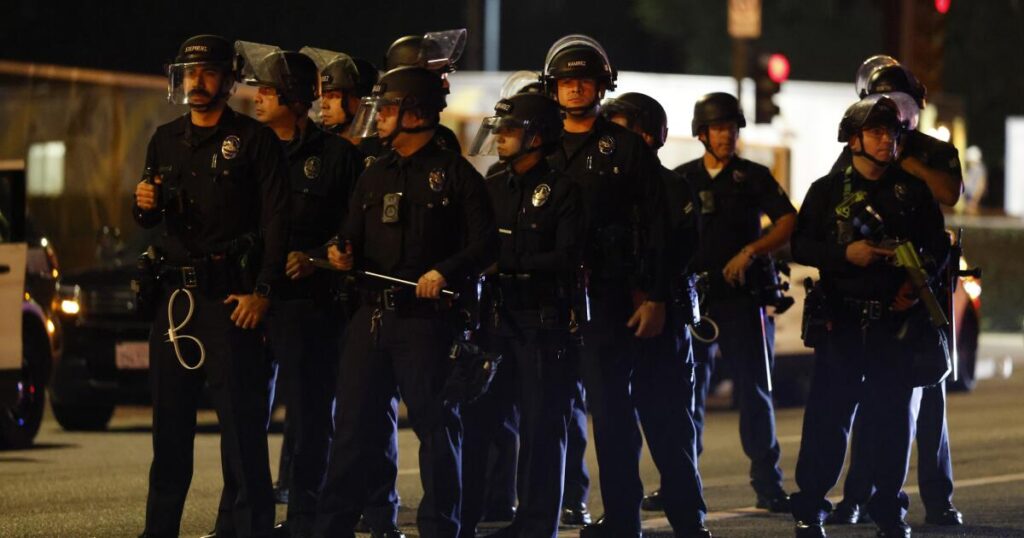
A federal judge banned Los Angeles Police Department officers from using some so-called less-lethal launchers at protests, after finding that the department violated previous court restrictions by using such projectile weapons to disperse crowds at last summer’s mass demonstrations against immigration enforcement.
In her ruling Wednesday, U.S. District Judge Consuelo B. Marshall sided with a contempt motion filed by attorneys for Black Lives Matter-Los Angeles.
That same day LAPD officials sent a department-wide memo announcing an immediate moratorium on the use of the 40-millimeter weapons in light of Marshall’s ruling. The memo advised those seeking further clarity to contact the department’s risk management and legal affairs division.
“Accordingly, EFFECTIVE IMMEDIATELY the 40mm SHALL NOT be used during any CROWD CONTROL situation,” said the memo, a copy of which was reviewed by The Times.
A preliminary injunction handed down by Marshall in 2021 placed certain restrictions on the weapons’ use, including requiring specialized training for handlers; the issuance of a warning before firing such weapons; and restricting their use only to situations in which “the officer reasonably believes that a suspect is violently resisting arrest or poses an immediate threat of violence or physical harm.”
The latest order halts the use of a weapon, recognizable by its neon green handle, that has been used by police during recent protests to clear crowds after demonstrations were declared unlawful. The weapon launches projectiles the size of a mini soda can at speeds of more than 200 mph.
But attorneys for Black Lives Matters-L.A. argued that LAPD routinely flouted the injunction — citing numerous apparent violations in their contempt motion. Officers already were barred from firing their weapons from five feet away or closer, or from targeting a person’s head, groin or spine, but attorneys argued that police repeatedly did so.
One lawyer said the department also seemed to be violating its own guidelines governing the 40-millimeter’s use by shooting journalists and others in sensitive areas such as the head.
“And they’re certainly not supposed to shoot them in the back of the head as they’re trying to leave,” said Carol Sobel, a prominent attorney whose litigation forced the LAPD to scale back aggressive crowd-control practices in the past. “The bottom line is the LAPD is going to bankrupt the city with its refusal to follow the law.”
The motion also cited a 9th Circuit Court of Appeals ruling that found such weapons shouldn’t be used to disperse crowds. It was the latest legal challenge to the use of the 40-millimeter, which the LAPD also uses in day-to-day operations. The order doesn’t apply to such uses.
In the past the department issued similar, if temporary moratoriums on the use of other projectile weapons that fire so-called skip and beanbag rounds.
This week the City Council voted in favor of new limits on the deployment of LAPD officers at protests, encouraging a “graded response” in which officers in riot gear would be deployed only if needed.
Los Angeles police faced multiple allegations of excessive force during protests against the Trump administration’s immigration crackdown last summer. The department’s response already spawned lawsuits, including from the Los Angeles Press Club, which pointed to video evidence and scores of testimonials suggesting that law enforcement violated its own guidelines and state law.
Earlier this year a different federal judge issued an order barring the LAPD from using less-lethal munitions against journalists and nonviolent protesters — a ruling that is under appeal.
Lawyers for the City of Los Angeles and Department of Homeland Security previously argued that the judge’s ban was impractical and overly broad. Although police still can use less-lethal weapons to contain unruly demonstrators, the city claimed the rules put officers at risk of hesitating in chaotic situations.
The post Federal judge bars the LAPD’s use of some ‘less-lethal’ weapons at protests appeared first on Los Angeles Times.