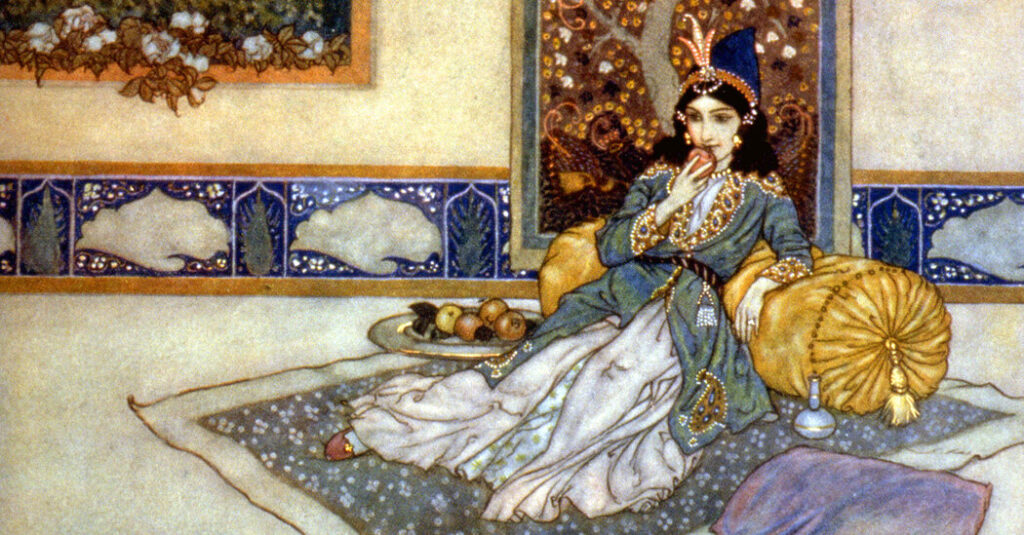
ONE ALADDIN TWO LAMPS, by Jeanette Winterson
Jeanette Winterson’s new nonfiction work, “One Aladdin Two Lamps,” takes as its framing device “One Thousand and One Nights,” the immortal set of Middle Eastern folk tales often referred to as “The Arabian Nights.”
The premise is as well known as it is disturbing: After discovering his wives’ infidelities, the Sultan Shahryar vows to wed a succession of virgins and murder each one after their wedding night. Enter the prospective bride and ingenious storyteller Scheherazade, whose wondrous tales inevitably end on a cliffhanger, staying her planned execution. In this manner, night after night, Scheherazade saves not only herself but every other virgin he wasn’t able to behead.
Winterson, a justly celebrated novelist, critic and memoirist, uses all the genres at her disposal to retell some of Scheherazade’s stories, examine them historically and personally, and extract from them lessons about life in the present moment. The result is an often insightful but finally unsuccessful book that falters under its own arguments. It’s a common misstep in these types of works — the instinct, via playful explorations of ancient or classic literature, to inject more into the text than is really there.
Born in Manchester in 1959, Winterson was given up for adoption, and her primary parental figure became her adoptive mother, whom Winterson almost always refers to as Mrs. Winterson. A Pentecostal zealot, Mrs. Winterson forbade her daughter books, scolded her for being “born bad” and saw the world “as a battleground between good and evil.”
The author, who would come out as a lesbian at age 16 and escape this suffocating household, explored her upbringing, to great acclaim, in her 1985 debut novel, “Oranges Are Not the Only Fruit,” and again in her more exacting 2011 memoir, “Why Be Happy When You Could Be Normal?” Mrs. Winterson haunts this newest work too, as a sultan of sorts, a powerful and intimate overlord her daughter must best.
How to combat Mrs. Winterson’s evangelical oppression? The same way Scheherazade did with Shahryar: by wielding the power of stories. For Scheherazade, as the author John Barth trenchantly noted, it’s publish or perish. For Winterson, books gave her direction, a beacon beckoning her to the life of a writer. Sometimes, we tell others stories in order to live.
Because that’s what “One Aladdin Two Lamps” is ultimately about: stories. Most meditations on the “Nights” end up as celebrations of storytelling, an ur-text of narrative possibility. For Winterson, stories are multivalent creatures. For example, she writes, “Biological essentialism — this is a woman, that is a man — has never been a story for everyone. For millions, it’s been a prison.”
Throughout, Winterson playfully wrests insights into human nature by using stories as a primal metaphor. “Think how many lives are lost to the ‘wrong’ story,” she commands early in the book, and all the ways in which “our lines are being written by others.” Learning to wield narrative with Scheherazade-like dexterity can lead us out of this tangle of imposed plots and into something that resembles self-actualization.
The underlying principle of a work that analyzes ancient texts in the context of the present moment must be that there is something shared between the older content (the writers, the characters, the messages) and a contemporary audience. As Winterson puts it: “Money. Power. Prestige. Sex. Fame. Glory. … It’s amazing how little humans change.”
She’s keenly aware of governmental corruption, corporate power, societal prejudices and systemic oppression, the myriad factors that perpetuate much of what keeps humans tragically stagnant. Yet her antidote to thousands of years of bad-faith heteronormative hegemony amounts to: Tell a better story. But if we’ve been telling the same stories for millenniums, what hope do we now have to suddenly amend the plot?
What’s more troubling still is Winterson’s endorsement of artificial intelligence as a path toward a better future. She wonders why “the panic around A.I. is that it will take away work,” because “wouldn’t it be better for humans only to work meaningfully, and for fewer hours?” There are so many things wrong with this, I don’t have nearly enough space to unpack it all.
Though she acknowledges the current limitations of A.I., Winterson seems strangely naïve about its potential. “The monstrous inequalities created by the machine age have widened and deepened with the digital revolution,” she writes — a fact she attributes to “a few powerful people” choosing the story. Who does she think is in control of A.I.?
Stories can certainly transform a person, a community, a world — but their magic cannot be wielded intentionally any more than a person can fall in love on purpose. Power, on the other hand, can be used deliberately and successfully to force a narrative on us. It may not be a good story, or a moral one, but it’s the one we’ve been told, in different guises and with varying promises, by those in power. A.I. is just another dismal tale told not by idiots but by crass technocrats. In this story, we, sadly, are the idiots.
ONE ALADDIN TWO LAMPS | By Jeanette Winterson | Grove | 272 pp. | $28
The post One Thousand and One Nights, and One Tumultuous Year appeared first on New York Times.