Ugandan opposition leader Bobi Wine said Saturday that he escaped a police and military raid on his home as the country awaits the results of a presidential race marred by violence and allegations of electoral interference and voter suppression.
Wine’s National Unity Platform party said Friday that the Ugandan military had forced the pop star turned politician into a helicopter and flown him to an unknown location — an account later denied by police.
“I want to confirm that I managed to escape,” Wine, who is waging his second challenge to Ugandan President Yoweri Museveni’s decades-long rule, wrote in a statement posted on social media Saturday. He said his wife and other family members “remain under house arrest” but did not reveal his current location, adding, “I am trying my best to keep safe.”
Police spokesman Kituuma Rusoke on Saturday told the Uganda Broadcasting Corporation that reports of Wine’s abduction were a “lie” and denied that Wine had left his home.
The police, military and the National Unity Platform party did not immediately respond to requests for comment. The Washington Post has been unable to independently verify the reports.
Wine, who is waging a second challenge to Museveni’s decades-long rule, has alleged widespread electoral fraud and ballot stuffing in Thursday’s election.
On Friday, Wine said Museveni’s security forces had surrounded his compound, effectively placing him on house arrest. He accused security forces of killing 10 of his supporters.
National Unity Platform spokesman Joel Besekezi Ssenyonyi told local media the same day that Ugandan military forces had cut power to Wine’s compound, scaled the fence surrounding the residence and began to break into the home. Wine said in his statement Saturday that the “commotion” and lack of access to his home had led neighbors to believe that he had been abducted.
Wine rose to fame after releasing songs critical of Museveni’s government, drawing support from the East African nation’s young demographic, though his emergence as a key opposition figure placed him in the crosshairs of Museveni’s security forces. Wine sought medical treatment in the United States in 2018, saying he was tortured by the Ugandan military while in custody following a scuffle at a political rally where in which his driver was fatally shot.
The third-longest-serving ruler in Africa, 81-year-old Museveni has led Uganda since 1986, when his guerrilla fighters seized control of the country, promising to restore democracy and promote human rights. But during his nearly 40-year rule, Museveni has scrapped presidential age and term limits, jailed political rivals and ordered violent crackdowns on anti-government protests in an effort to tighten his grip on power.
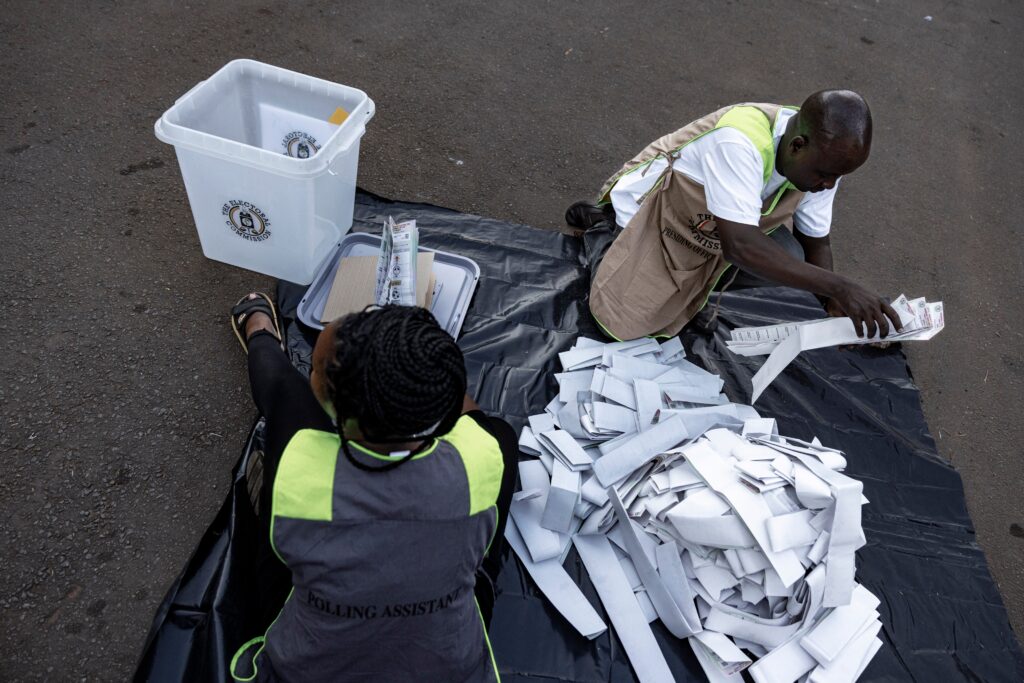
Museveni has secured 73.72 percent of the votes so far, according to preliminary results from the country’s electoral commission. Wine trails with just 22.66 percent of the votes.
In the weeks leading up to Thursday’s contest, Ugandan security forces fired tear gas and pepper spray into crowds attending opposition rallies and beat rally-goers, subjecting some to arbitrary arrests and torture, according to Amnesty International.
On Tuesday, two days before Ugandans were scheduled to head to the polls, Museveni’s government cut off internet and phone lines, according to the monitoring group NetBlocks. The Uganda Communications Commission said in a notice that it had decided to temporarily suspend internet access and some mobile services to the country’s some 45 million people in an effort “to mitigate the rapid spread of misinformation and disinformation, curb risks of electoral fraud, and prevent incitement to violence.”
NetBlocks director Alp Toker confirmed in an email early Saturday that internet in the country had been disrupted for 92 hours, impacting “most connectivity available to the general public.” He added that Uganda imposed the same measures during its last elections in 2021.
Election day in Uganda got off to a chaotic start Thursday, with residents waiting in line for hours to cast their vote. At polling stations across the country, officials resorted to using paper registration records to manually verify voters after biometric machines failed.
Wine first challenged Museveni’s rule in 2021. During that contest, Museveni cast Wine as a destabilizing figure and ordered the government’s security forces to crack down on his political rallies with deadly force. Uganda’s security forces arrested Wine three times over the course of that race. They also arrested his lawyer and at least 600 of his rally-goers, and killed his bodyguard.
Though Wine only secured a third of the 2021 vote according to the official tally, Museveni received his smallest vote share since his first electoral campaign three decades ago, according to the Associated Press.
The post Ugandan presidential candidate says he escaped raid as police deny claims appeared first on Washington Post.