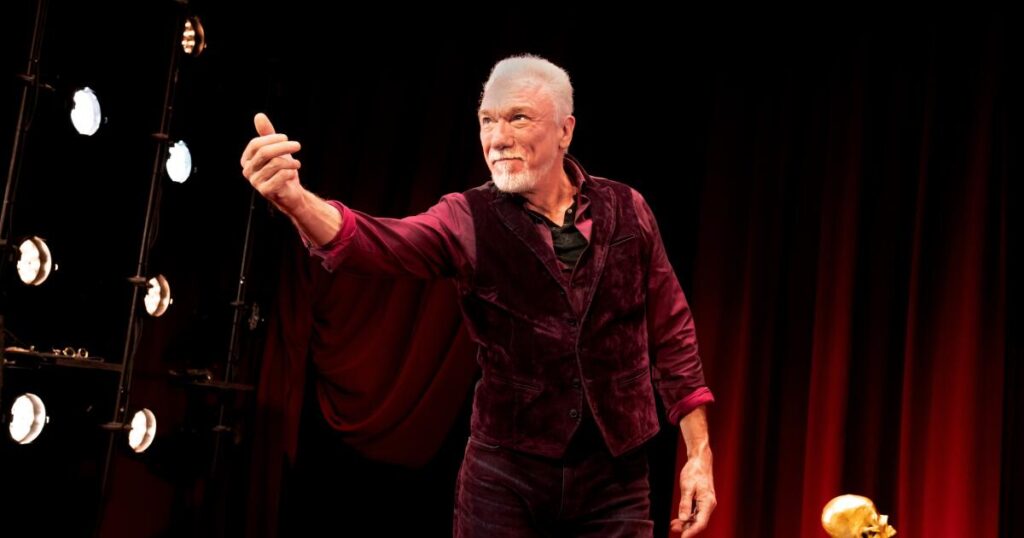
There’s something refreshingly 19th century about Patrick Page’s traveling Shakespeare seminar, “All the Devils Are Here,” which opened Thursday at BroadStage in Santa Monica.
The show, a touring tutorial he created and performs solo, allows Page the opportunity to animate with barnstorming crackle a rogue’s gallery of Shakespearean scoundrels. Villains come quite naturally to this stage veteran, who might not smack his lips when impersonating evil, but he certainly doesn’t stint on the flamboyant color. An American Shakespearean who can hold his own with the Brits, he combines mellifluous diction with muscular imagination.
Page received a Tony nomination for his performance in the musical “Hadestown,”in which he played Hades, ruler of the underworld, with a sexy, tyrannical malevolence and a voice so deep it resonated as darkly as Leonard Cohen’s. And he’s had prior success creating outlandish villains on Broadway with the Grinch and, from “Spider-Man: Turn Off the Dark,” Norman Osborn/Green Goblin.
But Shakespeare has long been a touchstone. He’s dedicated himself to the work, as was evident in his triumphant turn in the Shakespeare Theatre Company’s 2023 production of “King Lear” in Washington, D.C., directed by Simon Godwin. The producers of which had the good sense to stream worldwide for all of us outside the nation’s capital who wanted to experience the thunderclap of Page’s Lear.
Godwin, the artistic director of the Shakespeare Theatre Company and an associate director of the National Theatre in London, leaves little distance between Page and the audience in his staging of “All the Devils Are Here.” The direct-address simplicity of the production serves the fluidity of Page’s performance. The actor transitions from talking about the characters to becoming them with just a shift in his posture and vocal tone.
Proximity is the point. Shakespeare’s bad guys, with a few notable exceptions, are quite like you and me, which is to say they are human. Their worst deeds are the product of desires and fears that aren’t foreign to any of us. We might not be capable of atrocities, but in our dreams we’re all occasionally raving lunatics, giving vent to feelings we keep buried away in the light of day.
Page makes the tendentious claim that Shakespeare invented the villain, then walks it back to explain exactly what he means. His thesis is that Shakespeare early in his playwriting career followed the prevailing models of villainy. These vicious and vindictive antagonists tended to be outsiders, Jews (in the case of Christopher Marlowe’s “The Jew of Malta”), Moors (such as Aaron the Moor in Shakespeare’s “Titus Andronicus”) or the physically deformed (most notably, Richard, Duke of Gloucester, who first appeared in Shakespeare’s “Henry VI” and proved to be such a hit that he was given his own play, “Richard III”).
We get a taste of these Machiavels, who have none of the misgivings about vengeance that will plague Hamlet. Page portrays them without much introspection. They tell you what they’re going to do and then they bloody well do it. They can be scathingly ironic, alert to every hypocrisy that corroborates their cynical worldview, and even seductive in a perverse, power-mad way.
For these reasons, they are, like the arch-villains of “Batman,” the most entertaining characters in their stories. This lawless crew shares dramaturgical DNA with the vice figures from medieval morality plays, personifications of sinfulness who would confide their schemes to the audience and make theatergoers their co-conspirators in a riveting game that obviously left its mark on a young Shakespeare.
Iago, one of Shakespeare’s greatest villains, is an updated version of this stock character. Page consults Martha Stout’s book “The Sociopath Next Door” to understand the character’s lack of empathy and remorse. But then he enacts the scene in which Iago subtly poisons Othello’s mind into believing that his wife is having an affair with a handsome lieutenant. Sociopaths like Iago may be an empty shell of evil, but they can also be ingenious manipulators. Shakespeare put all his understanding of human nature into Iago’s brainwashing master class.
But before Page reaches Iago, he spends time with Shylock from the “The Merchant of Venice.” Shakespeare humanizes the Elizabethan stage stereotype of the villainous Jew by giving Shylock ample reason for wanting to get back at his Christian persecutors. Marlowe treats Barabas in “The Jew of Malta” as a farcical demon, but Shakespeare has Shylock ask, “Has a Jew not eyes? … If you prick us, do we not bleed?”
Yes, Shakespeare is having his cake and eating it too. But Page’s portrayal, perhaps the most complete in his gallery, makes a convincing case of the playwriting leap forward.
From “Hamlet,” Page gives us Claudius on his knees praying for pardon he knows he doesn’t deserve. (“May one be pardoned and retain the offense?” he asks himself, already knowing the answer.) Here we see that even the most sealed-off conscience can be invaded by second thoughts.
Lady Macbeth has no such qualms when she’s summoning evil spirits to unsex her in “Macbeth.” She knows conventional morality is a liability and begs these forces “to stop up the access and passage to remorse” so that nothing will impede the murderous plot that’s brewing within her.
To establish the right note of terror on a fog-strewn set by Arnulfo Maldonado that resembles the private chamber of a writer or madman, Page begins with Lady Macbeth’s chilling incantation. He returns to the tragedy later in his survey after guilt has alienated the Macbeths from each other and they find themselves trapped in a nightmare of their own making.
King Lear mournfully wonders, “Is there any cause in nature that makes these hard hearts?” Shakespeare can’t explain evil, but he can look at it directly. And what he sees, Page argues, is our own reflection — humanity, in all its fractured and flailing self-destructive foolishness.
The case Page smoothly makes is a convincing one. He is a pliant enough actor to daub each portrait with just enough psychological color. It’s not easy to do justice to such complex roles in quick succession. The genius of these troubling characters is embedded in their full dramatic contexts, requiring more than rhetorical flourishes and vocal modulations to bring them to life.
But by collectively presenting them in such a vivid and intelligent manner, Page urges us to see these devils for what they are — an inextricable part of our collective story, as any perusal of the day’s political headlines will disturbingly attest.
The post Patrick Page finds Shakespeare’s villains disturbingly human in ‘All the Devils Are Here’ appeared first on Los Angeles Times.