The first warning sign might be quiet moves by Beijing to move financial assets away from Western countries that might freeze them in a war. A second might be patriotic campaigns in China calling on citizens to donate blood.
Then, amid troop movements and debates about whether these constituted a genuine threat or were a bluff, cyberattacks might disable a chunk of Taiwan’s electrical grid and banking system, and the island’s internet service would grow sluggish because of sabotage of undersea cables linking Taiwan to the world.
Missiles would strike the presidential office and military and intelligence sites in an attempted decapitation, and perhaps also American bases in Japan and Guam to keep American forces from riding to the rescue. Chinese ships would blockade Taiwan, with a special focus on keeping the United States and Japan from providing assistance.
That’s an extreme version of what an initial Chinese attack to take over Taiwan might look like, drawn from conversations with military planners and from a forthcoming book, “Defending Taiwan,” by Eyck Freymann of Stanford University.
Pentagon strategists worry about such invasion scenarios, for that’s their job. But Taiwan officials are (rightly, I think) more focused on “gray zone” moves on Taiwan that fall short of war. An all-out invasion of Taiwan by China might well fail — that’s why I’m skeptical that it will happen in the next few years — but gray zone pressures today pose a daily challenge and are likely to grow. And they, too, risk escalation into all-out war that pulls in the United States.
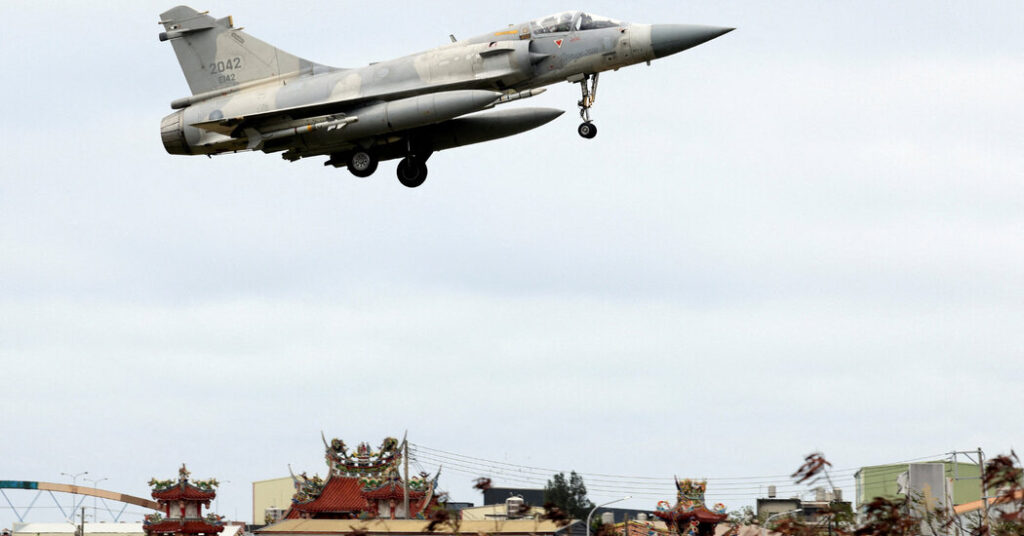
In this gray zone, China is already mounting cyberattacks, cutting internet cables and sending planes and ships toward Taiwan. It also holds live-fire military exercises, most recently a couple of weeks ago, to try to bully the island into accepting a future as some kind of autonomous zone under China’s oversight. One metric of the gray zone: In 2025, China undertook an average of 2.6 million cyberintrusions per day against Taiwan’s infrastructure, according to a new Taiwan government report.
If President Xi Jinping of China wanted to dial up the pressure and wear down Taiwan further without necessarily starting a war, he could impose a naval quarantine. For example, he might demand that ships stop at mainland ports like Xiamen or Shanghai for brief “customs checks” before going on to Taiwan; he might require “environmental inspections” of oil tankers bound for Taiwan. He could (disingenuously) tell countries: We agree that there is one China, so how can you object to the Chinese government conducting customs and safety inspections of cargoes bound for a part of China?
Even if some ships did not obey the quarantine, the move would raise insurance and shipping costs and undermine Taiwan’s economy.
The next step up from a quarantine would be a blockade, particularly of oil and gas, and that would probably lead to all-out war. Taiwan’s economy depends on imported petroleum products, and it has only two or three weeks’ worth of natural gas on hand. Taiwan’s future might then depend on whether President Trump were willing to order the U.S. Navy to escort ships to Taiwan to break the blockade.
The most common view among China-watchers I most respect is that war is unlikely in the next decade. But they might be wrong. The Taiwan Strait Risk Report, a consultancy, foresees a 30 percent chance of a Chinese invasion in the next five years, and a 60 percent possibility of an air and naval blockade of the island.
War would be staggeringly costly, and the United States would most likely become involved. The German Marshall Fund published a study this month suggesting that a plausible toll even for a modest conventional war that lasted just a few months (and that China lost) would claim 100,000 Taiwanese casualties, 100,000 from China and 6,000 from America.
.op-aside { display: none; border-top: 1px solid var(–color-stroke-tertiary,#C7C7C7); border-bottom: 1px solid var(–color-stroke-tertiary,#C7C7C7); font-family: nyt-franklin, helvetica, sans-serif; flex-direction: row; justify-content: space-between; padding-top: 1.25rem; padding-bottom: 1.25rem; position: relative; max-width: 600px; margin: 2rem 20px; }
.op-aside p { margin: 0; font-family: nyt-franklin, helvetica, sans-serif; font-size: 1rem; line-height: 1.3rem; margin-top: 0.4rem; margin-right: 2rem; font-weight: 600; flex-grow: 1; }
.SHA_opinionPrompt_0325_1_Prompt .op-aside { display: flex; }
@media (min-width: 640px) { .op-aside { margin: 2rem auto; } }
.op-buttonWrap { visibility: hidden; display: flex; right: 42px; position: absolute; background: var(–color-background-inverseSecondary, hsla(0,0%,21.18%,1)); border-radius: 3px; height: 25px; padding: 0 10px; align-items: center; justify-content: center; top: calc((100% – 25px) / 2); }
.op-copiedText { font-size: 0.75rem; line-height: 0.75rem; color: var(–color-content-inversePrimary, #fff); white-space: pre; margin-top: 1px; }
.op-button { display: flex; border: 1px solid var(–color-stroke-tertiary, #C7C7C7); height: 2rem; width: 2rem; background: transparent; border-radius: 50%; cursor: pointer; margin: auto; padding-inline: 6px; flex-direction: column; justify-content: center; flex-shrink: 0; }
.op-button:hover { background-color: var(–color-background-tertiary, #EBEBEB); }
.op-button path { fill: var(–color-content-primary,#121212); }
Know someone who would want to read this? Share the column.
If China succeeded in absorbing Taiwan, whether through war or peacefully through gray zone pressure and salami slicing tactics, the result would be the collapse of the first island chain that limits China’s capacity to project power in the Pacific. China might also gain the highly advanced chip fabs of the Taiwan Semiconductor Manufacturing Company — in strategic terms, the most important corporation in the world. If the fabs were disabled by war, the result would be “a global economic depression,” the Council on Foreign Relations concluded in a 2023 report.
That’s why deterrence is essential, and the United States, Taiwan and American allies such as Japan and the Philippines have a reasonable chance of deterring a serious Chinese military action if they work together.
But here’s the central puzzle of Taiwan: While the rest of the world frets about the risk of war in the strait, many Taiwanese don’t seem to. During the recent Chinese military exercises around Taiwan, for example, Taiwan’s stock index rose.
Some Taiwanese acknowledge the dangers but don’t see any point to even trying to resist China, seeing it as hopeless. When I asked an old Taiwanese friend, a journalist, what the island should do if attacked by China, she didn’t hesitate. “Surrender,” she answered.
Another old friend, a businessman, said he expected that in 10 years, Taiwan would be under China’s control, whether through war or by Taiwan reluctantly accepting a promise of autonomy under Chinese rule. (Skeptics point to what Hong Kong has endured and consider this hopelessly naïve.)
I love Taiwan. I lived here for a time in the 1980s, studying Chinese, and it has been remarkable to see the wealthy, high-tech democracy that people have built since then, a place with everything except a consensus about how to preserve all this.
Taiwan’s politics are poisoned by bitter feuds, both within each party and among them. The upshot is that compared with other places that face existential threats, such as Estonia and Israel, Poland and South Korea, Taiwan seems much less prepared. If Ukrainians are a model of political will to resist a powerful aggressor, Taiwan is closer to the opposite: Many people seem unprepared to make major sacrifices to preserve their island’s independence and freedom.
President William Lai, whom China despises, seems to appreciate the risks and has tried to increase military spending and boost military readiness. But it’s not clear whether the Taiwanese people want to be led in that direction, and his proposed supplementary military budget may not even pass the legislature.
All this raises a fundamental question: Why should Americans risk their lives and spend billions of dollars defending Taiwanese who aren’t clearly willing to make major sacrifices themselves? I asked Taiwanese officials about that.
“Taiwan’s defense is our own responsibility,” acknowledged Chen Ming-chi, the deputy foreign minister. “We have to tell our young people, defending your democratic way of living is your obligation.”
Joseph Wu, the secretary general of the National Security Council, put it this way: “We can’t ask other countries to help Taiwan if Taiwan does not help itself.”
At the same time, Wu, Chen and other officials pushed back at the idea that the island was lackadaisical about its defense. “Our fighting ability has been improving dramatically,” Wu said.
Officials noted that Lai is trying to increase military spending so that it will exceed 3 percent of G.D.P. this year and 5 percent in 2030. Taiwan has also extended mandatory military service from a pathetic four months to one year (only for men).
All this is positive but not nearly enough.
Given the stakes, a top priority for American foreign policy must be deterring China without provoking China. Deterrence means working with Taiwan, Japan and others to achieve a common front not just against an invasion but also against gray zone pressures. If deterrence failed and a war actually erupted, then it obviously would be better to win than to lose, but this might be a case where, as President John F. Kennedy once put it, “even the fruits of victory would be ashes in our mouth.”
The Times is committed to publishing a diversity of letters to the editor. We’d like to hear what you think about this or any of our articles. Here are some tips. And here’s our email: [email protected].
Follow the New York Times Opinion section on Facebook, Instagram, TikTok, Bluesky, WhatsApp and Threads.
The post How War With China Begins appeared first on New York Times.