A deadly crackdown by Iran’s government appeared to have largely suppressed protests that began almost three weeks ago over economic woes but that broadened into a mass movement challenging the country’s authoritarian clerical rulers.
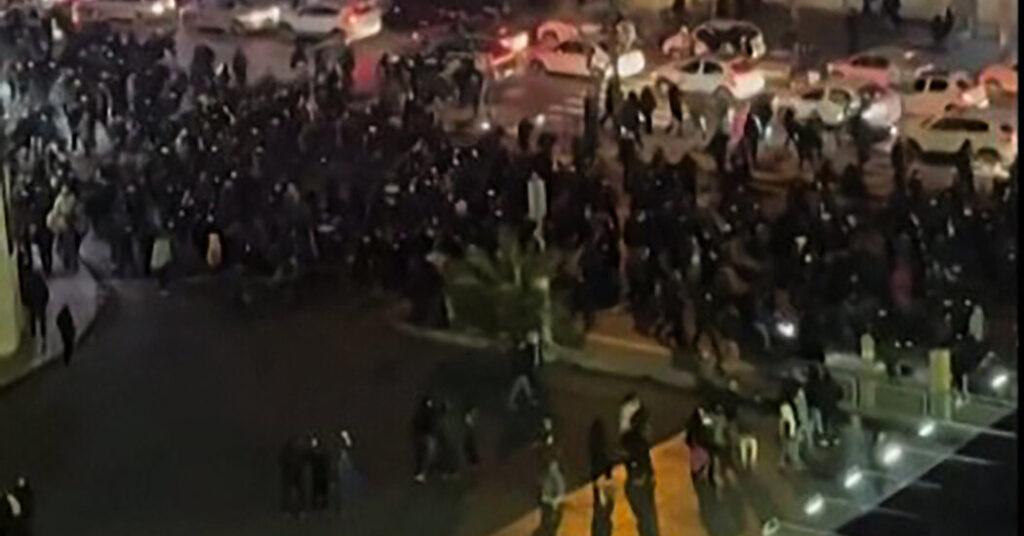
An ongoing communication blackout has made it difficult to independently assess what is going on inside Iran. But according to several witnesses and a human rights group, the streets of Tehran, the capital, have largely been quiet of protests in recent days.
The demonstrations were brutally repressed by Iranian authorities. Thousands of people have been killed after government forces fired on protesters in cities across the country, according to eyewitnesses and human rights groups.
President Trump had repeatedly threatened to strike Iran to try to deter its leaders from killing more protesters, and amid those threats, Iranian authorities appeared to backpedal on previous statements that suggested protesters would face the death penalty.
Mr. Trump said on Wednesday that he had been told executions would not go ahead and that the killing in Iran had stopped, without offering further details.
But analysts say that the Iranian government is increasingly trying to draw a distinction between ordinary protesters and those whom it calls rioters and terrorists, backed by foreign powers. That nuance of messaging, the analysts said, was intended to put pressure on citizens and dissuade them from protesting.
Why have Iranians been protesting?
Iran’s economy has been under sustained pressure for years, largely as a result of U.S. and European sanctions tied to its nuclear ambitions. A 12-day war with Israel this past June, which the United States joined to bomb Iranian nuclear facilities, further drained the country’s financial resources.
When the currency plunged against the U.S. dollar in late December, amid persistently high inflation, merchants and university students staged days of protests.
As the rallies grew, the protests became a broader criticism of the rule of Iran’s theocratic government. Across social media and television, protesters were seen chanting slogans including, “Death to the dictator” and “Iranians, raise your voice, shout out for your rights.”
Demonstrations spread to dozens of cities across Iran, according to tracking by the U.S.-based Institute for the Study of War.
How deadly have the protests been?
Human rights groups have struggled to reach their contacts inside Iran and follow the methodology they normally use to verify information. Internet and cellular networks have been shut down by the authorities, and information has been scarce, often flowing through a network of activists using Starlink satellite internet systems.
Still, human rights groups say they have counted thousands dead.
More than 2,600 people have been killed since the protests began, according to the U.S.-based Human Rights Activists News Agency. Iran Human Rights, a group based in Norway, said that more than 3,400 people had been killed and thousands of others injured.
Witnesses have described seeing security forces firing on unarmed demonstrators at close range and snipers firing into crowds from rooftops in downtown Tehran. Videos uploaded by opposition activists on social media have shown families sobbing as they huddle together over bloodied corpses in unzipped bags, while footage aired on Iranian state television has shown body bags arranged on the floor of a morgue.
The government initially signaled a willingness to listen to protesters. Earlier this month, it announced plans to provide most citizens with a monthly payment equivalent to about $7. Yet Iranian officials then hardened their stance, an echo of previous rounds of unrest when the authorities used mass arrests and violence to suppress demonstrations.
The brutal crackdown appears to have had a chilling effect on the demonstrations. Witnesses and videos verified by The New York Times suggest that security forces have been widely deployed in Tehran and other cities.
There have been no large-scale protests documented in Iran since Sunday, according to Arina Moradi and Mina Khani, members of the Norway-based Hengaw Organization for Human Rights, which has been monitoring the demonstrations since they began.
An Israeli defense assessment also found that the scale of protests had noticeably declined since Sunday, after the Iranian forces’ escalating use of live ammunition and the internet blackout, according to two Israeli officials who spoke to The Times on the condition of anonymity to discuss sensitive matters.
How has the United States reacted?
Iran’s government is weakened on the international stage and dealing with the fear of another round of U.S. or Israeli military strikes. Threats from Mr. Trump have been especially resonant after the capture of Venezuela’s president, Nicolás Maduro, earlier this month.
Mr. Trump has said that the United States is “locked and loaded and ready to go” if the Iranian government used lethal force against demonstrators, but he has yet to follow through on that threat.
Democratic and Republican lawmakers have expressed wariness about American interference in Iran, which would most likely lead to a forceful reaction from Iranian authorities, possibly by targeting U.S. and Israeli military bases.
Israel and Arab nations have asked Mr. Trump to postpone any plans for an American attack on Iran, amid fears it could lead to a wider regional conflict.
Mr. Trump has also left the door open to diplomacy with Iran, but it is unclear what ground any negotiations would cover. Talks on Iran’s nuclear program have stalled.
Karoline Leavitt, the White House press secretary, said on Thursday that Mr. Trump and his team were “closely monitoring the situation” and that “all options remain on the table.”
Aurelien Breeden and Sanjana Varghese contributed reporting.
Abdi Latif Dahir is a Middle East correspondent for The Times, covering Lebanon and Syria. He is based in Beirut.
The post Here’s What to Know About the Protests in Iran appeared first on New York Times.