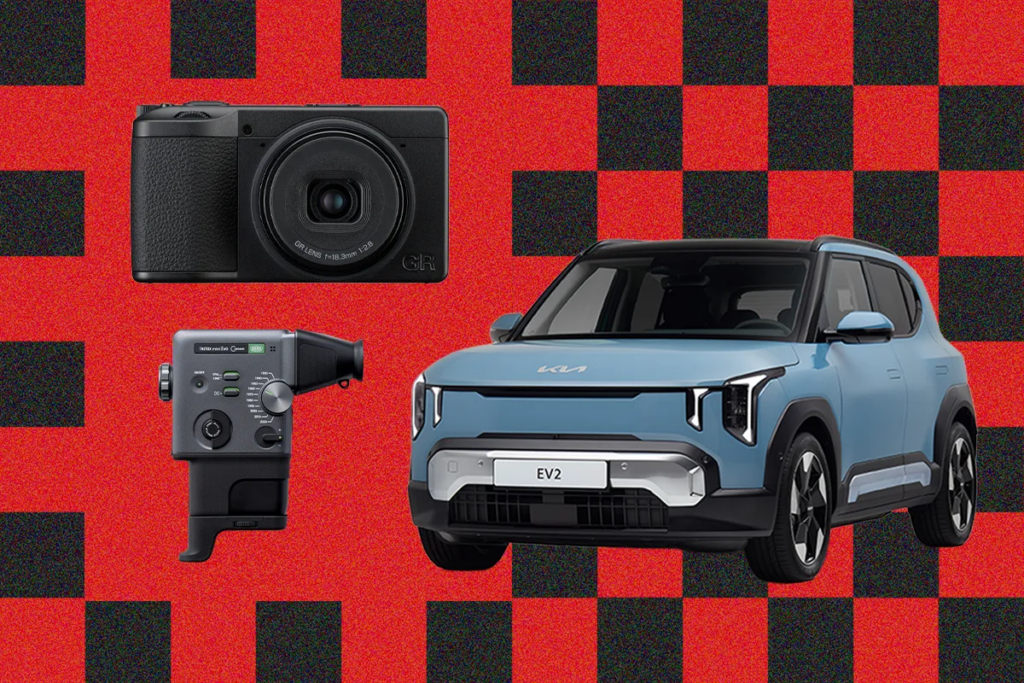
This week at the Brussels Motor Show, Kia unveiled its most important EV for 2026, the diminutive EV2, a shrunken version of its supersized SUV, the EV9. Kia has managed to make the boxy design endearing, making the electric vehicle appear ready for any urban adventure you wish to throw at it.
Being an entry-level electric car, the EV2 will apparently retail somewhere around $32,000, but don’t be fooled by the price or small size (it’s barely more than 13 feet long)—the top-spec version will have a 61-kWh battery that should be good for just shy of 280 miles. Meanwhile, the 400-volt e‑GMP platform lets you recharge in 30 minutes from 10 to 80 percent.
This is a city car, so adjust your performance expectations accordingly. Still, the EV2 is good for 144 horsepower, a zero to 60 mph time of 8.6 seconds, and a top speed of 99 mph—more than enough for school and supermarket runs, as well as freeway missions.
Wireless Apple CarPlay and Android Auto are standard, and the quality interior continues with USB-C charging ports alongside a domestic plug socket, lots of storage, a triple‑screen infotainment setup, seating available in four‑ or five‑seat layouts, and a maximum of 403 liters of trunk space. With all this in such a small package, the EV2 should do very well for Kia. —Jeremy White
Fujifilm Debuts an Instant Video Camera
Fujifilm has announced two new Instax instant cameras and printers: the Mini Link+, a printer, and the Mini Evo Cinema hybrid instant camera, which looks something like a Super 8 film camera from the 1970s.
The Mini Link+ is a straightforward update to the Mini Link smartphone-to-printer line, with many of the same features, including the ability to add text, graphics, illustrations, and more to your images, along with different frame options. The outer design is different in the Link+, though, with a boxy look reminiscent of some external hard drive cases I’ve used.
The Mini Evo Cinema is far more interesting, bringing video to the Instax line. It can shoot up to 15-second clips, which you can then share via a QR code printed on an Instax print. The same process has been around for a while with other Instax cameras, like the recently released Mini LiPlay+, though until now, these have only relied on audio or videos made from stills. Fujifilm says the design is based on the Fujica Single-8 camera. A particularly nice touch is the way the Instax logo has been done to mimic the old cine camera logos.
The Mini Evo has what Fujifilm is calling an “Eras Dial” that lets you style your images to look like the 1930s, ’40s, ’50s, and so on up through 2020. Depending on your age, you will likely find this appealing or cringe-inducing. I tend toward the latter camp, but some of these are actually quite well done based on the prints Fujifilm has shared. The 1930s setting does a nice job of mimicking the soft black and white look of cinema in that era (if you’re not familiar, watch Angels with Dirty Faces).
The Mini Evo Cinema camera will be available in early February 2026 for $410. You can preorder it right now. —Scott Gilbertson
Ricoh Has a New Monochrome Camera
Ricoh unveiled a new Monochrome GR IV camera, which comes on the heels of the new, full-color GR IV released late last year. Aside from Leica, Ricoh is the only other company making black-and-white cameras, like the monochrome version of the Pentax K-3.
It might seem strange to buy a camera that can only shoot black-and-white when you can take the output of a color sensor and convert it to black and white afterward. But having shot with both the K-3 monochrome and the Leica M10 Monochrome, I can vouch that there is definitely a better tonal range from a monochrome sensor compared to converting in post. If you’re a dedicated black-and-white shooter, it’s worth considering. I really like the idea of a pocketable monochrome camera that doesn’t have a Leica price attached to it.
Gear Roundup
All the top gear news of the week in one place. Here’s more you may have missed this week:
New Proposed Legislation Would Let Self-Driving Cars Operate in New York StateHundreds of Millions of Audio Devices Need a Patch to Prevent Wireless Hacking and TrackingMeta’s Layoffs Leave Supernatural Fitness Users in Mourning
The GR IV monochrome is essentially the same camera as the GR IV—same lens, same internals aside from the sensor. Inside the GR IV is a 26-megapixel sensor with no color filter array. Based on my experience with other monochrome sensors, you can expect marginally less shadow noise and slightly better high ISO performance compared to the color version. I especially like that there will be an optional built-in red filter for upping contrast.
The big downside is that the monochrome GR IV costs $2,200, a full $700 more than the color version. You can preorder one today, and the camera should ship around the middle of February. —Scott Gilbertson
Fender Rebrands PreSonus App
Big news for guitarists and fans of home recording: After having purchased PreSonus in 2021, Fender has decided to rebrand the music production software previously known as PreSonus Studio One as Fender Studio Pro.
The move comes in addition to several native amplifier and effects pedal models that are now included in the re-skinned app, as well as a few other features that should keep longtime Studio One users (like yours truly) happy. I am very excited about the new timeline view at the top of the screen, for example, which makes it easier to track where I am in the context of the overall track when recording overdubs.
The name makes everything easier to understand for Fender users, who can use the Fender Studio app (akin to GarageBand) on their tablets and mobile devices, then easily export it to Fender Studio Pro for more in-depth recording. It also makes Fender the only major instrument manufacturer that owns its own top-tier recording software.
I have been testing a preview version of the software for several weeks and have been impressed with the update’s streamlined looks and added functionality, though admittedly, I am not the biggest power user out there. —Parker Hall
Omega’s New Speedmasters
After the much-admired white-dial Speedmaster Professional in 2024, Omega clearly feels that now is the time to give its most iconic wristwatch a new “reverse-panda” makeover. Instead of a classic “panda” design of white dial and black sub-dials, the aesthetic is switched (hence the name), and it’s just the sort of style tweak that makes collectors come running.
Landing in 18-karat yellow gold ($49,300) and a more attainable steel version ($10,400), these two new Speedys are essentially identical to Omega’s current Moonwatch models, apart from ceramic bezels and those reverse-panda dials, which actually consist of two layers. This means that the recessed sub-dials are now positioned slightly deeper in the dial. The dial also has a glossy, varnished, and lacquered (with more than 20 layers) finish to create a sheen. Both have the caliber 3861 inside, offering up resistance to magnetic fields of up to 15,000 gauss and a 50-hour power reserve.
Yes, this certainly isn’t a radical redesign from Omega, but, with the Rolex Daytona firmly in its sights, releases such as this further the brand’s more upmarket ambitions—the lower cost reverse-panda, after all, marks a steel Moonwatch stepping over the $10K threshold for the very first time. —Jeremy White
The post Gear News of the Week: Kia Shows off the EV2, and Fujifilm Debuts New Instax Cameras appeared first on Wired.