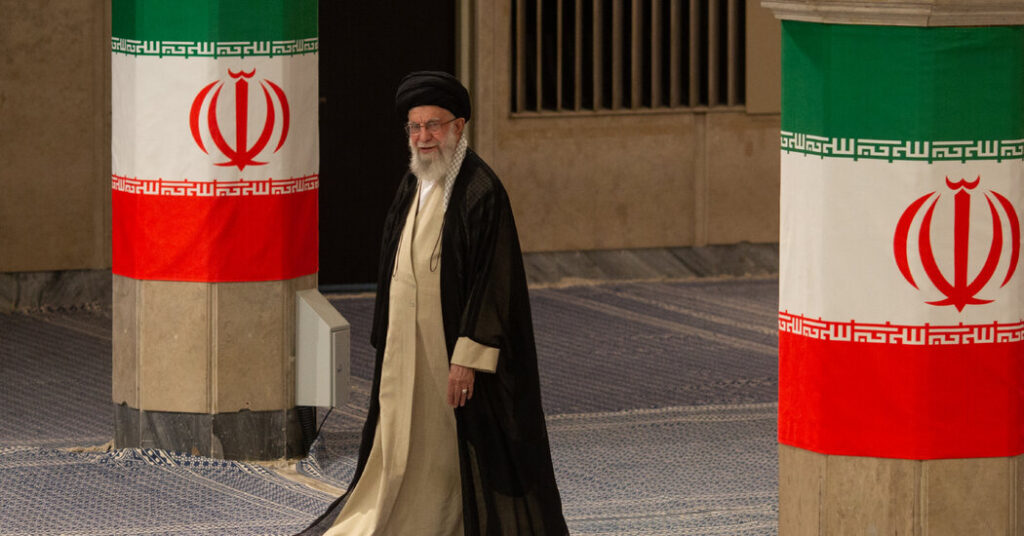
During the 12-day war with Israel and the United States last June, Iran’s supreme leader reportedly retreated to a bunker beneath his sprawling compound in central Tehran, avoiding public appearances and all electronic communication.
That bunker mentality resonates with many Iran analysts as a metaphor for the 37-year rule of Ayatollah Ali Khamenei, 86, over the Islamic Republic. He has created a static, authoritarian system resistant to change. The twin pillars of that system remain his ideological fixations — the refusal of any political or social changes that might dilute the power of the regime, and implacable enmity toward the United States.
“He is an obstructionist; I do not see him late in life compromising on ideology and his legacy,” said Sanam Vakil, the director of the Middle East and North Africa Program at Chatham House, an international affairs think tank in London. “Whatever it takes to stay in power down to the last Iranian, he’s very keen to keep this system intact, and sees it as an existential and ideological struggle.”
For more than 25 years, each new round of nationwide protests, which in recent times have erupted with increasing frequency, has been met with ever more brutal repression. Thousands of protesters have been shot dead on the streets or imprisoned and at times executed. The latest killings, along with the anticipated start of hanging protesters after summary trials, prompted President Trump to threaten American military intervention.
Although the protests and hence the bloodshed have slowed in recent days, the U.S. threat created a dilemma for Ayatollah Khamenei and his enforcers, analysts said. Escalating repression might prompt an American attack, but allowing the protests to grow could present a real challenge.
In either case, the situation is likely to widen the yawning gulf between the government and the Iranian people.
Enemies, Enemies Everywhere
Few expected Ayatollah Khamenei to show restraint for long.
“He sees compromise as an avenue to further weakening and unraveling of the Islamic Republic,” Ms. Vakil said. “Of course, the irony is that his inability to compromise is also leading to the weakening and unraveling of the Islamic Republic.”
Ayatollah Khamenei’s default argument has long been that Iran’s problems, and certainly any instability, are caused by enemies at home, or especially abroad, intent on destroying the country.
“The enemy’s plots must be recognized,” he said in public remarks during the first week of the current unrest. “The enemy does not rest.”
Among other issues, he described the volatile swings in the foreign exchange rate that helped prompt the demonstrations as “the work of the enemy.” Sometimes he says the enemy is “world arrogance,” a favored pseudonym for the United States, or Israel, which he has called “a cancerous tumor that must be removed.”
Mr. Khamenei’s predecessor, Ayatollah Ruhollah Khomeini, remains the symbol of the 1979 revolution that overthrew the shah and ushered in the Islamic Republic.
He established the regime’s abiding intolerance, fomenting terror against any challengers, first with mass executions of officials from the shah’s reign and then by turning on his leftist allies. Ayatollah Khomeini described protests against his rule as a war on God, condemning opponents as “wild animals” who deserved to be shot.
Guardian of the Revolution
When Ayatollah Khomeini died in 1989, Mr. Khamenei, a protégé who had been president of Iran since 1981, emerged as the consensus candidate for supreme leader. He had been jailed six times under the shah and had lost the use of his right arm after a failed assassination attempt.
As a mid-ranking cleric, Mr. Khamenei lacked the exalted religious credentials required for his new role. So the clergy quickly anointed him an ayatollah, and in 1994 elevated him to the status of marja, or a source of emulation for all Muslims. He also carries the title Vali Faqih, meaning the most senior guardian of the Shiite Muslim faith. He has not left the country in decades.
Ayatollah Khamenei was conscious of his lower religious status. “I am an individual with many faults and shortcomings,” he said at the beginning of his rule. “I am truly a minor seminarian. However, a responsibility has been placed on my shoulders, and I will use all my capabilities and all my faith in the Almighty in order to be able to bear this heavy responsibility.”
He set about concentrating sweeping power in his own hands, giving him the last word in all matters of state in order to safeguard the revolution and the vision of Ayatollah Khomeini.
Ayatollah Khamenei controls the judiciary and appoints the head of state television, as well as the men on the Guardian Council that vets election candidates. He names the ministers running key national security departments including interior, defense, intelligence and foreign affairs.
He has fostered Iran’s nuclear program while denying that Tehran is pursuing weapons, and built the system of regional allies that crumbled over the past two years with the collapse of the regime of Bashar al-Assad in Syria and the decimation of Hezbollah in Lebanon.
Ayatollah Khamenei alone appoints the commanders of the Revolutionary Guards Corps and the Basij, the powerful armed forces established as a kind of separate militia to preserve the revolution.
He has also expanded those forces while creating a rotating inner circle of men whose backgrounds mirrored his own — lesser clerics and military commanders.
Although the system is opaque and difficult to analyze, his apparatchiks have remained deeply loyal. They have not broken publicly with him despite the government’s many economic and military failures.
Resist, Repress, Repeat
That solidarity means repeated unrest has failed to produce any substantial cracks in the regime.
Significant nationwide protests erupted in 1999 over the shuttering of a reformist newspaper; in 2009 over presidential elections widely believed to be rigged; in the late 2010s over rising prices of basic goods including fuel; and in 2022 over the death of a woman killed in custody after being accused of not wearing a proper hijab to cover her hair.
Each flare-up amplified calls for change and even for the downfall of Ayatollah Khamenei. The last bout, titled, “Women, Life, Freedom,” also led to more women challenging the often draconian enforcement of the mandatory hijab law.
The violence against demonstrators also escalated each time.
The protests have weakened the regime, but not fatally, and it remains unable to address the social and economic issues that form the root of the public’s dissatisfaction.
Modern Iranian society has evolved to be more urban and connected to the outside world, with more educated women, analysts noted. But Ayatollah Khamenei has not changed with it.
Sweeping economic sanctions that sharply limited sales of Iran’s oil have severely contracted government spending, while rampant inflation has left the public poorer and more hostile.
Roughly 20 percent of the electorate of 61 million people remain hard-core supporters of the regime, analysts said. But they estimate that most Iranians view the supreme leader as a corrupt, murderous dictator whose animosity toward the West has left the country bankrupt and isolated.
Washington has long criticized Iran’s human rights record and portrayed the regime as a menace to its people, to the region and the wider world. Ayatollah Khamenei has always responded to the accusations by saying they are rooted in hostility over Tehran’s rejecting the hegemony of what he calls “the Great Satan.”
Through it all, he has grown increasingly paranoid about enemies both real and imagined, analysts said, and remains deeply suspicious of the threats presented by internal dissent, reform and foreign influence.
The American and Israeli attacks on Iran last June killed dozens of elite military commanders and top scientists, while also weakening the country’s nuclear facilities. Iran’s retaliatory strikes on Israel killed 32 people and injured hundreds while causing relatively minor structural damage.
Ayatollah Khamenei portrays the outcome as a victory, not least because the regime endured.
“It has been proven that the Iranian nation, by relying on its own capabilities and under the shadow of faith and righteous action, can stand firm against corrupt and oppressive arrogant powers and convey the call to Islamic values more loudly than ever before,” he said in a speech in December right before the latest demonstrations.
Kitty Bennett contributed research.
Neil MacFarquhar has been a Times reporter since 1995, writing about a range of topics from war to politics to the arts, both internationally and in the United States.
The post Iran’s Supreme Leader, Unbending Over Time appeared first on New York Times.