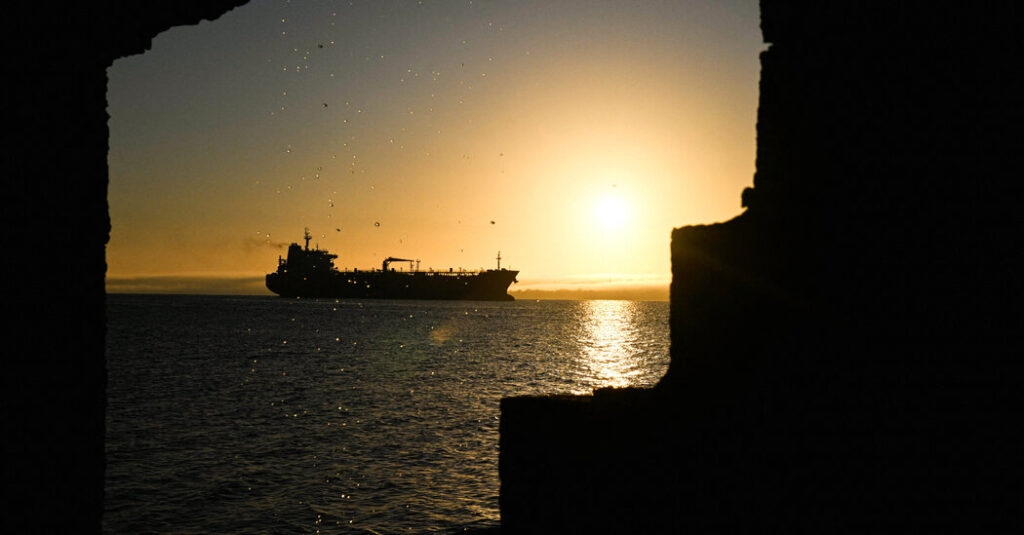
Cuba needs 100,000 barrels of oil a day to keep the lights on, experts say, and to keep its buses, trains and factories running.
But because of President Trump, it is not getting nearly enough.
With the Trump administration exerting control over Venezuela’s oil industry, Cuba is receiving only a trickle of the oil it needs — a shortage experts warn is increasingly likely to trigger a humanitarian crisis unlike any the country has ever experienced.
From diesel to operate buses to gasoline for cars to jet fuel to power airplanes, oil is in short supply in Cuba. A nation already enduring prolonged blackouts could come to a grinding halt as reserves run out, the country plunges into darkness and its economy craters, according to energy experts and economists who follow Cuba closely.
A government-run television and radio broadcaster in central Cuba announced Tuesday that it had been off the air for several days because it had run out of diesel to power its station. Without power many people also do not have running water.
More than 20 years ago, Venezuela’s president at the time, Hugo Chávez, struck a deal with his ideological ally, Fidel Castro, to provide oil and help keep Cuba afloat, though the amount has declined sharply over the years.
Lacking cash or lines of credit, Cuba compensated Venezuela by sending doctors, nurses and other professionals. Cubans were also a key part of President Nicolás Maduro’s security detail, and 32 of them died in the United States’ attack to capture him in Venezuela.
But following the U.S. raid, President Trump declared that oil shipments to Cuba would stop.
“THERE WILL BE NO MORE OIL OR MONEY GOING TO CUBA — ZERO!” Mr. Trump wrote on Truth Social.
The plan to cripple — and ultimately topple — Cuba’s government is widely seen as a dream of Secretary of State Marco Rubio, the son of Cuban immigrants.
At its peak, Venezuela sent its ally some 100,000 barrels a day. More recently, that number had dropped to about 35,000 barrels a day, experts say.
“If Cuba loses that, the impact is basically going to be catastrophic,” said Jorge R. Piñon, a former oil executive who is now a researcher for the energy institute at the University of Texas.
“The chain of events is that the Cuban economy literally collapses, there is no food in the markets, the trains are not moving, the buses are not moving,” he said.
Mexico had been sending about 22,000 barrels a day, but that figure dropped to about 7,000 toward the end of 2025, Mr. Piñon said. One shipment from Mexico of about 85,000 barrels arrived this month. Other countries, like Russia, that have at times supplied oil to Cuba, have not come to their rescue, he said.
The Cuban government has sharply criticized the United States for blocking the Venezuelan oil shipments.
Cuba’s foreign minister, Bruno Rodríguez, said Cuba had the right to import oil without interference.
“Law and justice are on Cuba’s side,” he said on X. “The US is behaving like a criminal and uncontrolled hegemon that threatens peace and security not only of Cuba and this hemisphere but of the entire world.”
Cubans are already feeling the abrupt loss of Venezuelan oil.
To avoid long queues at gas stations, the Cuban government is making people use an app to sign up for a spot in line.
Carlos Manuel Vargas, 78, a retired teacher who now works as a security guard, said his turn comes up about every two months. But since Mr. Maduro’s ouster on Jan. 3, Mr. Vargas said his place in line had not budged: He has been No. 10,231 for nearly two weeks.
Mr. Vargas’s spouse has cancer, and he needs gas to go to the hospital, so he said his only other option is buying gasoline at the much more expensive dollar-based gas stations, where lines are shorter.
“If have to sell my cellphone or my TV, I will,” Mr. Vargas said.
Cuba experienced outages even when Venezuelan oil was flowing, at least two dozen widespread, long-duration blackouts — known as W.L.D.s — in the past two years, said Juan A.B. Belt, an economist who studies the oil industry.
“The blackouts are amazing,” he said. “These are wide-area and long-duration events. They had so many — some lasting several days and quite a few covering the entire country.”
Beyond blackouts, the lack of fuel has also upended the water supply because water pumps require electricity.
A sustained oil shortage that triggers multiple hardships will almost certainly stir discontent in the country of nine million people and place new pressure on a government that has struggled to address the country’s longstanding economic challenges.
The government has responded harshly to popular unrest in the past. During the last wave of huge street demonstrations, in 2021, which was motivated by human rights abuses and pandemic-related economic problems, the government detained more than 1,400 people, according to human rights groups.
President Miguel Díaz-Canel has acknowledged the crisis and responded by railing against the U.S. government and a decades-long trade embargo that limits its ability to do business internationally.
“The very dark object of imperialist desire is Venezuelan oil,” he said in a recent speech.
Mr. Díaz-Canel, a former minister of higher education, party leader and vice president, became president in 2018. He took over from Raúl Castro, the brother of Fidel Castro, a socialist icon who died in 2016. He is the first person outside the Castro family to lead Cuba since its 1959 revolution.
Born in 1960, Mr. Díaz-Canel is not as respected as many older party leaders and is widely believed to hold little sway over his own nation’s affairs. Raúl Castro, 94, still has considerable power over government as well as the powerful military, which manages the economy.
Mr. Díaz-Canel’s tenure in office “almost exactly overlaps with utter economic, logistical, health, migratory, social and political catastrophe,” said Ted Henken, a Cuba scholar at Baruch College in New York. “Cubans associate him with the crisis of the last five years.”
The real power in Cuba rests with GAESA, Cuba’s military-controlled conglomerate, and with the state security agency — not with the president, Mr. Henken said.
The closest parallel to what Cuba is now facing took place 35 years ago when the Soviet Union collapsed, which also meant the end of oil shipments and tumbled Cuba into a major economic crisis known as the “special period.”
That crisis eased after Cuba discovered oil fields of its own, opened the country to tourism and eventually began receiving oil from Venezuela.
But the tourism industry, hit by sanctions by the Trump administration, has never recovered from pandemic shutdowns, and domestic oil production amounts to only about 40 percent of Cuba’s oil needs.
The number of tourists visiting Cuba has declined 68 percent compared with 2019, said Emilio Morales, an economist who owns a consulting company that specializes in Cuba. Cuba invested heavily in tourism, but wound up with white elephant hotels that sit largely empty, he said.
Experts note that the Communist government survived the grim days after the Soviet Union’s dissolution, and it would be premature to predict its collapse now.
Despite the Trump administration’s desire to weaken Cuba’s government, the United States, for now, will not pressure Mexico to reduce or cut off shipments to Cuba to avoid worsening conditions there, according to an administration official who was not authorized to speak publicly.
The Trump administration does not believe the Cuban government has much oil in storage, the official said, and is concerned that the government will use whatever oil it does have on hand to keep its intelligence and security apparatus going.
The State Department recently announced it was sending $3 million in humanitarian aid through the Catholic Church to areas in Cuba affected in the fall by Hurricane Melissa.
Asked whether the Trump administration was risking setting off a humanitarian crisis by cutting off Venezuelan oil shipments, Jeremy P. Lewin, an acting under secretary of state, said that those shipments never benefited Cuban people — an argument belied by those experiencing blackouts in Cuba.
Mr. Trump urged the Cuban government to “make a deal” or suffer the consequences.
“Don’t play games with this president,” Mr. Lewin said.
Carlos Fernández de Cossio, Cuba’s deputy foreign minister, said the United States was making “apocalyptic threats” while Cubans were in the street honoring the 32 intelligence and military officers who died in the U.S. attack against Venezuela.
“There are clear miscalculations,” he wrote on X.
While the two nations’ governments engage in a war of words, Cubans are left in increasingly dire straits.
“It’s been ages since I got my turn to buy gas,” a user of the queuing app, Maritza Fernández, posted last week on it. “How long do I have to wait?”
David C. Adams contributed reporting from Florida, Hannah Berkeley Cohen from Curaçao, and James Wagner from Mexico City.
Frances Robles is a Times reporter covering Latin America and the Caribbean. She has reported on the region for more than 25 years.
The post Can Cuba Survive Without Venezuela’s Oil? appeared first on New York Times.