It’s been an unusually long time since a cast member from “Saturday Night Live” went on to become a superstar.
Pete Davidson got close, helped by the power of tabloid chatter, but his momentum didn’t really accelerate when he moved into movies. (Next stop: podcasting.) Kate McKinnon has been dynamic in a few blockbusters (“Barbie,” “A Minecraft Movie”), but they weren’t exactly star vehicles for her. Shane Gillis did become an arena act after getting fired by the show, but that’s no repeatable route to success.
Is this just an unlucky streak for the comedians from one of the premier launchpads in popular culture? Or does it say something broader about the entertainment ecosystem, the decline of big-budget studio comedies or buzzy network sitcoms?
It’s unclear, but the career of Marcello Hernández will be an interesting test case. Powered by the success of his lothario character Domingo, he has become the breakout star of the current cast. And judging by his just-released debut comedy special, on Netflix, he exudes not only leading-man charisma but also a Glen Powell-like hunger for winning the game of showbiz success.
Start with the title: “American Boy.” This is not a choice trying to be clever or unusual. “American” (possibly the most common word in the history of titles) signals symbolic heft and mass appeal. And “boy” is generic while hinting at one of the most powerful commercial tools deployed early and often in this ingratiating special: nostalgia.
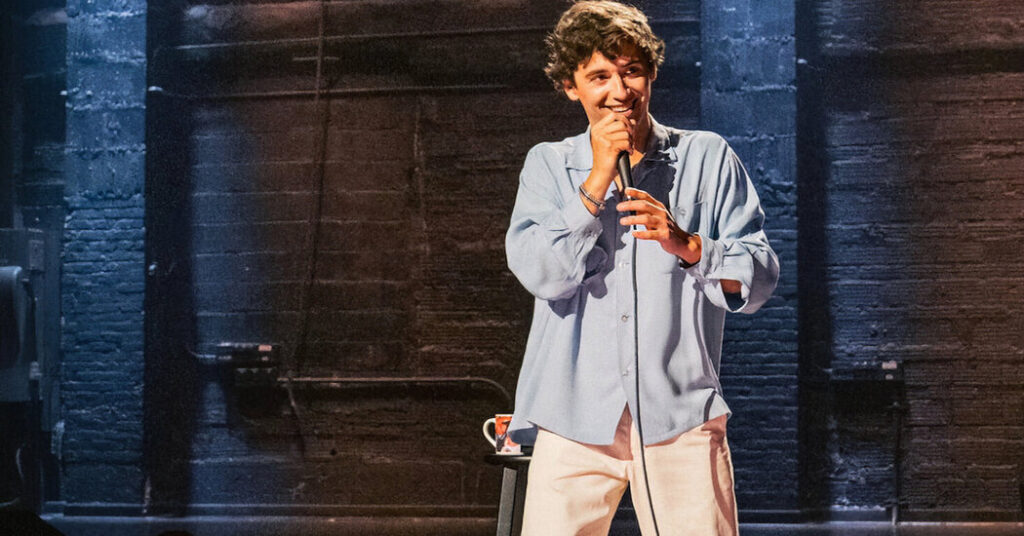
His hair flopping just above his anime eyes, Hernández, 28, looks and moves like an overgrown, overcaffeinated kid. His deep, growly voice takes you by surprise and his face is perfect for caricature, though what quality to emphasize for cartoonish exaggeration would be a tough choice between his puckered lips and his sparkly smile. There’s a Looney Tunes quality to Hernández’s persona that is fun to be around.
That’s before you get to the schmaltz. His show begins and ends with his mother, a Cuban immigrant who fled the country as a child and raised Marcello and his sister by herself. She introduces him to the stage, then joins him for a warm embrace; she hugs him at the end, too. It’s become increasingly common for family members to join popular comedians onstage (see Jim Gaffigan, Nate Bargatze, Leanne Morgan).
In this case, the embrace plays a key role in the hour, much of which involves jokes about what it’s like to be raised by a disciplinarian who is, say, quick to hit her son in a public bathroom. The hugs soften these stories and tell you he appreciated the tough love.
The special should really be called “Mama’s Boy.” He quickly breaks into dance but then tells us that when he was a boy at family parties, this was coerced. His mother insisted that he entertain relatives. “I didn’t want to escape Cuba,” she told him. “So dance!”
Then Hernández turns the knob on the wattage of his gleaming grin to look a little more forced than usual, still warm but also unnerving. In different hands, this could be a dark “star is born” story about a stage mother’s command to dance through pain.
But Hernández doesn’t do grim. His description of Latin music — as a happy beat even with the saddest lyrics — applies to his comedy. He’s no tell-it-like-it-is wise guy. His childhood stories emerge from the perspective of a baffled, disoriented innocent, recalling a weird uncle who wants to show you a cockroach and another uncle offering some whiskey.
The lines are delivered with a goofy sweetness and physical exuberance that put you in mind of Eddie Murphy describing kids hearing the ice cream truck in “Delirious,” a stand-up special that helped rocket that charmer from an earlier “S.N.L.” into stardom.
Hernández also projects a certain confidence and sex appeal that makes it easy to imagine him in a romantic comedy. But unlike with Murphy, there’s no danger here. Hernández is the opposite of a rebel. He finds humor in fantasizing about ratting out other kids who get away with things that his mother never would allow.
When he talks about dating, his men vs. women material is, by the standards of straight male comics, the stuff of dream boyfriends. He suggests that what women want is simply someone who listens. When he and a friend see a beautiful woman with an ugly man, he replays the scene: “My bro is like: ‘That guy is rich.’” Hernández responds. “No, dog, that guy has,” he says, pausing as if about to reveal a secret, “follow-up questions.”
Hernández’s accent gets broader as he works his way through a bit. And his overly enunciated reactions are a reminder that Sebastian Maniscalco has become one of the most imitated comics working today. This assists Hernández’s jokes about growing up around his sister and mother, reporting back from the world of women with the severity of a hard-bitten foreign correspondent.
“They live a violent life behind the scenes,” he says soberly, before giving an insider’s perspective on a Brazilian wax or getting your period for the first time. “Blood only today,” he describes his sister saying before transforming his face into that of his mother, looking like a demon: “Blood forever.”
This is the strongest, funniest part of the hour. Hernández delivers jokes with such hustling charm that he can coast when it comes to craftsmanship. He does a bit about how feminist women dance to songs with sexist lyrics that is a pale reflection of an old Chris Rock bit. You can also see the strain when Hernández’s feel-good comedy takes on weightier subjects like the current demonization of immigrants.
“I’ve been watching the news for the first time,” he says before switching to his coerced smiling-while-dancing voice. “Because they’re talking about us!”
Fun start, but it leads to a lukewarm argument that despite the news, everyone loves Latino immigrants. Look at how white people treat them at resorts, he says. “You love us,” he says. “We’re fun.”
It’s an oddly tentative comic take, one in which his innocence doesn’t play as well. The political comedy seems dutiful, but culminates in a nice moment when he tells the audience that kicking immigrants out of the country won’t work. “We’ll be back,” he says. “We always come back.”
You can see a fierceness underneath the megawatt smile. Hernández has just started his career outside “S.N.L.” and he’s flexing different muscles. I’ve seen him perform stand-up in New York that suggests he has other ones, as ruthless in getting hard laughs as he is in making you like him.
Will he follow in the footsteps of “S.N.L.” stars like Murphy, Adam Sandler, Tina Fey? I could see it. But that kind of success requires luck as well as talent and drive. One thing I am sure of is this: He will be back.
Jason Zinoman is a critic at large for the Culture section of The Times and writes a column about comedy.
The post ‘S.N.L.’ Hasn’t Produced a Superstar in a While. Could It Be Marcello Hernández? appeared first on New York Times.