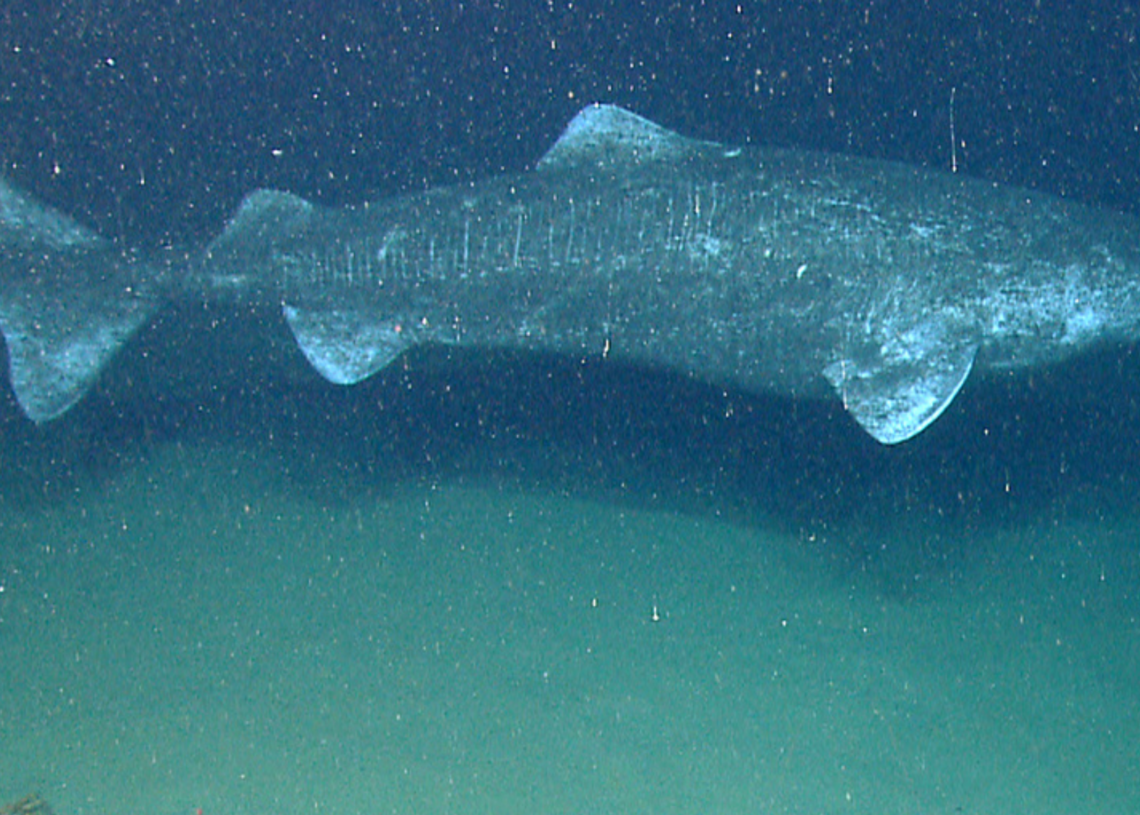
Greenland sharks look like they shouldn’t be able to see much of anything. They live in near-total darkness, drift through freezing water, and usually have parasites attached directly to their eyes. For years, that combination led scientists to assume vision wasn’t exactly tip-top. A new study suggests the opposite. These sharks can see, and they keep their vision intact for an astonishingly long time.
Greenland sharks are among the longest-living vertebrates ever studied. Some are estimated to be roughly 400 years old. The sharks examined in this research, aged using radiocarbon dating of eye tissue, were younger by Greenland shark standards but still remarkable. Every individual studied was over 100 years old, with the oldest estimated at more than 130.
The international research team, publishing their findings in Nature Communications, analyzed eyes from Greenland sharks collected between 2020 and 2024 under government permits. These animals spend most of their lives hundreds to more than a thousand meters below the surface, where sunlight is basically nonexistent.
Between the darkness and the eye parasites, Greenland sharks were written off as animals that simply got by without seeing much. The new research says otherwise. Detailed eye analysis found intact, healthy retinas in sharks more than a century old, with no signs of age-related damage.
Unlike humans, Greenland sharks don’t rely on cones for color vision. Their retinas rely entirely on rods, the cells built for low-light vision. Researchers also looked at rhodopsin, the protein that makes those rods work. In Greenland sharks, it’s tuned to blue light around 458 nanometers, which travels farther in deep water. The setup fits their dark environment almost too well.
The cornea offered another surprise. Even with parasites attached, it still lets most incoming light through. In other words, the sharks’ eyes aren’t nearly as compromised as they look.
“Our findings support the presence of a preserved and functional visual system in the adult Greenland shark,” the researchers wrote, pointing to retinal integrity maintained at both molecular and structural levels.
The study doesn’t claim sharks hold a direct solution for human vision loss. Still, the implications are difficult to ignore. Greenland sharks already attract scientific attention for their extreme longevity and unusually strong DNA repair systems. Preserving delicate retinal neurons for more than a century suggests those same mechanisms could protect vision as well.
Greenland sharks don’t fit the usual aging narrative. In conditions that punish the senses, they keep their eyesight intact for longer than biology says they should.
The post Could 400-Year-Old Sharks Hold the Secret to Eye Health for Humans? appeared first on VICE.