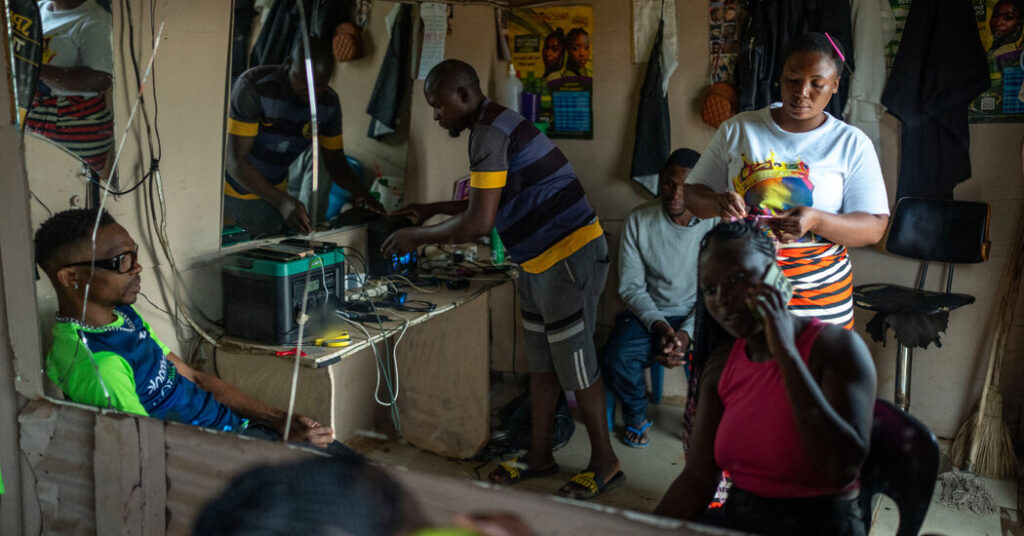
Almost as soon as Anselmo Munghabe plopped the 23-pound battery onto a table in his tin shack barbershop, people began to flock in.
He plugged two power strips into the battery. Soon it sprouted a bouquet of cellphones and wires.
Customers had arrived not to cut their hair, but to charge their phones, paying Mr. Munghabe 5 rand (about 30 cents) for each plug.
Mr. Munghabe’s community north of Johannesburg has been without electricity since last April.
Although nine in 10 South Africans are connected to the national electricity grid, power cuts in the country are frequent. Poor, dense urban areas like Mr. Munghabe’s are hit particularly hard because the grid is overloaded, causing transformers to break and leaving residents in the dark.
These batteries allow business owners like Mr. Munghabe to keep their operations open, and provide them with an extra source of income by charging neighbors to use the batteries. They have become a fixture in Tembisa, a sprawling township where residents occupy a mix of tin shacks and concrete homes.
The batteries are part of a business venture launched last year by the oil company, BP. The program, known as BPowerd, offers daily rental batteries, ranging from 300 to 1,000 watts and able to power lights, televisions, laptops and some appliances for several hours before they must be returned and recharged for the next day’s use. Customers like Mr. Munghabe pick up the batteries from a nearby gas station equipped with solar panels to charge the batteries. It comes as BP focuses its business squarely on oil and gas, abandoning previous efforts to diversify to renewables.
Residents use the batteries to operate makeshift music studios, convenience stores, taverns and church services. One woman relies on a battery to run her nebulizer. A grandmother said she uses them to power her television.
The program is part of a growing effort to bring energy solutions to the more than half a billion Africans who don’t have access to electricity.
About 200 million people in sub-Saharan Africa live in households that rely on some form of solar power, according to the global association for the off-grid solar energy industry.
The BP program, which plans to expand to Nigeria, is similar to one launched about a decade ago by another company, MOPO, which has about 125,000 batteries in circulation in seven African nations.
MOPO sets up its battery-charging stations at modest structures in communities, allowing it to reach rural areas that may not have gas stations or other major infrastructure.
Daily rental solar batteries have another limitation. The power they offer is limited, meaning they may not work for many large appliances and electronics.
The blackout in Mr. Munghabe’s section of Tembisa forced him to close his barbershop for a month because he did not have power to operate his hair clippers. Then a customer told him about the rentals.
He rents one for 40 rand ($2.35) per day; a smaller 300-watt battery goes for half the price.
In Tembisa, residents lug the batteries — by hand, by wheelbarrow, sometimes by trash can — each day between the gas station hubs and their homes or businesses.
Mr. Munghabe, 37, said his daily battery rental rate was covered, and then some, by the money he makes allowing people to charge their phones.
Experts in renewable energy say this system could play a critical role on the continent as demand for electricity grows. Renting a small battery is far cheaper than buying solar panels and batteries outright.
“I think this is a game changer,” said Ifeoma Malo, the founder of Clean Technology Hub, a Nigeria-based firm that does research and incubation for green technologies. “This is creating inclusiveness in access.”
John Eligon is the Johannesburg bureau chief for The Times, covering a wide range of events and trends that influence and shape the lives of ordinary people across southern Africa.
The post $2 Rental Batteries Are Helping to Power South Africa appeared first on New York Times.