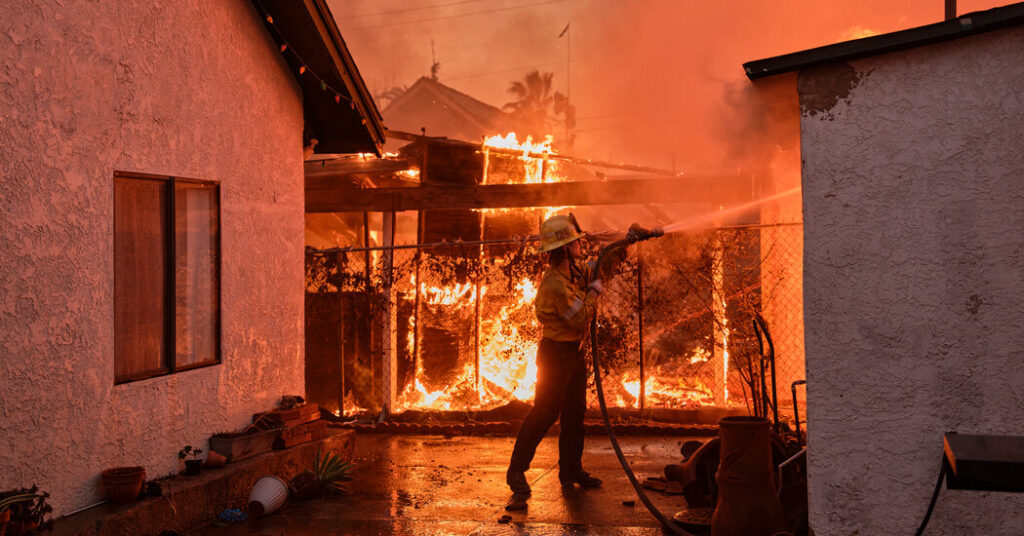
Southern California Edison, the utility company whose equipment is believed to have started the Eaton fire last January, filed lawsuits on Friday accusing government agencies and businesses of failing to warn residents and prevent the spread of the fire.
Edison has acknowledged that its equipment most likely caused the blaze, which killed 19 people and destroyed more than 9,400 buildings in the Los Angeles suburb of Altadena. But in its new lawsuits, the company asserts that almost a dozen businesses and government agencies share responsibility for the devastation.
The utility company is claiming that Los Angeles County failed to clear brush that contributed to the intensity of the blaze. It also said the Los Angeles County Fire Department and the county’s Office of Emergency Management did not issue timely warnings urging residents to evacuate.
Southern California Gas Company, the nation’s largest natural gas distribution utility, topped the list of businesses named in the lawsuit because it allowed gas to continue flowing during the fire.
“Ultimate accountability should be shared by everyone whose actions — and equally important inactions — made this disaster worse and contributed to it,” said Douglas J. Dixon, a partner at Hueston Hennigan, the law firm representing the utility.
Counterclaims in wildfire cases are common, but what is unusual here is that Edison is acknowledging that its equipment was probably responsible for igniting the inferno that burned Altadena, a tightknit community below the soaring peaks of the San Gabriel Mountains to the north and east of downtown Los Angeles.
Friday was the last day to file a claim related to the Eaton fire, Mr. Dixon said. Edison has been the main legal target, when it comes to seeking redress, for the families of people killed in the fires, residents and businesses. Mr. Dixon added that the utility had done its “due diligence,” by filing the lawsuits after examining some of the many reports that government officials and other groups produced to study what went wrong.
The exact cause of the Eaton fire remains under investigation by California officials. But scores of fire victims and government agencies have already sued Edison, citing data that suggested the utility equipment was stressed and videos that showed sparks and fires igniting beneath power lines. In a lawsuit filed in September, the Justice Department accused Edison, one of California’s largest utilities, of failing to properly maintain power lines that prosecutors said had sparked the fire.
In late October, the utility started a program to compensate fire victims in exchange for their agreement not to sue Edison. The program — which was designed and is being managed by lawyers who also oversaw compensation programs for survivors of the Sept. 11, 2001, attacks — aims to resolve cases faster than lawsuits would, utility executives have said. Victims of other fires including the deadly Camp fire in 2018 — which was caused by the equipment of Pacific Gas & Electric, California’s largest utility — have in some cases waited more than five years to be compensated.
Faster payouts, Southern California Edison executives have said, would be better for families and for the company, its customers and its shareholders.
But many survivors and their lawyers have countered that the utility’s compensation offers are too small and would not help people whose insurance payments were running out before they had been able to rebuild homes or find other permanent housing. A recent survey found that roughly seven in 10 survivors of the Los Angeles fires — which include the Eaton and Palisades fires — were still displaced.
One Eaton fire survivors group asked that Southern California Edison advance every affected family $200,000, which would count toward the ultimate payouts.
In a December interview with The New York Times, Pedro J. Pizarro, the president and chief executive of Edison International, the utility’s parent company, said an array of factors had conspired to make the Eaton fire a unique catastrophe. At the time, the area was subject to hurricane-force winds, and firefighting agencies were stretched and hamstrung. In addition, many residents in the greatest peril had not received alerts telling them to evacuate.
Nearly all of the people who died in the Eaton fire were in West Altadena, a neighborhood that is home to many Black seniors who have lived there for decades. Residents have criticized the county government for neglecting the lower-income Black and Latino community and prioritizing the safety of wealthier white residents of other parts of Altadena.
County leaders have opened investigations into the evacuation and emergency response.
“Wherever that spark came from, that spark came at the wrong place at the wrong time,” Mr. Pizarro said. “The catastrophe is about all of these other things.”
Mr. Pizarro said that while he understood residents’ pain and the fury directed at the utility, he and other executives must balance competing risks and regulatory requirements.
The utility is required to provide service to areas that have high fire risk, he said, adding that even if the utility is found responsible for starting a fire, government agencies and insurers are also responsible for the intensity of the destruction and the difficulty of recovery.
Mr. Pizarro said the utility must require some documentation from survivors before compensating them to prudently spend money it received from all of its customers.
“I’m trying to make sure that Edison does our part, and do the right thing,” Mr. Pizarro said. “There’s a lot of players involved, including insurance companies, who also have to do the right thing and do their part.”
As of this week, almost 2,000 families have submitted claims under the company’s compensation program, and the utility has made 95 offers, which total about $42.8 million, according to Southern California Edison. More than half of those offers have been accepted, and none have been declined. Survivors have months to make a decision. The utility has paid 33 claims.
Ivan Penn is a reporter based in Los Angeles and covers the energy industry. His work has included reporting on clean energy, failures in the electric grid and the economics of utility services.
The post Edison Files Claims Against Los Angeles County and Others on Eaton Fire appeared first on New York Times.