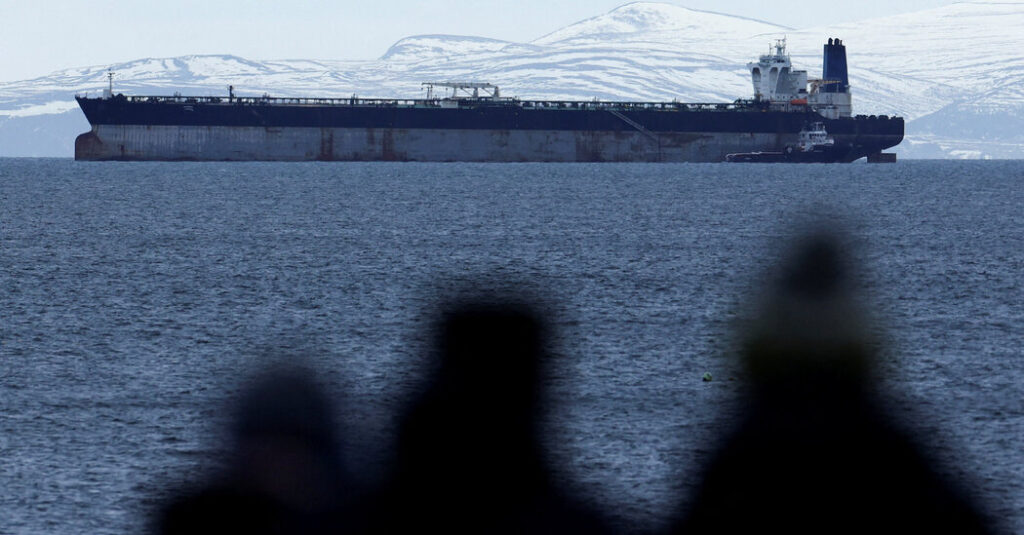
The video posted by the U.S. military on Thursday showed what is now a familiar scene: American troops sliding down thick braided ropes from a helicopter hovering just above a civilian oil tanker that is about to come under their control.
The troops are armed with assault rifles slung across their chests and have night-vision goggles mounted to their helmets.
Once they reach the tanker’s steel deck, they grab hold of their firearms. Some take a knee and point their weapons toward the ship’s stern to offer covering fire if needed, while others begin moving toward the tanker’s bridge.
While the video is edited and incomplete, it shows how quickly the U.S. military can insert boarding teams onto “noncompliant” ships by using “fast-roping” techniques pioneered by special forces that spread to more conventional units over the past 30 years.
The United States has intercepted at least six ships linked to Venezuela since December, as the Trump administration tries to take over the country’s oil industry. One was seized in the North Atlantic after running from Coast Guard cutters for weeks.
While the Coast Guard has long boarded vessels from their cutters at sea, the service began exploring the possibility of boarding ships from helicopters in earnest after the Sept. 11, 2001, attacks.
A retired Coast Guard officer who helped establish the tactics and techniques used by these boarding teams said the service had invested heavily in special training for the teams that do these kinds of boardings, as well as the aviation units that deploy and support them.
Speaking on the condition of anonymity to discuss operational details, he said the people seen in these videos included members of the Coast Guard’s elite Maritime Security Response Teams.
For decades, fast-roping has been an option for quickly inserting an assault force in places where a helicopter cannot safely land, but until recent years, the training to do so was typically limited to special operations forces and Marines.
According to an official Coast Guard historian, the service has boarded vessels at sea since its founding in 1790. It created specialized teams to seize drug smugglers beginning in the 1970s.
Over time, that training came to include close-combat tactics, fast-roping and climbing tall stacks of shipping containers typically used to move cargo around the world’s shipping lanes at sea.
The fast-rope tactic allows large numbers of troops to more safely and quickly hit a target area than traditional methods of approaching a vessel with an armed motorboat, which has inherent hazards based on wind and the weather, as well as waves and swells on the water.
When using a motorboat, assaulters often have to use telescoping poles to attach a flexible ladder via hooks to a vessel’s deck, which could be 30 feet or more above the ocean’s surface. Climbing such a ladder during daylight hours, even in calm seas, presents hazards, as troops wearing body armor and carrying weapons and bags of equipment have to follow one another up to the vessel’s main deck.
Doing so at night, or in rough seas, compounds the danger.
That hazard resulted in tragedy in January 2024, when two Navy SEALs on a mission to intercept weapons headed to Iran-backed Houthi fighters drowned in the Arabian Sea off the coast of Somalia while trying to board a small dhow suspected of smuggling contraband munitions.
After one SEAL fell into rough waters while trying to climb a rope ladder to the dhow, a teammate jumped into the ocean to save him and both were lost at sea.
The two men were declared dead days later.
These kinds of operations, which the military calls noncompliant boardings, are typically launched only after U.S. forces attempt to hail a target vessel via radio and requesting that it stop or make accommodations to receive a boarding party.
From the 1990s through the early 2000s, the Navy gained considerable experience in compliant and noncompliant boardings in the Persian Gulf, enforcing United Nations sanctions on Iraqi oil shipments.
According to Mike Vining, an Army Delta Force veteran, fast-roping was pioneered by British naval special forces and introduced to the U.S. military via Delta Force in the late 1970s.
“It’s basically like a fireman’s pole, with assaulters stacked on top of each other sliding down the same rope,” Mr. Vining said in an interview. “It’s much faster than rappelling, where only one soldier can be on the rope at any given time.”
But in the presence of intense enemy fire, keeping a helicopter hovering over a target long enough to slide down to the surface can become untenable, he said.
Mr. Vining noted that Delta Force aborted its first attempt to fast-rope in combat during the Oct. 25, 1983, assault on Richmond Hill Prison as part of the U.S. invasion of Granada to free roughly 300 political prisoners, which was also the first combat use of the MH-60 Black Hawk helicopter.
“We wanted to use the fast-ropes, but the enemy fire was too intense for the helicopters to stay in a hover and a lot of our guys got wounded,” he said. “We had to land the helicopters outside the prison and then aborted the assault into the compound once we learned the political prisoners had been freed.”
The troops usually wear welders’ gloves to maintain their grip as they slide down the braided ropes using only their hands and feet. The friction can quickly generate intense heat. The inside soles of their boots often wear away from the heat as they squeeze the rope with their feet.
The ropes are typically 90 feet long, but for safety’s sake, the troops try to deploy them when their helicopters are no more than 30 feet from the ground.
“It’s not without its risk, though,” Mr. Vining said, recalling some early fatal accidents as Delta Force refined its techniques.
John Ismay is a reporter covering the Pentagon for The Times. He served as an explosive ordnance disposal officer in the U.S. Navy.
The post U.S. Boardings of Oil Tankers Reflect Hard Lessons Learned at Sea appeared first on New York Times.