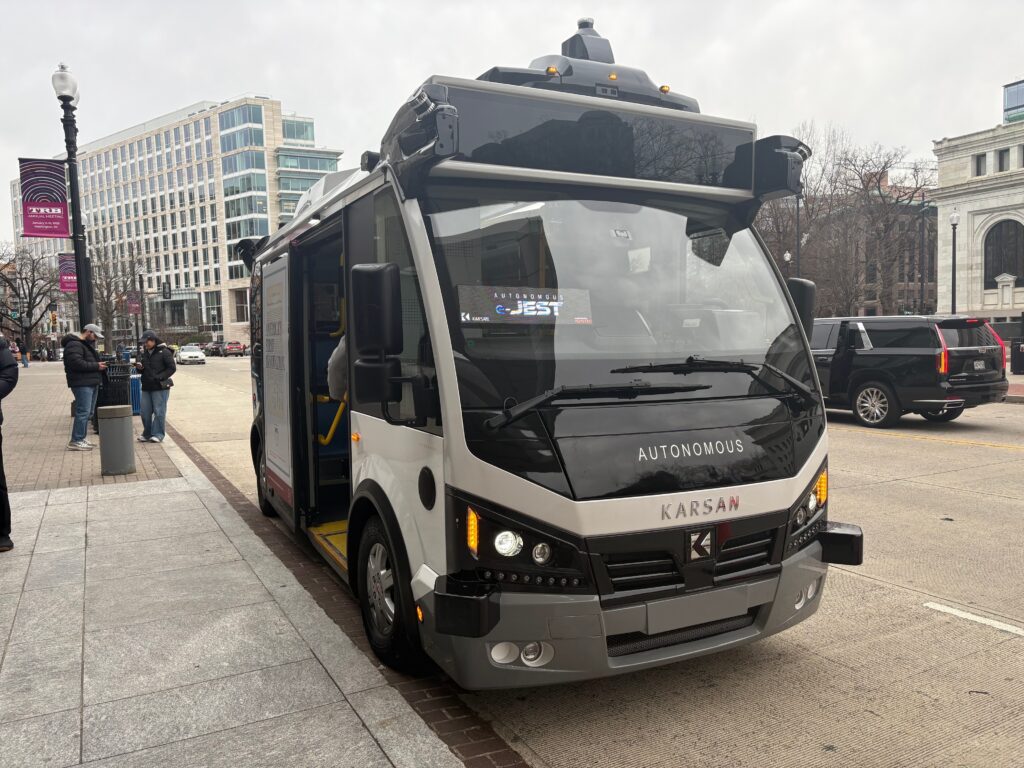
The U.S. Department of Transportation brought an automated bus to D.C. this week to showcase its work on self-driving vehicles, taking officials from around the country on a ride between agency headquarters at Navy Yard and Union Station. One of those trips was interrupted Sunday when the bus got rear-ended.
The bus, produced by the company Beep, was following its fixed route when it was struck by a Tesla with Maryland plates whose driver was trying to change lanes, officials said. The bus had a human driver behind the wheel for backup as required by the city. The Tesla driver stayed on the scene on H Street for about 10 minutes. No police were called.
“The service was temporarily paused after another vehicle made an illegal lane change and contacted the rear of the autonomous bus, which resulted in minor cosmetic damage to both vehicles,” a spokesman for Beep said in a statement. “The autonomous bus operated appropriately in the moment and, after review, it was determined the autonomous bus was safe to resume service.”
Beep is working with the Transportation Department and Carnegie Mellon University on a pilot program of automated public buses. The vehicle was brought to D.C. for an annual conference that brings together transportation researchers and policymakers, where officials from the Trump administration emphasized the White House’s interest in automated driving.
“One of President [Donald] Trump’s priorities, given to us through Secretary [Sean P.] Duffy, is to accelerate the commercial deployment of autonomous vehicles, and we’re all in on that,” Peter Simshauser, chief counsel at the National Highway Traffic Safety Administration said during a Monday panel discussion at the conference.
Simshauser previously worked on a Hyundai robotaxi venture, Motional, which is hoping to launch in Las Vegas this year. Also on the panel about the administration’s “innovation agenda” was Seval Oz, assistant transportation secretary for research, who worked on Google’s self-driving car program, which became Waymo, and on sensors and software for autonomous driving.
She called the roughly 40,000 road deaths a year in the U.S. “an epidemic” autonomous vehicles could help end. “But autonomy will also change our cities. It will change the way in which we look at driving,” she said.
Nationally, a handful of cities and states allow fully autonomous driving, with many more doing tests. District leaders have been considering allowing automated cars and busesfor almost a decade, and Waymo and other companies are interested in operating self-driving taxis in the city. But officials say they are still waiting on a long-overdue report on how best to regulate the vehicles before allowing them on the streets without human oversight.
Any crash of an automated vehicle, no matter how minor, has to be reported to NHTSA. There have been six previous crashes involving automated vehicles tested in D.C., according to the agency.
The post Officials showed off a robo-bus in D.C. It got hit by a Tesla driver. appeared first on Washington Post.