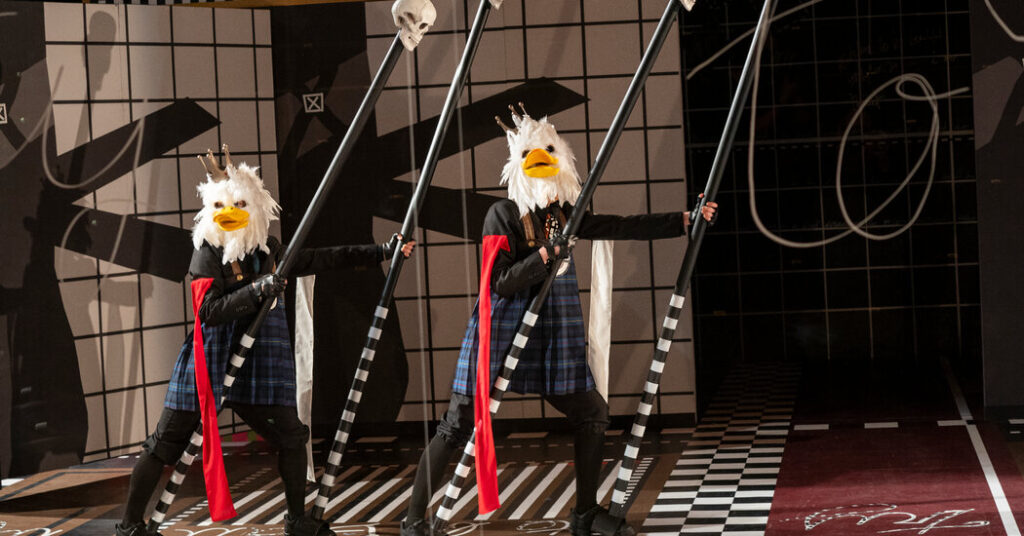
The hottest opera ticket in New York right now is an absurdist post-rock pageant about clothes. And golf-playing ducks. All four performances of “What to Wear,” the collaboration between the composer Michael Gordon and the experimental theater director Richard Foreman at the Brooklyn Academy of Music’s Harvey Theater, are sold out. On resale sites, you can still snag a ticket for $700 — much more than the cost of parterre box seats at the Met.
All that buzz for an opera that offers a visual riot of geometric elements — tartans and stripes, cones and pyramids, checkerboard borders and diagonally strung fishing lines — but no plot or message. The question I took away from the delightfully baffling performance on Thursday, opening night, was not about what “What to Wear” means, but what it speaks to in this cultural moment.
Premiered at CalArts in 2006 and now revived by Paul Lazar and Annie-B Parson of Big Dance Theater, “What to Wear,” part of the Prototype Festival, unfolds as a sequence of framed tableau that take us into the mind of Madeline X as she considers her wardrobe and the pressures of a society that banishes ugly ducklings “from the realm of the oh-so-beautiful people.”
Madeline is sung by four performers — two sopranos, a mezzo-soprano and a tenor — who intone Foreman’s gnomic text, sometimes in succession, sometimes as a vocal quartet. A tartan-clad chorus marches on and off, offering props with solemn, ritualistic gestures and forming a living barrier behind the principals. In front of them, large plexiglass panels create a literal fourth wall and the uneasy impression of peering into a zoo display, or a controlled experiment that needs to be shielded from the audience’s germs.
Musically, too, expression is held at arm’s length. The singers are amplified and often adopt a forced straight tone that sounds almost deliberately unmusical. In a more effusive mode, the tenor Morgan Mastrangelo was terrific as a Madeline considering the predicament of a duck entering a fine restaurant. The mezzo-soprano Hai-Ting Chinn delivered a hypnotic meditation on the question “Am I still beautiful?” in rising scales over mournful, wobbling strings. Foreman’s recorded voice periodically intrudes, raspy and portentous.
To one side of the stage, the members of Bang on a Can, under the direction of Alan Pierson — all costumed in bellboy caps festooned with colorful pompoms — contribute a loud, clanging sound world, heavy on electric guitars and ostinatos pounded out on electric keyboards. The score consists of discrete blocks with sharply defined edges: A phrase is sung again and again; the texture thickens as the music grows louder, more insistent and then stops abruptly.
With its clear demarcations, the music echoes the geometric sets, patterned borders and strings that run from ceiling to floor at mad angles. The impression is of a world obsessed with mapping and measuring, with plotting order at the expense of an ordered plot. If “What to Wear” is about anything, it may be about the fetishization of objects and the objectification of beauty.
Foreman, who died last year at 87, looms large over this revival. “What to Wear” now plays as a kind of memorial both to Foreman and to an experimental theatrical tradition that prized disorientation over explanation.
That Surrealist instinct may be making a comeback. A case in point: This was the third Prototype production I saw in a week that featured bird-headed figures. In “Precipice,” a folk-tinged chamber opera about female autonomy by the composer Rima Fand and the designer Susan Zeeman Rogers, a child wearing a raven mask stands guard over the protagonist as she fights to articulate her own voice. In “Hildegard,” Sarah Kirkland Snider’s polished and emotionally generous opera about the 12th-century abbess and mystic Hildegard von Bingen, shaggy eagle-chick monsters hover on the periphery of the saint’s visions.
Bringing the strange, the absurd and the inexplicable into opera feels like a welcome antidote to the earnestness that dominates so much contemporary work. Too many new operas seem intent on telling audiences exactly what to feel and how a piece is relevant to the present moment.
“Precipice” and “Hildegard” both include passages that edge toward the expository and the didactic. Yet the moments that lingered were the visionary eruptions in “Hildegard” and the animalistic vocalizations in “Precipice,” moments that defied translation but obliquely made space for a listener’s subconscious resonance. That is what opera has always done best: create the conditions for a kind of collaborative dreaming.
The fascination with “What to Wear,” which offers no story and withholds clear meaning, may lie precisely there. At a moment of waning trust in language, whether in politics, media or education, the work’s radical silliness feels bracingly, brashly honest. That makes it — absurdly — a hot commodity.
The post Viva the Absurd: ‘What to Wear’ and a Wave of Opera Surrealism appeared first on New York Times.