On Jan. 3, I was at home in Caracas when I heard explosions. My room’s windows shook and the walls trembled. At first I thought it was an earthquake, but as the second, fourth, and fifth hollow explosions followed, I knew it was the Americans. A military buildup in the Caribbean that started in Aug. 2025 hung loosely inside millions of Venezuelan’s minds. As I heard the sounds of aircraft echo above me, uncertainty sank in.
[time-brightcove not-tgx=”true”]
Around the world, Venezuelans were seen celebrating what many believed was the end of Nicolás Maduro’s rule. The scenes puzzled observers abroad. How could people celebrate while worrying about foreign intervention? How could relief coexist with fear?
Those reactions make sense only if you understand how democracy died in Venezuela: not suddenly, but slowly, quietly, and through institutions that once claimed to protect it.
Democracy rarely disappears overnight. More often, it erodes—procedure by procedure—until people must risk their lives to prove that their votes ever mattered. Venezuela is not a warning about ideology. It is a warning about complacency.
Context matters. Over the past decade, roughly a quarter of Venezuela’s population—one in every four people—has left my country. (For comparison, imagine if the population of California, Texas, and a couple of smaller states left the U.S.) People do not abandon their families, their homes, and their futures without reason.
Part of the answer is bad governance and corruption. Another part is democratic backsliding: the installation of authoritarianism through elections, laws, and procedures that retain the appearance of legitimacy.
When I was six years old, in 1998, Hugo Chávez was elected president by popular vote. Widening inequality and political instability made the 1990s fertile ground for an anti-establishment campaign. Once in power, Chávez used oil-boom revenues to fund expansive populist programs, and to “coup-proof” the state.
Over time, democratic institutions eroded. Hundreds of independent media outlets were shut down, including the longest-running national television station, RCTV, and all print newspapers in 12 out of 24 Venezuelan states. Dissent was vilified. Loyalty was rewarded over competence. Political violence, in speech and action, became normalized.
Unlike coups or insurrections, which are swift and explicit, modern democratic backsliding is often incremental. Institutions weaken gradually. Accountability fades. Corruption grows. The rule of law frays.
By 2013—Chávez’s last year in office and Nicolás Maduro’s first—Venezuela already had the highest annual inflation rate in the world, at 56%. Three years later, the country entered one of the longest periods of hyperinflation in modern history. When the United States imposed its first financial sanctions in late 2017, Venezuela was already deep into an economic and humanitarian crisis. By 2021, when hyperinflation formally ended through de facto dollarization, 78% of Venezuelans lived in poverty, and 57% in extreme poverty.
It was the worst economic collapse outside of war in modern history. Venezuela’s economy shrank by 70% in less than a decade. As basic services faltered, one third of the population lost access to running water. Newborn babies in intensive care units were put in cardboard boxes—no funds were left for incubators. Crime rates exploded with 46 kidnappings a day. Thousands died queuing for medicines. Millions of people became increasingly dependent on government handouts to survive.
What makes this crisis particularly baffling is that it coincided with the largest oil boom in Venezuela’s history. When Chávez was elected in 1998, oil sold for about $11 a barrel. Between 2008 and 2014, prices neared $100. Estimates vary, but according to Chávez’s own finance minister, Jorge Giordani, roughly $1 trillion entered the country during those years.
Giordani later said that about two-thirds was redistributed—often inefficiently—but that one-third simply “slipped through the cracks.”
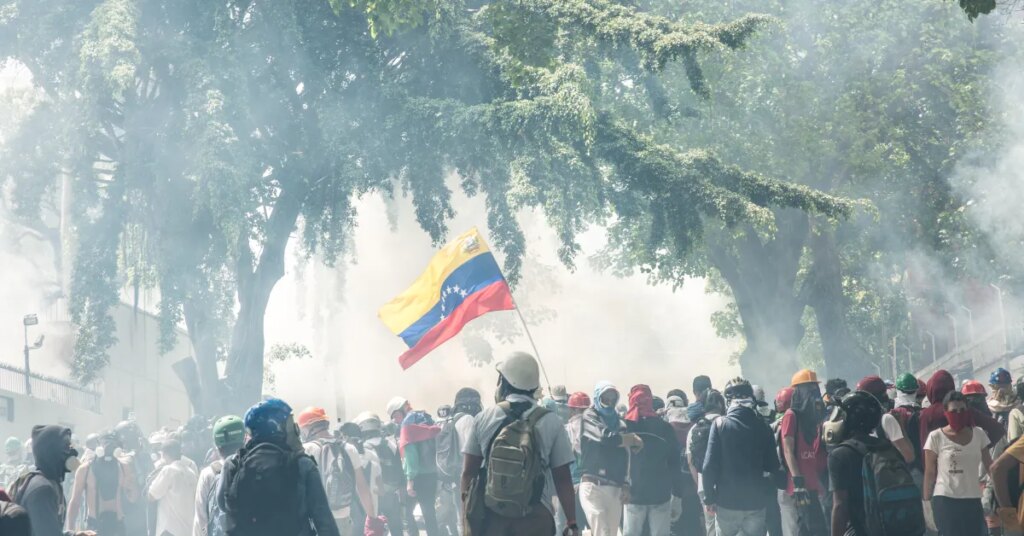
As conditions deteriorated, Venezuelans protested. Nationwide, peaceful demonstrations shook the country in 2014 and again in 2017. I covered those protests as a journalist for national and international agencies. I hid behind kiosks as people inside government buildings shot bullets from above. I learned to use milk or toothpaste to quench tear gas’s sting on sweaty skin. I carried a dying protester as her eyes turned purple—security forces had shot a gas canister at her head.
Repression intensified. At least 200 people were killed during those protests,and more than 5,400 were detained. Torture became an increasingly common political weapon: 33 documented cases in 2014, and at least 88 in 2017.
The government also deepened its control over territory and labor. Maduro decreed that 12% of Venezuela’s land—much of it Amazon rainforest—would be opened to mining. The Communist Party, long an ally of Chávez, was persecuted and forcibly intervened. Dozens of union leaders and labor-rights advocates were jailed on charges of “conspiracy” or “treason.”
By 2024, Venezuela was no longer a functioning democracy, but elections still mattered, because they revealed the regime’s illegitimacy.
That year, the opposition won the presidential election, and Maduro refused to concede. Government forces detained over 2,000 people in one month. Intelligence agencies livestreamed arbitrary arrests of political opponents using the soundtrack from A Nightmare on Elm Street. Masked officers patrolled cities in vehicles bearing slogans like “Doubt Is Treason.” A 65-year-old doctor who criticized Maduro in a WhatsApp voice note was sentenced to 30 years in prison. Similar cases followed. Venezuelans stopped using social media and venting on WhatsApp groups. Fear replaced speech. Silence disguised itself as normalcy.
Yet the election result was not a matter of belief—it was a matter of proof.
Venezuela’s electoral system is designed with redundancies. All 30,026 voting machines print multiple identical copies of the election-day tally, signed by polling officials and witnesses. Copies are distributed to the political parties participating in the election, including Maduro’s own party. Everyone across the political spectrum holds the same receipts.
Anticipating fraud, opposition leader María Corina Machado, who had won the primaries with 93% of the votes but was barred from running, organized hundreds of thousands volunteers months in advance, covering all 15,797 voting centers in the country. Their mission: retrieve the official tallies, digitize them, and safeguard them.
On election night, it became clear that many tallies were being illegally withheld. I was monitoring irregularities and at 6 p.m., as exit-polls made it clear that the opposition was winning by a wide margin, there was a surge. Masked gunmen on motorcycles shot into the air outside polling centers, and government personnel started prohibiting the retrieval of voting tallies. Some civilian groups deliberately distracted armed paramilitary gangs so others could hide the receipts in their clothing and smuggle them out of polling stations. People risked their lives for those pieces of paper.
The tallies were transported—sometimes by canoe through Amazon rivers, other times by vehicle—to secret locations where they were digitized and uploaded via Starlink to a secure database.
That night, the National Electoral Council announced results that were mathematically impossible, according to analyses later conducted by Columbia University mathematicians. Machado and her candidate, Edmundo González Urrutia, challenged the official count. The next day, their team published digitized tallies from 85% of voting machines nationwide. The data showed a two-to-one opposition victory—even though the quarter of Venezuelans who live abroad, and overwhelmingly oppose Maduro, were left out of the voting registry.
Gonzalez Urrutia won in all states. He also won in many military and police polling stations, including the government armed forces university and Libertador airbase, among Venezuela’s largest. Venezuelans were united in their democratic will for change.
To this day, neither Maduro’s party nor the electoral authorities have published their own tallies or disaggregated results.
Regardless of what anyone feels towards Machado’s politics, she led one of the most consequential democratic challenges to an authoritarian regime in contemporary history. That unprecedented effort is what ultimately earned her the Nobel Peace Prize.
For at least 67% of Venezuelan voters, Maduro is now uncontestably an illegitimate ruler clinging to power.
This brings us to sovereignty, and why foreign involvement provokes less outrage than outsiders might expect.
Yes, U.S. intervention worries Venezuelans. But many no longer feel sovereign in any meaningful sense. Cuban intelligence operatives have been present in Venezuela since the early 2000s. Venezuela’s presidential security has long been Cuban-trained, and at least 32 of the people who died protecting Maduro on Jan. 3, were Cuban.
Chávez and Maduro granted Russia and China extensive concessions over Venezuelan territory and resources, often bypassing legal frameworks and legislative oversight. Colombian guerrilla groups operate in at least eight of Venezuela’s 24 states. Some experts now describe parts of the country as a failed state.
If a government is an illegitimate coalition focused solely on its own survival, at the expense of the population, does sovereignty still apply simply because its leaders are Venezuelan?
Oil offers a similar paradox. Venezuelans care deeply about their natural resources, but they have not benefited from oil wealth in over a decade. In 1998, Venezuela produced 3.4 million barrels per day, and ranked among the world’s top five oil producers. By 2018, before the most severe sanctions on the state oil company took effect, production had already collapsed to 1.5 million barrels per day—a 55% decline.
According to energy experts, this is the fastest collapse of a national oil industry outside of war. Mismanagement, corruption, lack of maintenance, and the prioritization of political loyalty over expertise hollowed out the industry. Analysts estimate it would take an investment of at least $100 billion over a decade to restore production to 1998 levels.
Even today, much of Venezuela’s oil does not generate usable revenue. Less than half of exports involve cash payments; the rest service debts to Russia, China, and other creditors. PDVSA, Venezuela’s state-owned oil and gas company, owes around $55 billion to partners, service companies, and financial lenders. Between 2020 and 2023, the company could confirm receipt of just $4.08 billion out of $25.27 billion in oil exports.
The rest, once again, slipped through the cracks.
Many worry about the precedent that intervention sets. They are right to worry. But it was also dangerous to ignore Venezuelans for years as we documented torture, censorship, forced migration, extrajudicial killings, starvation, illegal mining, and crimes against humanity. On parts of the international left, loyalty to Chávez blinded many to the scale of Venezuelan suffering. Today, reflexive opposition to President Donald Trump risks repeating that mistake.
To be sure, Venezuela’s road to democracy does not start or end with Trump’s extraction of Maduro. We are not naive. But as we have proven for decades, we are willing to risk everything for our right to exist as a democracy.
Sustaining democracy is a team effort that requires an interconnected system of institutions, legal frameworks, and shared values that transcend any nation. When one democracy fails, the consequences extend far beyond its borders.
Authoritarians play by a different rulebook: one that rejects independent institutions, free elections, transparency, and dissent. And as time passes, these oppressive leaders become entrenched, making redemocratization harder and harder.
Venezuelans did not fail to defend democracy. We defended it with our lives. We protested peacefully. We denounced abuses internationally. We negotiated. We voted, even when the outcome was predetermined.
No democracy can survive when people, within or abroad, look the other away. What failed was our belief that democracy, once established, is self-sustaining.
The post How Democracy Died In Venezuela appeared first on TIME.