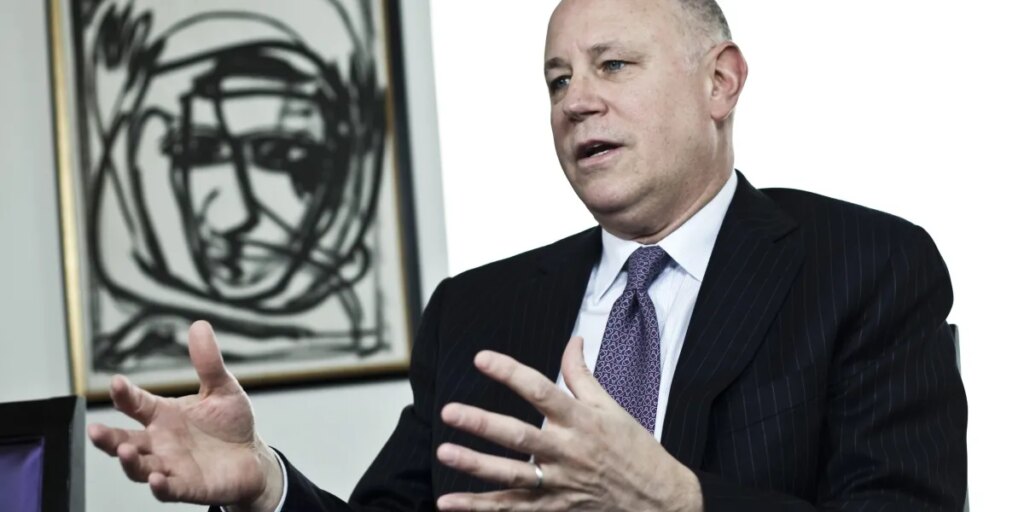
A small investment made at the right moment has the power to launch ordinary people to millionaire status. All it took was $1,000 and an out-there idea for Jeffrey Sprecher, the founder and CEO of Intercontinental Exchange, to set his business on a path to becoming a $98 billion behemoth.
“I had this idea that you should be able to trade electric power, buy and sell electric power, on an exchange,” Sprecher recalled recently at the Rotary Club Of Atlanta. But there was a huge caveat: He “had no idea how to do that. I’d never worked on Wall Street, I never traded.”
At the time, Sprecher had heard that Continental Power Exchange—owned by Warren Buffett’s electric utility company, MidAmerican Energy—was about to go bankrupt. Despite Buffett’s business pumping $35 million into it, the company was still struggling. And so Sprecher saw this as an opportune moment to swoop in and pursue his entrepreneurial vision.
“I bought the company for a dollar a share, and there were a thousand shares. So I bought it for $1,000, and I used that as the basis to build Intercontinental Exchange.”
Thanks to his quick thinking and business savvy, Sprecher now boasts a net worth of $1.3 billion. But the journey to the top was not very glamorous.
Living in a 500-ft studio and driving a used car while scaling the business
That measly $1,000 investment made back in 1997 served as the launchpad for Intercontinental Exchange, founded just three years later. A small team of nine employees set off to build the technology in 2000; setting up shop in Atlanta, Georgia, Sprecher and his staffers went all-in on building the business up from its former demise.
It was all hands on deck, and even as the founder and CEO, Sprecher was doing the menial labor to keep everything in order. With money being tight, the entrepreneur lived in a small apartment and drove a used car to the office to keep Intercontinental Energy afloat.
“I bought a 500-foot, one room studio apartment in Midtown…I bought a used car that I kept and I’d go into the office from time to time,” Sprecher explained, adding that he “took the trash out, shut the lights out, answered the phone, bought the staplers and the paper for the photocopier. That was the way the company started.”
Nearly 26 years later, the company boasts a market cap of $98 billion and a team of more than 12,000 employees—and has proudly owned the NYSE for over a decade.
Entrepreneurs who made a key investment at the right moment
Some of the wealthiest entrepreneurs made their billions by spotting the perfect window to invest small and earn big.
Take Kenn Ricci as an example: the serial American aviation businessman and chairman of private jet company Flexjet is a billionaire thanks to his intuition to buy a struggling business four decades ago. After being put on leave from his first pilot job out of the Air Force, he turned a sticky situation into a 10-figure fortune.
“I worked for [airline] Northwest Orient for a brief period of time. I get furloughed. Unemployed, back living with my parents,” Ricci told the Wall Street Journal in a 2025 interview, reminiscing on how he made his first $1 million.
But instead of throwing in the towel, he spotted a golden opportunity. Ricci took a contract pilot job at Professional Flight Crews, and one of the companies he flew for was private aviation company Corporate Wings. The budding businessman was intrigued when its owners put the business up for sale at $27,500 in 1981—and jumped on the opportunity to buy it. By the early 1990s, the business was pulling in $3 million a year.
But people don’t need to buy and scale a company to make a worthwhile investment; millennial investing wiz Martin Mignot became a self-made millionairethanks to his ability to spot unicorn companies before they make it big. One of his biggest wins was an early investment in Deliveroo—back when the business was just a small, London-based operation.
“They had eight employees. They were in three London boroughs. Overall, they had a few 1000 users to date, so it was very, very early,” Mignot told Fortune last year. “They didn’t have an app. Their first website was pretty terrible and ugly, if I’m frank, but the delivery experience was incredible.”
Lo and behold, Deliveroo grew to become a $3.5 billion company with millions of global customers. And as a partner at Index Ventures, Mignot is part of a team reaping billion-dollar rewards from forward-thinking investments in tech businesses including Figma, Scale AI, and Wiz. Aside from his day job, Mignot has also strategically put money towards iconic European start-ups including Revolut, Trainline and Personio. Before he was even 30, he solidified himself as a notable investor—and advised others that “It’s about owning equity, that is the key.”
The post Meet the self-made billionaire who bought a nearly bankrupt company off Warren Buffett for $1,000 and turned it into a $98 billion giant appeared first on Fortune.