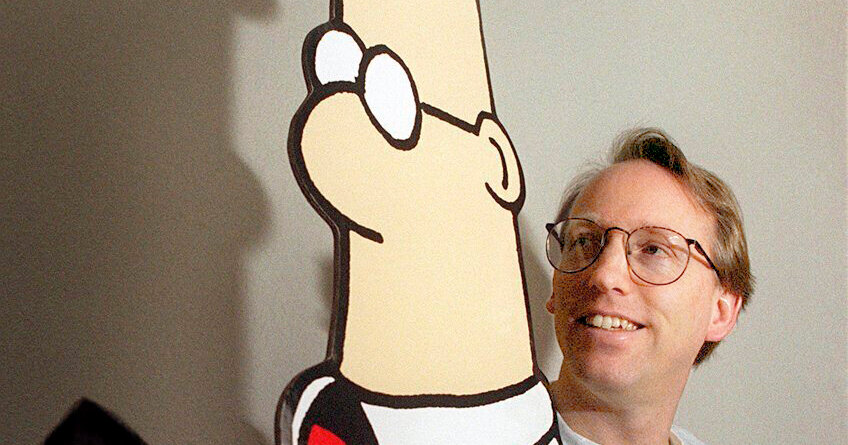
As a Jew from a liberal East Coast town, I have been deprived of a MAGA uncle to argue with. To fix this, I sought out Scott Adams, the wildly successful syndicated “Dilbert” cartoonist who, by 2017, had come out in support of Donald Trump and amassed an online community that raged against the smug progressive elites.
This felt like a betrayal from one of our own. After all, he was a pescatarian agnostic who went to graduate school at Berkeley, lived in an overwhelmingly Democratic Bay Area town, put solar panels on his roof and made art for a living. Why would he suddenly turn against his class?
Mr. Adams, who died Tuesday, agreed to be interviewed for my book “In Defense of Elitism: Why I’m Better Than You and You Are Better Than Someone Who Didn’t Buy This Book.” I planned to have a kind of fiery, high-level policy debate that only a cartoonist and a humor columnist could have.
When I pulled into his driveway in Pleasanton, Calif., however, I met a smiling, soft-spoken man. He gave me a house tour, which took a very long time because it was 8,372 square feet. His wife had left him shortly before they finished building it, and almost all of his friends had left him since he went MAGA, so he was padding around the place alone.
Despite its enormity, it was a house of the people, its features having been crowdsourced from more than 3,000 fans who had sent ideas to the Dilbert’s Ultimate House (DUH) project, leading to innovations including a cat bathroom, a Christmas tree closet and a Dilbert-head-shaped tower whose window-eyes overlooked the pool. There was also a gift-wrapping room that, apparently because of the loss-of-friends thing, had been converted into a music studio where Mr. Adams was learning to play drums.
When I finally asked Mr. Adams how he had turned on his fellow well-educated high achievers, he patiently explained that I had misunderstood him. His father was a postal worker and his mother worked for a time on an assembly line. He’d gone to a rural college in upstate New York, worked as a bank teller where he was robbed at gunpoint twice, he said, then got a business degree at night and landed a job at Pacific Bell. When we met, he did not own a suit and had only recently traveled outside the country for his first time.
“Dilbert” was a war cry against the management class — the system of deluded jerks you work for who think they know better. Workers posted it on their cubicles like resistance fighters chalking V’s on walls in occupied Paris. But their bosses posted “Dilbert” in their offices too, since they also had a boss who was an idiot. In the Dilbertverse, “It’s turtles all the way up,” Mr. Adams explained to me when we met. The bottom rungs are filled with put-upon competent workers, oppressed by an infinite bureaucracy of people upholding a system that isn’t actually based on actual expertise.
Maybe Mr. Adams was an early Trump supporter because “Dilbert” was itself proto-MAGA. The strip’s everyday resentments and cynicism added up to a now-familiar worldview. “There’s no such thing as expertise. It just doesn’t exist,” Mr. Scott said.
Mr. Adams thought this extended even to issues like international trade. “In these big complicated situations, no one really knows if we have a good deal. It’s best just to negotiate from ignorance and hope the other side gives in,” he told me. “In the real world there is a fog. In a world where nobody knows, the loudest person is going to get the most.”
From his point of view, I had lived so long among the well-credentialed languishing in abstract thoughts that I was fooled into thinking complex problems required expert solutions. “In your movie,” by which he meant my perception of reality, “there’s a big incompetent guy who doesn’t know the details,” he told me. “I’m telling you it’s the best thing possible. When President Trump acts without all the information and his facts are not accurate, he’s operating on a higher level, not a lower level. He’s operating in the real world.”
Mr. Adams took me to the room where each day at 7 a.m. Pacific time he livestreamed “Real Coffee With Scott Adams” and his fans tuned in for the “simultaneous sip.” There he explained to me in person the sorts of things he talked about online: the danger of vaccines and the rigging of the election.
At other times, I’d heard him argue that Republicans were superior because they ignored the unachievable feminine Democratic impulse toward fairness, and instead focused on the only thing that was useful: power. In one blog post, he called into question the tally of Jews who died in the Holocaust. In 2023, years after our visit, that he said on his podcast, “based on the current way things are going, the best advice I would give to white people is to get the hell away from Black people.” His newspaper syndicators and book publishers dropped him.
Eating veggie pasta at a restaurant in downtown Pleasanton, I noted his ripped physique. And that he was dating an Instagram model half his age. And those drum lessons. I asked him if he was having his midlife crisis. Probably, he said. But his politics, he assured me, were not a part of it.
Mr. Adams said he hadn’t changed. Instead, the political parties had. The liberals used to be the rebels, the outsiders, the ones poking fun at the self-serious establishment. He reminded me that 17 years earlier, I had done a Q. & A. in which I had said to him: “If you wanted, you could draw better than that. Right?”
“You and I have a similar brand. We mock the elite. That’s part of our job,” Mr. Adams said. “The amount of fun Trump supporters have is huge. You think you’re having one conversation, but one side is laughing and one is crying. The memes are great. I have a meme guy. Some are too mean, so I don’t put my name on the memes.”
After Mr. Adams died of prostate cancer, Donald Trump, our commander in chief and main mean meme guy, put out a statement online that made it all about himself: “Sadly, the Great Influencer, Scott Adams, has passed away. He was a fantastic guy, who liked and respected me when it wasn’t fashionable to do so.”
I’m glad I got to know Scott Adams. But I don’t know how you people with MAGA uncles deal with it.
Mr. Stein writes the Substack newsletter The End of My Career.
The Times is committed to publishing a diversity of letters to the editor. We’d like to hear what you think about this or any of our articles. Here are some tips. And here’s our email: [email protected].
Follow the New York Times Opinion section on Facebook, Instagram, TikTok, Bluesky, WhatsApp and Threads.
The post ‘Dilbert’ Was Always MAGA appeared first on New York Times.