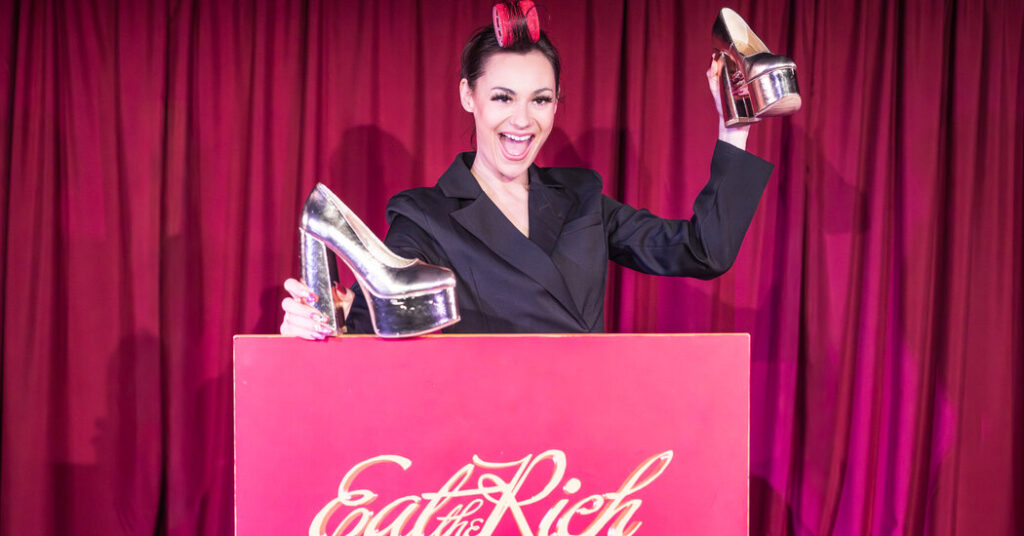
Jade, a gregarious 20-year-old from Liverpool, England, quits her call center job when she gets a place at Cambridge University. She’s the first member of her family to go to college, and her first months there are a culture shock as she tries to integrate with her privileged fellow students while working part-time as a cleaner to make ends meet. She is bewildered by their dress habits: The men wear sweaters tied around their shoulders, and the women don’t get glammed up for a night out. Some of them are unkind about her accent, and they look down on her home city.
None of this bodes well, but Jade is gamely determined to make the best of it — because, she says, “if there’s one thing worse than classism … it’s FOMO.”
This tension — between class loyalty and personal aspiration — lies at the heart of Jade Franks’ semi-autobiographical one-woman show, “Eat the Rich (but maybe not me mates x),” which was a hit at last summer’s Edinburgh Festival Fringe and is now playing in London, where it runs at the Soho Theater through Jan. 31.
A Netflix adaptation is also in development, so “Eat the Rich” is traveling the same path as “Fleabag” and “Baby Reindeer,” which also went from the Fringe to the TV screen via Soho.
The show’s title, with its parenthetical disclaimer, encapsulates a quintessentially British ambivalence about social status, and Franks articulates this with a charismatic blend of righteous indignation and self-effacing wit.
Despite her long nails and false eyelashes, there’s something of the aerobics instructor about her as she struts around the stage in a sports bra and matching shorts, with occasional bursts of pop music punctuating her shouty monologue. (Tatenda Shamiso directs.) When voicing Jade’s friend Denise, who likes to dispense self-help bromides, Franks goes practically nose-to-nose with an audience member as she intones, “We can’t become what we need to be by remaining what we are.”
Jade seems to agree — at first. When she gets together with a handsome posh boy named Greg, she symbolically throws away the chunky high heels she wore for most of her adolescence, as if to draw a line under her past self. But it’s not that simple.
The lights go down when Jade imagines a future with Greg and envisions becoming estranged from her friends and family back home and having a child who turns out nothing like her. (“I read him baby books with Greg’s mum and she corrects my vowels and says she hopes my accent won’t confuse him.”) Spooked, she imagines running out on him on their wedding day.
The point is that social class isn’t just an economic category — it’s also a cultural identity. In Jade’s spiraling angst, Franks captures the essential loneliness of the upwardly mobile. In truth, social mobility is a poor substitute for egalitarianism; Tony Blair, the British prime minister in the late 1990s, made it his mantra, even as he initiated sweeping overhauls to the university funding system that made working-class access to higher education conditional on accruing large debts.
Jade is one of the fortunate ones: She belatedly finds out she’s eligible for a college grant, paid for by a philanthropic fund. Still, she can’t shake a feeling of resentment, like she’s been co-opted: “You just got lucky,” she tells herself. “So stay quiet, and say thank you.”
Though the show doesn’t quite have the intense psychological frisson of a “Fleabag” or “Baby Reindeer,” its astutely observed social satire is timely. A staple of classic British screen hits like “Brideshead Revisited” and “Shirley Valentine,” class has somewhat fallen out of fashion as subject matter and is long overdue a comeback.
Some fleshing out may be required, however, to adapt “Eat the Rich” for the small screen. The show’s humor riffs broadly on the class connotations of cultural reference points that make sense to a British audience: soccer autobiographies, “Fifty Shades of Grey” and Echo Falls wine on one side of the wealth divide; tote bags and ski vacations on the other.
It’s good, crowd-pleasing fun, and engagingly animated by Franks’ energized, anecdotal delivery, which comfortable sustains a 60-minute run time. But much of the show’s charm derives from Jade’s interiority, and a compelling TV adaptation will probably demand a more plot-centric treatment.
The most politically resonant scenes are the moments of interpersonal solidarity, in which we transcend stereotypes and see a young person’s moral character taking shape. The awkward shame that Jade feels when her sister visits the college and is told off by a professor for being inappropriately dressed is offset by an instinctive sense of protectiveness, which prompts Jade to realize where her loyalties lie.
Elsewhere, she duets with Krystyna, her Polish colleague at the cleaning company, on a Dua Lipa number. It’s here, bonding with another human being rather than navigating the social world of college, that she is at her most joyous and vital — howling, “I feel alive!”
This is who she is, and why should she change? The world will meet her on her terms.
Eat the Rich (but maybe not me mates x) Through Jan. 31 at the Soho Theater in London; sohotheatre.com.
The post Cambridge Was a Culture Shock. She’s Getting the Last Laugh. appeared first on New York Times.