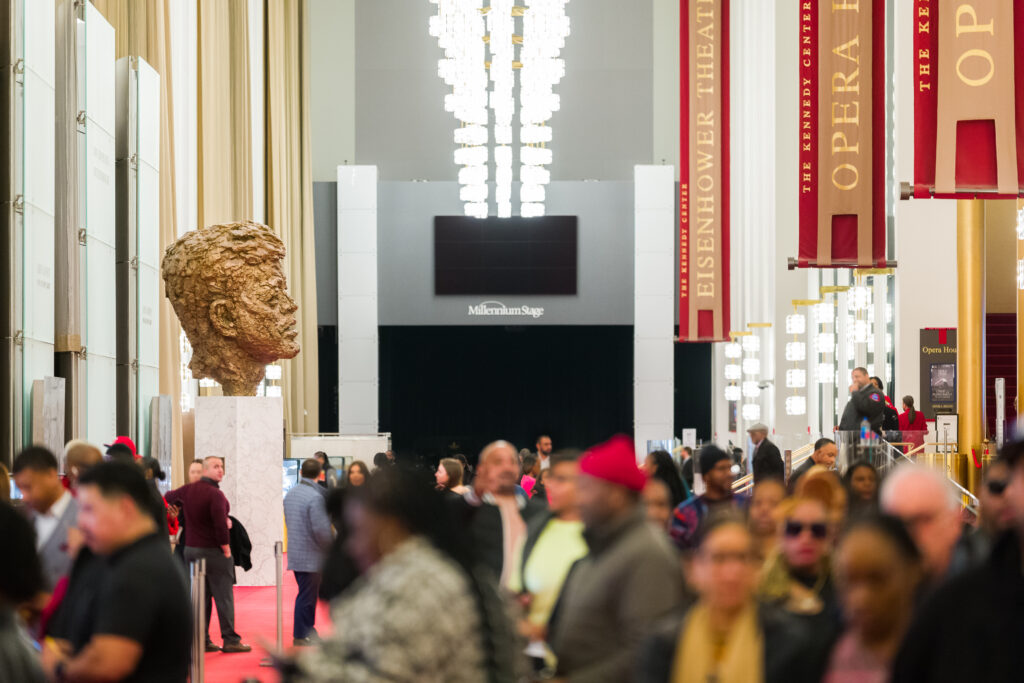
The Washington National Opera on Friday announced new venues for its spring season and a spike of donations from supporters after its public break with the Kennedy Center last week, as the performing arts complex faces upheaval following President Donald Trump’s takeover and a board vote to add his name to the building.
March productions of “Treemonisha” and “The Crucible” will be staged at the Lisner Auditorium at George Washington University — where the company gave its first performances 70 years ago — while a venue for its May production of “West Side Story” will be announced at a later date, the opera said.
“For this moment, returning to Lisner Auditorium is both a homecoming and renewal,” the opera’s general director, Timothy O’Leary, said in a statement, adding that the company plans to announce its 2026-2027 season across multiple venues later this year.
The relocation will come with a reduced seating capacity for the WNO’s March performances. The Kennedy Center’s Opera House has 2,364 seats, while the Lisner holds 1,500.
At the same time, the company reported an uptick in financial support, saying it received donations from more than 500 donors in the 72 hours after announcing its departure from the Kennedy Center on Jan. 9.
The opera’s annual fundraising gala, which had been scheduled for May at the Kennedy Center, will also move forward at a new venue to be announced later, the company said.
“Wicked” composer Stephen Schwartz, who said he had previously made an email commitment with the WNO to host the gala at the Kennedy Center but withdrew after the name change, was announced this week as a co-host for the relocated event — alongside Jamie Bernstein, author and daughter of composer Leonard Bernstein.
Schwartz noted in a statement to The Post that he was a part of the event that opened the Kennedy Center in 1971, Bernstein’s “Mass.”
“The Kennedy Center was founded to be an apolitical home for free expression for artists of all nationalities and ideologies,” he said. “It is no longer apolitical, and appearing there now has become a kind of ideological statement. As long as that remains the case, I will not appear there.”
Being an opera company newly without a home is “a big deal,” said Robert Spano, music director for the Washington National Opera. “It can feel chaotic, but we’re going to land on our feet.”
Spano likened moving to new performance spaces to being “in a completely new instrument” and said it requires “adjusting to what’s happening there spatially and acoustically.”
“Different venues provide different limitations, but they also provide different possibilities,” he said.
The size of the pit at Lisner could, for instance, raise questions about how to accommodate the full orchestra for “The Crucible,” he noted. “I don’t think we’re going to be changing the size of the orchestra, but I’ll find out tomorrow,” he told The Washington Post on Thursday evening. “The size of the ensemble is often heavily influenced by the venue.”
The opera’s departure occurred amid an uptick in performer cancellations at the Kennedy Center since the complex’s board of trustees, which was overhauled by Trump last year, voted in December to add his name to the center.
That move capped a year of turmoil for the center, which had seen waves of staff departures, artist cancellations and declining ticket sales since February, when Trump replaced the board of trustees with allies, who then named him chairman.
A Post analysis in October showed that ticket sales had plummeted across several genres at the Kennedy Center’s major theaters, including the Opera House.
The following month, the opera’s artistic director, Francesca Zambello, told the Guardian that the institutional turmoil had lead her troupe to consider moving out of the building. (At the time, the opera’s board chair denied plans to leave.)
Budget constraints had delayed the opera’s 2026-2027 season planning, a person familiar with the organization told The Post last month.
Last week, the opera announced it was leaving the Kennedy Center, citing changes to the institution’s business model and available resources.
The opera said in a statement that it would “seek an amicable early termination of its affiliation agreement with the Kennedy Center” and “resume operations as a fully independent nonprofit entity.”
The Kennedy Center said it had encouraged the end of the relationship, claiming that the Washington National Opera had become too much of a drain on the organization’s finances. Kennedy Center President Richard Grenell posted a portion of an email on X from what he said was the opera acknowledging that talks to split up began at his invitation last November.
“Having an exclusive Opera was just not financially smart,” he also wrote. “And our patrons clearly wanted a refresh.”
Some of the WNO’s patrons said they were dismayed by the breakup.
Karen Davis, who has been a Washington National Opera subscriber and donor for 38 years, said she was surprised to hear of the break-up and confused when she received an email this week telling her she would receive a refund from the Kennedy Center “with no cover letter, nothing.”
“I have to actually call because I don’t know where they’re going to refund me,” she said.
To Davis, the opera’s exit from the Kennedy Center is a big loss. It’s convenient to get to and built for the classic operas she enjoys.
“But I’ll keep going unless they’re too far out of town,” Davis said.
Susanna Beisler, a 55-year-old editor at the American Prospect, had purchased three tickets for next weekend’s American Opera Initiative program scheduled for the Kennedy Center’s Terrace Theater. She noticed this week a refund from the center on her credit card. (The American Opera Initiative, which was scheduled for Jan. 24, was postponed, Spano said, because they could not find a new venue on such a short timeline.)
Beisler said she’s eager to hear about upcoming performances and is more likely to buy additional tickets than in the past because of the company’s plight.
“It’s a very difficult situation, but this does offer more possibilities,” she said of the opera leaving the Kennedy Center. “I am concerned because I don’t know where else they could produce fully staged, grand opera in the manner they normally do, but I would be happy to see them put on smaller performances around the city in different venues than they might otherwise have used.”
Ryan McKinny, who is performing as John Proctor in the opera’s spring production of “The Crucible,” said in an email that he thought the company’s schism from the Kennedy Center was “the right thing to do.”
“I wouldn’t perform there in the current circumstance and every artist I have spoken to has expressed similar feelings,” the bass-baritone singer said. “It’s very sad it’s come to this but I’m proud of WNO for standing up for itself and its future.” He added that he hopes that “someday when the current leadership is no longer in charge, the WNO makes a triumphant return to the Kennedy Center.”
McKinny sees parallels between the current moment and the production he’s set to star in. “The Crucible is about leaders who persecute anyone who doesn’t toe the line, and what happens when someone chooses to stand up for the truth,” he said. “I expect audiences will find something that resonates today.”
Aaron Schaffer contributed to this report.
The post Washington National Opera announces new venues after split with Kennedy Center appeared first on Washington Post.