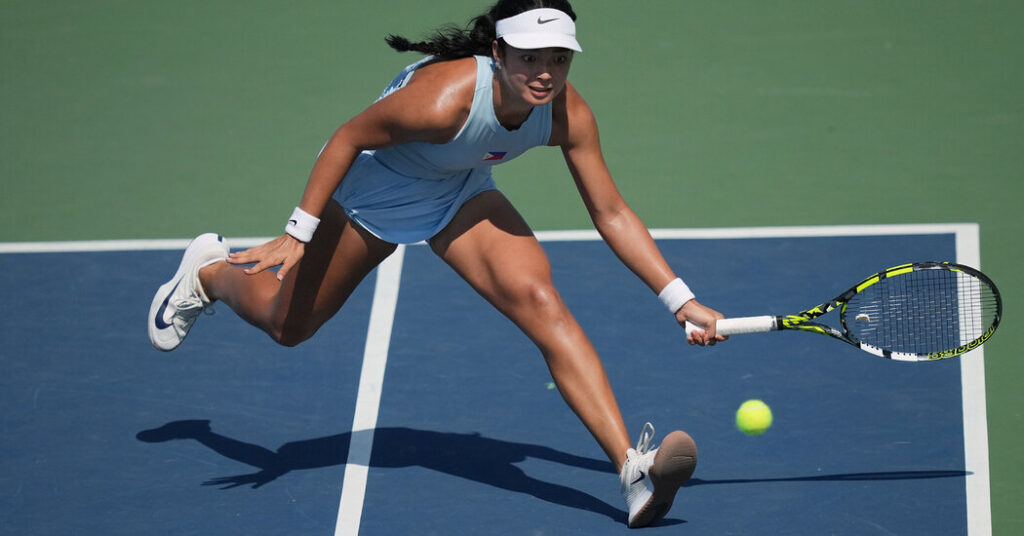
In mid-December, while many of their colleagues were wrapping up vacations and beginning preseason training ahead of the 2026 tennis year, Alexandra Eala and Janice Tjen were playing some of their most consequential matches.
Both were in Bangkok for the 33rd biennial Southeast Asian Games, a multisport competition involving close to 10,000 athletes from 10 nations across 50 sports, including Eala’s native Philippines and Tjen’s homeland Indonesia.
“These games are quite a big deal for our region,” said Eala by phone from Macau last month, where she was playing an exhibition. “It’s been on my radar and a goal of mine since I was very young.”
When the games concluded, Eala had claimed a gold medal in singles and Tjen had led Indonesia to the team title along with women’s doubles gold (with Aldila Sutjiadi). It was a fitting end to a breakout season for both.
“I just felt so much support,” Tjen said by phone last month from the Indonesia capital, Jakarta. “I know a lot of people are happy with my achievements.”
Eala and Tjen will be making their main draw debuts at the Australian Open, which begins Sunday in Melbourne. Tjen has never competed there, and Eala has lost in the first round of qualifying the last three years.
Both Tjen, 23, and Eala, 20, are part of a new wave of young, talented players from Southeast Asia, an area sparsely represented in professional tennis. Because of its size, population and proximity to Australia, the region is coveted by both organizers and sponsors of the only major championship to be contested within the Asia-Pacific.
“We are the Grand Slam of the Asia-Pacific so that area is critical to us,” said Cedric Cornelis, the chief commercial officer for Tennis Australia, by phone last month from Melbourne. “Chinese brands have long partnered with us and one of our major sponsors is Kia, the Korean car brand. Japanese players like Kei Nishikori and Naomi Osaka have been huge drivers of viewership.
“But Southeast Asia is a growing audience and has huge potential. Having two young players from Indonesia and the Philippines is very exciting for us.”
So valuable is the region that the Australian Open hosts the Asia-Pacific Wildcard Play-Off tournament open to all nationals ranked No. 105 or higher, in which the men’s and women’s singles and doubles winners are granted entry into the main draw.
Australians are excluded because they are already given most of the wild-card spots. (The United States also has a wild-card exchange, but is it based on points accumulated through a series of tournaments that were held late last year.)
Fifty years ago, the Australian Open was largely its own regional tournament. Many top players from the United States and Europe were reluctant to travel so far to compete in a tournament that started after Christmas. The women’s draw in 1976 featured 32 players from eight countries, including 21 from Australia. Only Kathleen Harter was from the United States.
The men’s side that year featured a 64 draw with 40 of the entrants from Australia and three — Stan Smith, Charlie Pasarell and Grover Reid — from the United States. All eight quarterfinalists hailed from the home country.
This year, the men’s and women’s entry lists showed some 38 nations included in the women’s field and about 30 in the men’s. The top four men entering the tournament — Carlos Alcaraz; Jannik Sinner, who won the event last year; Alexander Zverev; and Novak Djokovic — are from different countries. Four of the top seven women — Coco Gauff, Amanda Anisimova, Jessica Pegula and the returning champion Madison Keys — are from the United States.
Eala started as a swimmer like her mother, Rosemarie Maniego-Eala (a former Southeast Asian Games bronze medalist in the 100-meter backstroke), but quickly followed her older brother, Miko, to the tennis court. Eala, now ranked No. 49, is the first Filipino to break into the WTA’s top 50.
The winner of the 2022 U.S. Open junior title, Eala was ranked No. 140 in the world last March when she received a wild card to play in the Miami Open. She proceeded to upend the draw by defeating the former major winners Jelena Ostapenko, Keys and Iga Swiatek, before losing to Pegula in the semifinals. Her excitement and smile, coupled with a blistering backhand and creative short angles, made her a fan favorite.
“Being Filipino, hard work is a huge part of my identity,” said Eala last month. She made her Wimbledon debut last year wearing a hair tie that featured a sampaguita blossom, the national flower of the Philippines. “The culture really affects your values. It’s that feeling of community. We’re very positive people.”
When she was about 5, Eala had her picture taken with her idol, Maria Sharapova. A poster of Sharapova still hangs on the back of her bedroom door. As a teenager she moved to Spain to train at the Rafa Nadal Academy, graduating from the high school there in 2024. It was under the watchful eye of the 14-time French Open champion that Eala learned resilience, perseverance and the ability to race from one end of the court to the other. She still shouts “vamos” to motivate herself after points.
Tjen and Eala have known each other since their junior days. But while Eala always knew she wanted to turn pro, Tjen chose the U.S. college route, earning all-American honors at the University of Oregon and Pepperdine University. She joined the pro tour full time after graduating with a degree in sociology in 2024. When she qualified and won a round at the U.S. Open last year, Tjen became the first Indonesian to do so in more than 20 years.
“College was a huge steppingstone for my pro career,” said Tjen, who won her first pro title at the Chennai Open in India, in November and is ranked No. 56. “The college environment can be a little hostile and that really helped me get strong mentally and tactically.”
By the time Eala played her first WTA tournament of this year in Auckland, New Zealand, she was already being trailed by legions of Filipino supporters. When she defeated the 2024 Wimbledon semifinalist Donna Vekic in the first round, she charmed the crowd by telling the on-court interviewer, “If there’s one thing I learned in 2025, it’s that home is the people and not the place.”
The fans roared their approval.
Throughout the years there have been a few moderately successful Southeast Asian players. Thailand’s Paradorn Srichaphan reached a career-high No. 9 on the ATP in 2003. Tamarine Tanasugarn was born in Los Angeles, but competed for Thailand, reaching the Wimbledon quarterfinals in 2008. Yayuk Basuki became the first Indonesian to win a WTA title in 1991. And the Filipino Treat Huey, a all-American at the University of Virginia, won eight career ATP doubles titles.
The WTA recently announced its first-ever WTA 125 tournament to be played in Manila later this month. It coincides with the second week of the Australian Open, but if Eala and Tjen lose early in Melbourne they could attend.
Asian nations like China and Japan have a rich tennis history. China’s Li Na became the first Asian-born player to win a major at the French Open in 2011. She also reached three Australian Open finals, winning the title in 2014. Osaka, who grew up in the United States, won her two U.S. Open and two Australian Open titles while competing for Japan. She cherishes the richness of so many new and different faces in the locker room, including Tjen and Eala.
“It’s funny when you compare tennis to other sports,” Osaka said in an interview while in New York in December for the Garden Cup exhibition. “It’s kind of like the Olympics at every tournament. We all share our cultures and get to mingle with so many different languages and so many different upbringings. I feel really lucky to be able to do that.”
The post At the Australian Open, these Players Represent Southeast Asia’s Potential appeared first on New York Times.