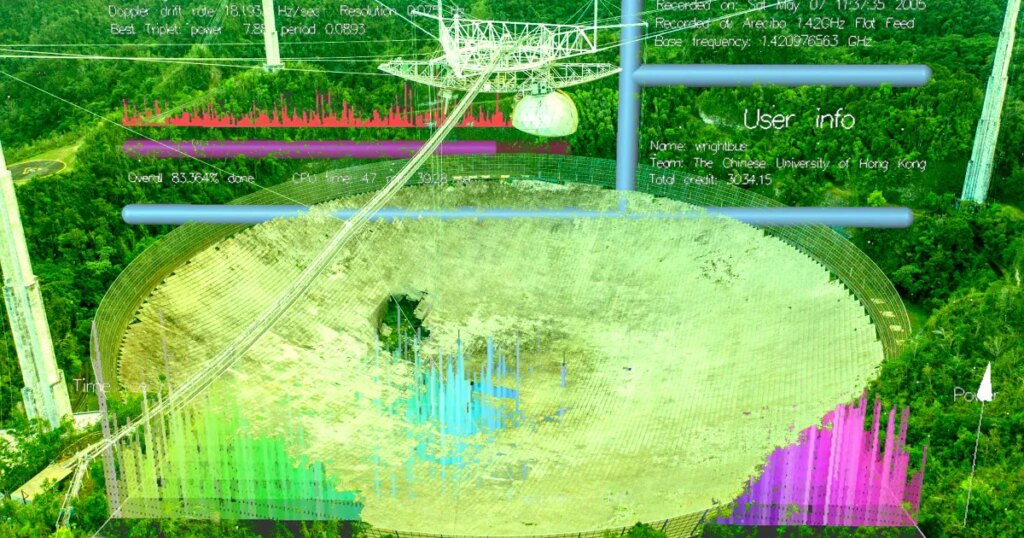
For over two decades, millions of people volunteered the computational capacity of their computers to help UC Berkeley scientists in their search for extraterrestrial intelligence (SETI).
The goal of the project, called SETI@home, was to trawl through data collected by the Arecibo Observatory in Puerto Rico for signs of unusual radio signals from the cosmos. It was a powerful example of “distributed computing,” which relies on a huge network of individual computers — but whether the search has borne any fruit remains unclear as scientists continue to analyze the wealth of data.
SETI@home concluded after 21 years in 2020, producing a whopping 12 billion detections, according to a UC Berkeley press release, making it “one of the most popular crowd-sourced research projects ever.”
Over the years, researchers whittled down the data to just 100 signals that were “worth a second look” by eliminating radio frequency interference and noise with the help of a supercomputer. Since July, they’ve been using China’s Five-hundred-meter Aperture Spherical Telescope (FAST), in the hopes of catching another glimpse of the identified targets.
Unfortunately, the Arecibo Observatory — once the world’s largest radio telescope — collapsed during a storm in 2020, and is being decommissioned.
Even if the project never leads to first contact with an intelligent extraterrestrial species, it doesn’t mean SETI@home was a waste of time. Researchers are still trawling through the FAST data, but early conclusions of the project and its effectiveness have already resulted in two papers that were published last year in The Astronomical Journal.
“If we don’t find ET, what we can say is that we established a new sensitivity level,” said project cofounder David Anderson in a statement. “If there were a signal above a certain power, we would have found it.”
The team is hoping to inspire a successor to the crowdsourced research project, while applying what they’ve learned.
“Some of our conclusions are that the project didn’t completely work the way we thought it was going to,” Anderson said. “And we have a long list of things that we would have done differently and that future sky survey projects should do differently.”
Astronomer and project director Eric Korpela also pointed out that the considerable amount of radio interference, which can emanate from other sources, including radio and TV broadcasts and even microwave ovens, could seriously mess with the data.
“We have to do a better job of measuring what we’re excluding,” he said. “Are we throwing out the baby with the bath water? I don’t think we know for most SETI searches, and that is really a lesson for SETI searches everywhere.”
Given the lack of a smoking gun after trawling “billions and billions” of stars in the Milky Way, the project left the alien-hunting organizers somewhat deflated.
“We are, without doubt, the most sensitive narrow-band search of large portions of the sky, so we had the best chance of finding something,” Korpela explained. “So yeah, there’s a little disappointment that we didn’t see anything.”
However, the researcher hasn’t given up on the idea, particularly given the immense advancements in computer power and improved internet connections.
“I think that you could still get significantly more processing power than we used for SETI@home and process more data because of a wider internet bandwidth,” Korpela said. However, “the biggest issue with such a project is that it requires personnel, and personnel means salaries. It’s not the cheapest way to do SETI.”
And plenty of what-ifs remain, especially considering the limitations of the SETI@home project.
“There’s still the potential that ET is in that data and we missed it just by a hair,” he pondered.
More on radio signals: Scientists Intrigued by Radio Signals Coming From Comet
The post Network of Home Computers Detected 100 Potential Alien Signals appeared first on Futurism.