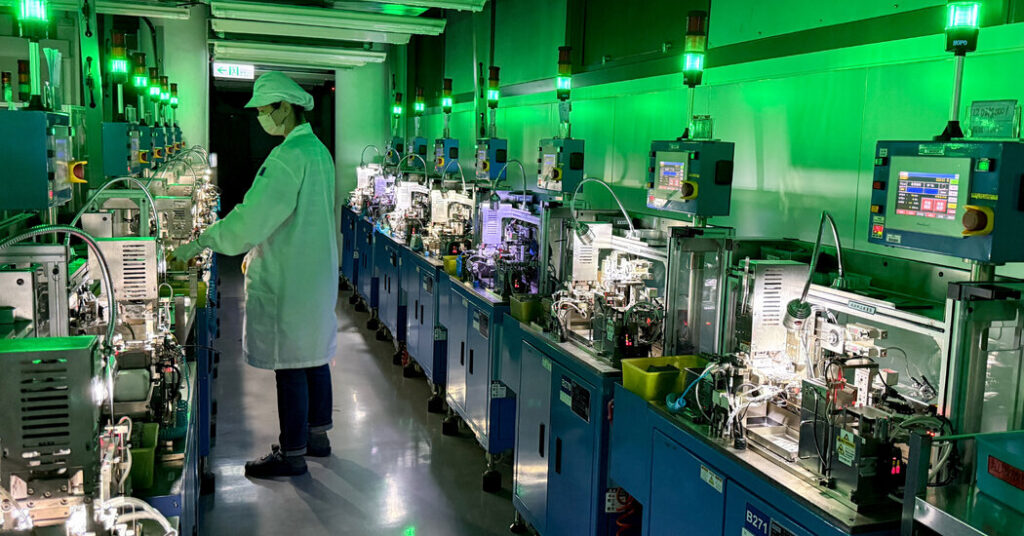
The United States announced a trade agreement with Taiwan on Thursday, securing commitments to invest $250 billion in semiconductor and technology manufacturing in America in exchange for lower tariffs on imports from the island.
The deal concludes months of negotiations focused on Taiwan’s lucrative chip-making industry, a key node in the global tech supply chain. Since last April, the Taiwanese team, led by Vice Premier Cheng Li-chiun and the chief trade representative Yang Jen-ni, flew to Washington six times to hammer out the agreement, which the Trump administration hailed as “restoring American semiconductor manufacturing leadership.”
Taiwanese officials now face another challenge: selling the deal at home to a public concerned that it would hollow out an industry that is the centerpiece of Taiwan’s economy. It’s more than jobs and revenue. Taiwan’s chip manufacturing sector is so valuable globally that it is seen by some as a shield against possible aggression by China, which claims Taiwan is part of its territory.
President Trump has repeatedly pressed Taiwan to loosen its vice grip on advanced semiconductors and to move production to the United States. Taiwan has one of the largest trade deficits with the United States. Chips and electronics account for 90 percent of that, Taiwanese officials said.
“We are going to bring it all over so that we become self-sufficient in the capacity of building semiconductors,” Howard Lutnick, the commerce secretary, said in a television interview on Thursday.
In addition to the billions in investment by Taiwanese companies, the two sides agreed that Taiwan’s government would provide an additional $250 billion in credit guarantees to support smaller firms in the industry’s complex chip supply chain to expand in the United States.
The Trump administration said it would lower the U.S. tariff rate on Taiwanese goods to 15 percent from the current 20 percent, an important concession since the United States overtook China in 2024 as Taiwan’s largest export market. Taiwan is also a major supplier of steel products to the United States, especially metal fasteners such as screws and bolts.
By value, only a small portion of Taiwan’s exports have been subject to the tariffs. These include plastic, textile and agricultural products. Under the new agreement, Washington would waive tariffs on generic pharmaceuticals and their ingredients, as well as aircraft parts and some natural resources.
Although the tariff reduction brings Taiwan in line with its neighbors, Japan and South Korea, the burden on manufacturers in traditional industries remains significant.
“Fifteen percent is still very high,” said Darson Chiu, director-general of the Confederation of Asia-Pacific Chambers of Commerce and Industry. “Their profit margins are not that high.”
The Trump administration had already exempted the majority of Taiwan’s high-tech exports — semiconductors and many electronics — from those tariffs, saying those sectors would be subject to separate national security tariffs issued under a legal provision known as Section 232.
Under the new agreement, the United States said it would allow Taiwanese companies that have built or are building semiconductor facilities to import a certain amount of chips, proportional to their U.S. production capacity, without paying the duty.
Taiwan said that, as the source of most of the world’s advanced chips, it had requested preferential treatment regardless of any tariffs the Trump administration imposes under Section 232.
Last March, Taiwan’s biggest chip maker, Taiwan Semiconductor Manufacturing Company, committed to investing $100 billion to expand its operations in Arizona. That amount will count toward the $250 billion, Mr. Lutnick said.
TSMC said this week that it plans to build more factories, known as fabs, in the United States.
The company recently bought a second piece of land in Arizona, C.C. Wei, chief executive of TSMC, said during the company’s earnings call on Thursday. “That gives you a hint of what we plan to do, because we need it. We are going to expand many fabs out there.”
TSMC has stressed that it is expanding because of customer demand, not to appease geopolitics. The Taiwanese giant makes chips for many of the world’s biggest tech companies, including Apple and Nvidia, and reported record revenue last year amid booming global interest in artificial intelligence, which requires large numbers of semiconductors.
TSMC planned to spend as much as $56 billion in the coming year on new fabs and other capital expenditures, Mr. Wei said.
The company’s operations in Arizona have already encountered a tangle of bureaucratic challenges, resulting in added costs and delays. The process of getting a new factory off the ground takes twice as long in Arizona as in Taiwan, Mr. Wei said last year.
Now, the Trump administration is pushing for more of Taiwan’s chip supply chain to join TSMC in the United States. Mr. Lutnick said the administration aims to bring 40 percent of Taiwan’s supply chain and chip-making to the United States.
If investing in the United States has been a challenge for TSMC, which reported gross profit margins above 60 percent last year, it’s an even bigger risk for smaller firms, said Dachrahn Wu, executive director of an economic research center at National Central University in Taoyuan, Taiwan.
The dozens of companies that supply materials and equipment to TSMC operate on much thinner margins, said Jason Hsu, a former Taiwan legislator and senior fellow at the Hudson Institute, a think tank in Washington.
To expand their operations globally, these companies will need major government support, Mr. Hsu said. “Without these peripheral suppliers, TSMC is not going to be able to operate at the same scale and with the same efficiency as it does in Taiwan.”
To help with the process, the United States had agreed to assist Taiwanese companies in acquiring resources such as land, water, electricity, infrastructure, tax incentives and visa programs, Taiwan’s cabinet, the Executive Yuan, said in a statement on Friday.
TSMC’s commitment to spend $100 billion in Arizona has already stirred debate and misgivings in Taiwan.
In Taipei on Friday, officials downplayed the notion that the deal represented a large-scale relocation of Taiwan’s chip industry, while emphasizing that the sector has deep local roots. The government has supported the growth of the semiconductor industry on the island through decades of investment, infrastructure building and talent incubation.
“Taiwan has a sacred mountain that protects the nation,” Premier Cho Jung-tai said on Friday. As long as the most advanced chip-making remains at home, Taiwan can maintain its dominance in the industry while expanding globally, he said.
But there is skepticism that shifting production to the United States will benefit Taiwanese businesses in the long run. Last year, the U.S. Commerce Department took a stake in TSMC’s American rival, Intel, as part of a push to manufacture cutting edge technology in the United States. In recent years, TSMC has manufactured the most advanced chips designed by Intel.
Mr. Wu at National Central University said that more American investment would not keep Taiwan secure. “If the U.S. has its own supply chain, why would it need to protect Taiwan?”
Meaghan Tobin covers business and tech stories in Asia with a focus on China and is based in Taipei.
The post Taiwan Reaches Trade Deal With Trump and Pledges More U.S. Chip Factories appeared first on New York Times.