The Trump administration’s removal of Nicolás Maduro as president of Venezuela has given the United States new leverage over an old adversary: Cuba.
Cuba relies on imports for most of its oil. It has been able to barter for this crucial commodity since April 1960, thanks in large part to its position as a beacon of socialism and a thorn in the side of the United States. But the Trump administration has blocked oil shipments to Cuba from Venezuela and pressured Cuba’s two other main suppliers, Mexico and Russia, to reduce shipments.
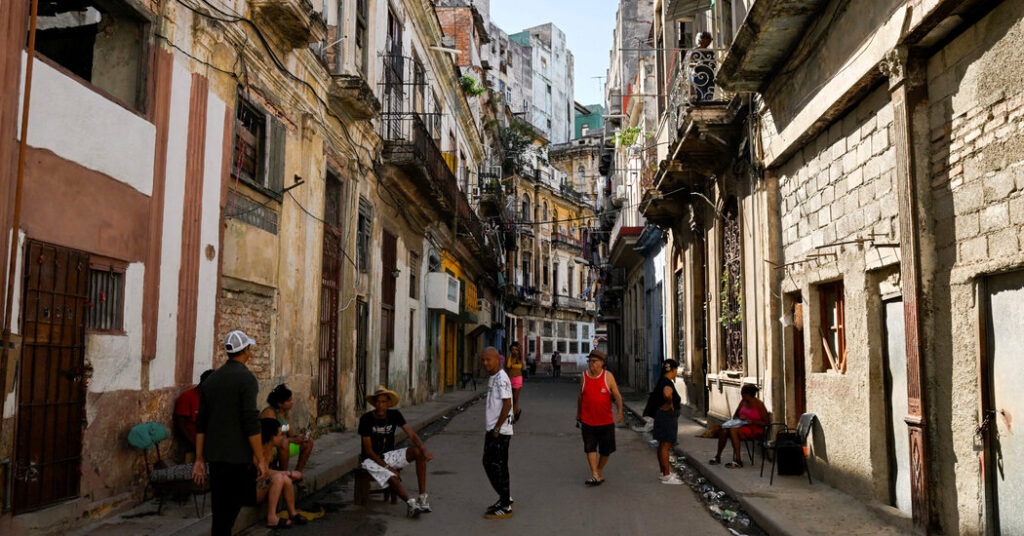
By most accounts, Cuba has less than two months of imported oil on hand. Power blackouts are already rampant, the country’s economy is contracting and street protests have flared up despite repression by Cuba’s vaunted security apparatus. The immediate future looks even worse.
But before you conclude that Cuba is doomed, remember: It has been in terrible shape many times before.
I was there during one of those times. It was 1989, months before the fall of the Berlin Wall. I flew to Havana as a correspondent for Newsday to cover a visit by Mikhail Gorbachev, who turned out to be the last leader of the Soviet Union. He went to Cuba to explain to Fidel Castro, Cuba’s own “Maximó Lider,” that Soviet support for Cuba would soon be coming to an end. Back then, the Soviet Union was Cuba’s main benefactor and oil supplier, much as Venezuela had been until the capture of Mr. Maduro this month.
In September 1991, I was in Moscow when Gorbachev announced that the Soviet Union would soon pull 11,000 troops from Cuba. A few months later, the Soviet Union itself ceased to exist. Without Soviet help, the Cuban economy looked ready to unravel.
What happened afterward wasn’t pretty. In the months — and, ultimately, decades — that followed, many Cubans suffered and hundreds of thousands of people fled the country, but the Cuban government has managed to survive.
Keep that in mind when assessing Cuba’s plight now. The country is in grave trouble, no doubt. But to paraphrase Mark Twain, it’s possible that reports of Cuba’s demise are greatly exaggerated once again.
Decades of Solitude
Now that I’m a financial columnist, assessing the geopolitics of Cuba isn’t part of my routine. To put it bluntly, Cuba barely matters in the global economy and markets. It is startling that an oil crisis has put the island nation back on my radar.
The Havana stock exchange was housed in a picturesque building that you can still see in the lovely, fading city’s downtown. But trading on the exchange fell into the doldrums more than 60 years ago, and then stopped completely, after the government nationalized leading industries, including all those owned by U.S. investors. Today, Cuba isn’t included in standard financial roundups for global investors — not even those specializing in emerging markets. It isn’t part of any major index that tracks global stock and bond markets. While companies controlled by the country’s military have been building hotels and other tourist niceties, you can’t easily invest in the country in your workplace retirement account in the United States.
How Cuba’s commercial isolation came about is a tangled historical question. The United States has played a major role in enforcing Cuba’s financial solitude since the revolution in 1959. The Eisenhower administration imposed the first trade and financial restrictions, which President John F. Kennedy ratcheted up sharply during the Cuban missile crisis of 1962. The various restrictions have ebbed and flowed — they were relaxed considerably during the Obama administration. But the United States has maintained them, in one form or another, ensuring that Cuba remained barely a factor in world markets.
Whether the Cuban revolution was destined to lead to Communism is another issue that historians will be debating for decades.
Were Castro and his brother and successor as Cuban leader, Raúl, as well as their comrade Che Guevara, Marxist-Leninist at the start? Many U.S. journalists didn’t think so. In April 1959, Castro came to New York and captivated the city. He said on the NBC show “Meet the Press” that given a choice between Communism and “democracy,” he sided wholeheartedly with democracy. Americans are “really nice people,” he said. And he told U.S. newspaper editors on that same 1959 visit, “I have said very clearly — we are not Communists.”
By the early 1960s, however, Cuban leaders were certainly close allies of the Soviet Union, and soon they were, unquestionably, doctrinaire Communists. In fact, unclassified documents now show that after the Gorbachev visit of 1989, and as the Soviet state collapsed, Castro criticized Gorbachev for what he saw as a disastrous swerve from orthodoxy. Gorbachev, you may recall, was preaching “perestroika,” reforms that included a radical reduction in central planning of the economy. Gorbachev failed. And by the early 1990s, Castro saw himself as a member of the old guard, fighting to preserve Marxist-Leninist purity.
Hemmed in by the United States and, for long periods, fervently anticapitalist, Cuba needed help from unconventional places.
In left-wing politics, and in its geopolitical significance as a socialist redoubt only 90 miles from the U.S. coast, Cuba has always punched way above its weight. Cuba’s doctors and nurses, soldiers, spies and security specialists have found temporary homes in many countries. And since the 1960s, it has been an ally not only of the countries of the former Soviet bloc but of left-wing groups and governments in a variety of countries, including Nicaragua, Bolivia, Chile, Angola, Algeria, China and, of course, Venezuela.
Cuba once traded its sugar, at friendship prices, for oil and technology with the countries of the old Soviet bloc. While Communism has faded away in most of those places, Russia, the Soviet Union’s main successor state, is flexing its muscles globally under Vladimir V. Putin and has maintained close relations with Cuba. And in Venezuela, Cuban intelligence and military services worked to keep Mr. Maduro in power, alerting him to a coup attempt in 2019 and helping him defeat it.
Oil Diplomacy
All this has helped to give Cuba access to important resources — most critically oil.
“In one form or another, Cuba has always bartered for oil,” said Jorge Piñon, a former Mexican oil executive and Cuban energy expert who works at the University of Texas at Austin.
Until the last six months or so, Venezuela was Cuba’s primary source of oil, with Russia, Mexico and other countries providing additional supplies.
Mexico’s role became increasingly important last year, as Venezuelan oil production and exports slackened in the face of sanctions and aging infrastructure, while sanctions imposed during the Ukraine war reduced shipments of Russian oil.
Because shippers of restricted oil use evasive tactics to avoid detection — “ghost fleet” ships aren’t always captured in standard statistics — complete and reliable data on oil shipments in the region isn’t available. Some reports have said Mexico at one point last year became the biggest oil supplier to Cuba. But I’m not confident about much of the data I’ve seen.
This much seems clear: Mr. Piñon reports a sharp decline in Mexican oil shipments to Cuba in the final three months of last year. That drop started soon after Secretary of State Marco Rubio visited Mexico City in early September.
Facing the prospect of steep tariffs and the threat of direct U.S. intervention against drug cartels on Mexican territory, President Claudia Sheinbaum of Mexico came under intense pressure from the Trump administration. She made a flurry of concessions to the United States while stressing her commitment to preserving Mexican sovereignty and independence.
Mexico has couched its oil trade with Mexico as “humanitarian aid,” based on a longstanding friendship between the countries and supplied through the Gasolinas Bienestar subsidiary of the heavily indebted state oil company, Pemex. The Ocean Mariner, a Liberian-flagged tanker, unloaded 85,000 barrels of oil in Havana earlier this month, according to Mr. Piñon, and in a news conference on Wednesday, President Sheinbaum said there would be further shipments. She also offered to serve as a go-between in negotiations between Cuba and the United States at some future date.
At current low volumes, Mexican oil shipments alone won’t be enough to maintain the Cuban economy. What room for agreement might exist between President Trump and Miguel Díaz-Canel, the president of Cuba and first secretary of its Communist Party, can only be imagined.
The end of this saga isn’t in sight. But we have entered a new historical stage in a long-running story about oil, markets and power politics, focused on this hemisphere.
Jeff Sommer writes Strategies, a weekly column on markets, finance and the economy.
The post What’s Next for Cuba, Now That Its Main Oil Supplier Is Gone? appeared first on New York Times.