(3 stars)
Thirty years after Israeli forces violently expelled Sharif and his family from their home in Jaffa, he tells his adult son about the delectable fruit they once grew on the property.
“Our family was one of the most important exporters of oranges in the world,” he says in Arabic, referring to life before the Nakba (translating to “catastrophe,” a term used for the mass displacement of Palestinians during the 1948 Arab-Israeli war). “Salim, Queen Elizabeth ate our oranges.”
“Queen Elizabeth ate all our oranges,” Salim responds in exasperation. His father agrees but finds this amusing. “She took them all!” he says, chuckling to himself.
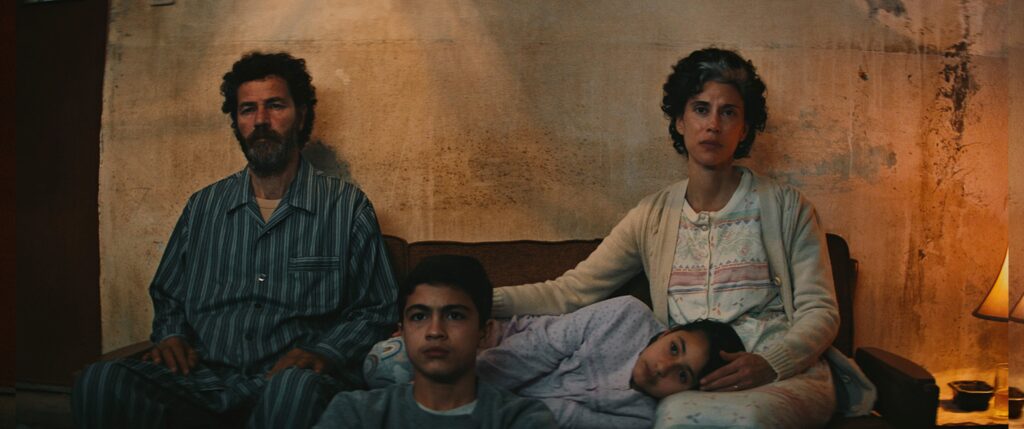
This scene captures the heart of “All That’s Left of You,” a multigenerational epic written and directed by Cherien Dabis, a Palestinian American, that explores what it feels like to live through relentless trauma. The film tactfully infuses gentle humor and nostalgia into its disturbing tale of a Palestinian family ripped apart by Israeli occupation. It follows patriarch Sharif (played by Mohammad Bakri in his older age and the renowned actor’s son Adam Bakri during the Nakba); his youngest son, Salim (Saleh Bakri, another of Mohammad’s sons, as an adult and Salah Aldeen Mai as a child); and Salim’s oldest son, Noor (Muhammad Abed Elrahman as a teenager and Sanad Alkabareti as a child).
While following the family’s male lineage, the narrative unfolds through flashbacks from the perspective of Salim’s wife, Hanan (Dabis), who shares their history with someone whose identity is not revealed until the third act. “You don’t know very much about us,” Hanan says. “It’s okay, I’m not here to blame you. I’m here to tell you who is my son. But for you to understand, I must tell you what happened to his grandfather.”
Hanan, reflecting on Noor getting shot by Israeli soldiers during a West Bank protest in 1988, traces the violence back to his grandfather, Sharif, being forcefully removed from his home 40 years before. Dabis and cinematographer Christopher Aoun (“The Man Who Sold His Skin”) do some of their best visual work in these early scenes, which are beautifully tragic. The magical golden-hour lighting in which Sharif meanders through the orange groves with his son contrasts with the cruelty of the drab refugee tent camps to which so many of their people are callously displaced.
Hanan, who speaks to the unnamed person — and, therefore, viewers — in 2022, revisits three years in her family history: 1948, during the Nakba; 1978, when Sharif lives with Salim, Hanan and their young children; and 1988, when Noor is shot. The latter two eras contain the film’s strongest performances. Mohammad Bakri commands attention as he solemnly — and, more often than not, indignantly — recalls all that was stolen from him. “They take your land, your health, your money,” he tells the doctor examining his heart, which was irreparably damaged when he suffered a heart attack in a labor camp.
As the adult Salim, Saleh Bakri effectively delivers the most difficult performance of the film. While less resentful than his father, who possesses adult memories of how Israel came to be, Salim exudes a jaded, heartbroken quality born of spending years subjugated to the often terrifying whims of Israeli soldiers. Bakri carries this existential weariness in his tense shoulders and drooping facial expressions.
Dabis is warm and speaks in soothing tones as Hanan tries to provide her children with a semblance of normalcy. But she shifts her demeanor when appropriate, hardening as a protective measure when Israeli bureaucrats threaten her family’s safety.
The film reaches its peak when Salim and Noor accidentally stay out a few minutes past curfew while retrieving medicine for Sharif. Mere feet from their home, they run into soldiers who taunt them and force Salim at gunpoint to refer to himself and his wife using derogatory terms. Noor stands behind his father, incensed by the humiliation — but also, it turns out, by Salim’s unwillingness to stand up for himself. (Salim, meanwhile, believes he is protecting his family by capitulating.) Tension builds in the days after the soldiers let them go, until Noor finally bursts, accusing his father of being a coward. His words haunt him for the next decade.
This encounter with Israeli forces is the most anxiety-inducing scene in “All That’s Left of You,” in which most of the violence is implied. Dabis herself has characterized the story as “a drama with piercing moments of joy, love and humor that keep it from becoming too hard to watch.”
Therein lies a central dilemma of making art about Palestinian struggle: Is it dishonest to omit the brutality on-screen, or respectful of the generations who have suffered? Who is the intended audience of a film that serves to humanize Palestinians, when Palestinians have always known this to be true and have communicated it for just as long?
Dabis’s film, while generous in its expressed empathy, is more for Westerners in need of a history lesson than it is for the community it lovingly depicts. The third act, which unfolds after Noor gets shot, becomes a bit muddled as it urges viewers to pursue the righteous path over one marred by hatred and lust for revenge — another message better received by the Western leaders influencing current policy in Gaza.
At minimum, “All That’s Left of You” is a thoughtful exploration of how trauma can both fracture and bond a family. But for those who need it, the film serves as an urgent reminder of how ignorance and passivity undermine what it means to be human.
Unrated. At Angelika Film Center Mosaic and Angelika Pop-Up at Union Market. Contains mature themes and war images. In Arabic, with English subtitles. 145 minutes.
The post ‘All That’s Left of You’ tempers relentless trauma with gentle humor appeared first on Washington Post.