Colombia’s President Gustavo Petro, a stalwart leftist, has promised to achieve peace settlements with armed groups that have kept the country in a near-constant state of conflict for more than half a century.
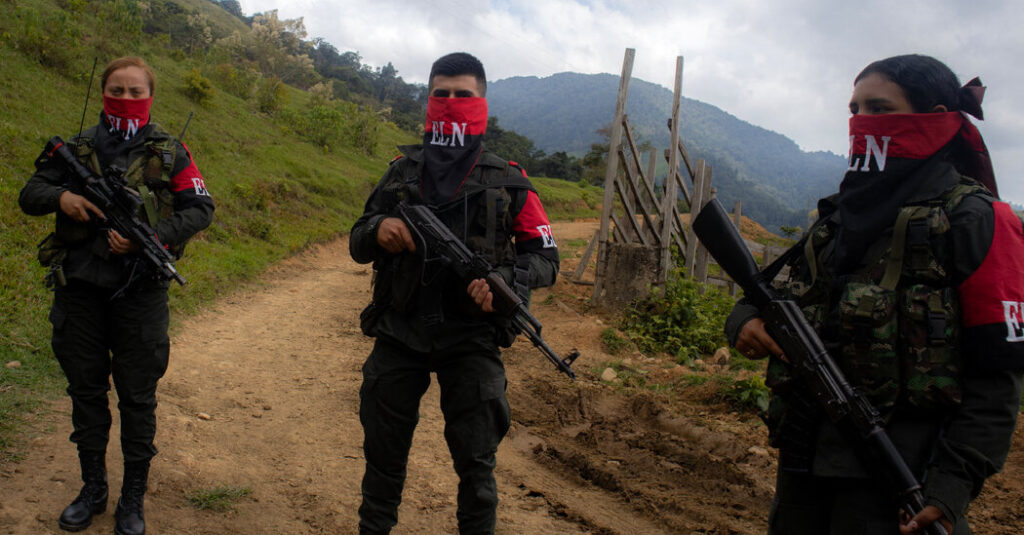
But now Mr. Petro is threatening military action, alongside Venezuela, against the largest of those groups, the National Liberation Army, or ELN, a one-time revolutionary guerrilla group that experts say has become a major cocaine trafficker with a deep foothold in Venezuela.
“If the ELN does not join the peace process by leaving Venezuela, there will be joint military actions with Venezuela,” Mr. Petro wrote on X on Monday.
Venezuela’s interim government did not respond to a request for comment on Mr. Petro’s message. But his warning reflects the pressure facing Latin American leaders as President Trump demands that the region’s countries — from Colombia to Mexico — target groups the United States has designated as terrorist organizations, or risk unilateral U.S. action.
The fear that Mr. Trump is serious grew significantly this month after the United States raided Venezuela and captured its leader, Nicolás Maduro, citing as a justification his federal indictment on charges of narco-terrorism.
The Trump administration has declared that the United States is in an armed conflict with a confidential list of 24 drug cartels and criminal groups it has designated as terrorists. (There is no evidence that the groups are engaged in such a conflict.)
The ELN is on that list, which The New York Time obtained.
The ELN’s top commander, Eliécer Herlinto Chamorro Acosta — who uses the nom de guerre Antonio García — in response to questions from The Times, asserted that U.S. prosecutors “will not find evidence because there is none — it does not exist. We are not and will not be drug traffickers.” He also denied the group was present in Venezuela.
The ELN formed in Colombia as a Catholic-Marxist group in the 1960s. But experts say that by the 1990s it had turned to cocaine trafficking, like the more powerful Revolutionary Armed Forces of Colombia, or FARC.
Then Colombia’s U.S.-backed military descended on the groups and the FARC splintered. Experts say the ELN took refuge in Venezuela, and expanded there, growing wealthier through drug trafficking, tripling in size to around 6,000 fighters, and forging links with corrupt Venezuelan officials.
Colombian authorities have said that the armed group served as a useful shield for the Maduro government against domestic and foreign threats.
As the U.S. military buildup began in the Caribbean, Venezuelan officials relied on the ELN to protect the border with Colombia, which they worried could be a back door for U.S. military operations, and the ELN vowed to respond to any American intervention, said Elizabeth Dickinson, an analyst at the International Crisis Group, a research institution.
“The message from Caracas over these recent months has been you lock down the border, that’s your job,” she said.
With Mr. Maduro gone and Venezuela’s interim government leaning toward rapprochement with Washington, the future of that alliance is uncertain.
Mr. García, of the ELN, acknowledged contact with the Maduro government, but said it was in the context of its peace negotiations with Colombia.
Colombia and Venezuela’s escalating crackdown on drug traffickers appears focused on Catatumbo, a mountainous border region that the ELN has fought to control.
Venezuela’s interior minister, Diosdado Cabello, in a news conference this week touted recent anti-narcotics operations, including in the Venezuelan side of Catatumbo. He called them a “serious blow” to the cocaine industry and the “narrative that Venezuela is a country that facilitates the traffic of drugs.”
He did not name the ELN. Asked by a reporter which “cartels” were involved, Mr. Cabello deflected. “Depends,” he said, adding, “What we do know is that they come from Colombia.”
Mr. Cabello’s assertions came as the he stands accused, in the federal indictment against Mr. Maduro, of being “enriched” by drug profits and of partnering with the ELN and other groups.
The day after Mr. Maduro’s capture, President Trump accused Mr. Petro of also being involved in the drug trade and suggested military action against Colombia was possible.
A hastily arranged phone call between the two presidents eased tensions but only increased the pressure on Mr. Petro, experts say.
In recent days, the Colombian president repeatedly trotted out data on his government’s drug seizures and its success in curbing the cultivation of coca, the base product for cocaine, which nonetheless remains at record levels amid soaring global demand.
He also turned his sights on the ELN. Peace talks between the government and the group were suspended last year after particularly deadly clashes in Catatumbo left 80 dead and more than 50,000 displaced, an episode Mr. Petro called a “massacre.”
This week, the ELN proposed a nationwide “agreement” with the government, an offer Mr. Petro rebuffed. “An agreement was offered, and the ELN destroyed it with blood and fire,” he wrote on X.
He called instead for ELN fighters in Venezuela to disarm, return to Colombia, and begin a process to cede territory and reintegrate into society — or face military action.
“The order I gave was a total offensive against the ELN in Catatumbo,” Mr. Petro said in an interview with The Times.
After Mr. Maduro’s capture, Mr. Petro also announced the deployment of 30,000 troops to his country’s 1,300-mile border with Venezuela. “The first order I gave was not to defend Venezuela or anything like that,” he said, alluding to claims he was in league with Mr. Maduro. Instead, Mr. Petro said, he ordered ELN fighters to “disarm and re-enter Colombia.”
Experts say Mr. Petro’s resolve to either dismantle or crush the ELN is a reflection both of Mr. Trump’s demands, and of domestic frustration over his past handling of armed groups.
Mr. Petro, Colombia’s first leftist president, entered office in 2022 criticizing its military-focused strategy against the groups as ineffective. He promised “total peace” with the groups, some of which still claim to be left-wing revolutionaries.
During talks, the military paused offensive operations, but analysts and government officials say groups like the ELN took advantage to expand their territory in Colombia, plant more coca crops and consolidate trafficking routes.
Ms. Dickinson, the analyst for the crisis group, said the failure of the government’s peace policy came as a disappointment to Mr. Petro and his government.
“They really believed that they could sit these armed groups down and make a deal because of who they were,’’ she said, “because they’re left and because they know them.”
The lack of any breakthrough shifted Mr. Petro toward “a hardhanded approach,” Ms. Dickinson added.
Mr. Petro’s original approach also eroded trust with Colombia’s security forces. A patchwork of cease-fires left them without any clear rules of engagement with armed groups.
“It’s difficult for police and soldiers to know exactly how they’re supposed to be combating those groups,” said Geoff Ramsey, who studies Colombia and Venezuela at the Atlantic Council, a Washington research institute.
Colombia has one of the region’s largest militaries, with about 269,000 active personnel — second only to Brazil in South America. Yet analysts say much of its equipment is aging and costly to maintain.
Mr. Petro, in the interview with The Times, also expressed concern over the military’s lack of newer technology including drones, even as the ELN has become a technologically capable and organized force.
The ELN commander, Mr. García, said his organization’s “engineers and technicians” had built drones and anti-drone systems over the past decade. Analysts say the group is, in fact, known to have such armaments.
Mr. Trump has suggested that United States wants to carry out land strikes against designated cartels and the administration is pressing Mexico to allow U.S. military forces to conduct joint operations against fentanyl labs in that country.
It is unclear if the United States has similar plans for Colombia or Venezuela.
Ms. Dickinson said any strikes against the ELN could cause civilian casualties and do little to dismantle the group.
“The ELN is not like a conventional force, it’s not like they’re parked in the forest and you can just bombard them,” she said. “They work in plain clothes, they operate within cities and towns. You can’t blow up the ELN. It doesn’t work.”
Jorge Valencia and Sheyla Urdaneta contributed reporting.
Annie Correal is a Times reporter covering Mexico, Central America and the Caribbean.
The post After Trump Call, Colombia Turns Up Heat on Rebels Accused of Drug Trafficking appeared first on New York Times.