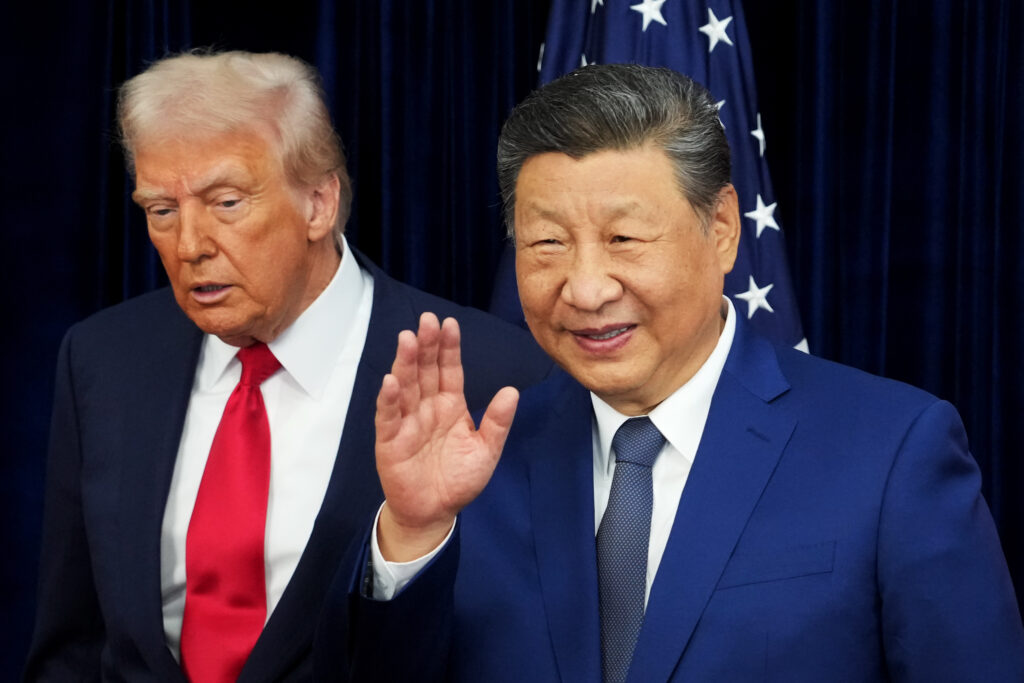
The political upheaval in Venezuela and Iran — including military strikes, threatened and realized, by the Trump administration — could provide opportunities for China to bolster its claim to being a reliable, stabilizing alternative to a U.S.-led world order, analysts say.
The U.S. military’s surprise operation in Venezuela led to the capture of President Nicolás Maduro and his removal to the United States to face criminal charges, abruptly ending the rule of a leader Beijing had backed for years with loans, oil deals and diplomatic support.
In Iran, mass protests were followed by a bloody crackdown, raising fresh questions about the durability of the Islamic Republic and prompting President Donald Trump to promise the Iranian people that the U.S. would come to their aid. The Pentagon began relocating personnel and equipment away from key facilities in the region, but Trump then appeared to step back from taking military action.
Beijing used the opportunity to differentiate its approach.
Foreign Minister Wang Yi on Thursday told his Iranian counterpart that China opposes the use or threat of force in international relations, and also opposes using the “law of the jungle.” China was willing to play a “constructive role” in resolving differences through dialogue, Wang told Iranian Foreign Minister Abbas Araghchi, according to a Chinese readout.
The Trump administration’s actions could have real implications for China. Venezuela and Iran are key parts of the anti-U.S. alliance that Chinese leader Xi Jinping — together with Russian President Vladimir Putin — has been leading in an effort to build influence among U.S. adversaries, secure energy supplies and demonstrate that Washington is no longer the indispensable organizer of global politics.
So, too, is Cuba, which Trump has also threatened.
But the upheaval could also have economic implications for Beijing: China has been Venezuela’s biggest customer for oil, purchasing most of its supply, and also buys more than 80 percent of Iran’s shipped oil, according to consultancy firms.
Trump this week warnedthat any country that continues doing business with Iran could face a 25 percent tariff on trade with the U.S. — a warning aimed squarely at China.
Still, Xi is likely following what American statesman Henry Kissinger characterized as the core Chinese approach to foreign policy: Focus on the long game.
China can afford to play the long game precisely because it can depend on the U.S. to create opportunities for it to do so, said Bates Gill, a senior fellow for Asian security with the National Bureau of Asian Research in Washington.
“To the degree countries see the United States as more of a problem than a solution to the challenges they face, China will try to provide an alternative,” he said.
In areas such as providing development assistance, opening export markets and in providing educational opportunities, for example, “that is already happening,” Gill said. “Washington is handing over the script for China to use.”
China has aggressively expanded into Latin America, including through enormous infrastructure projects. In Venezuela, for example, estimates of total Chinese investment, including loans and investment in the oil industry, range from $60 to $100 billion.
China has also grown its trading ties with the Middle East, including taking advantage of U.S. sanctions on Iran to buy discounted oil.
China remains oil thirsty
Though much reduced in recent years, China still depends on shipments from overseas for about two-thirds of its crude oil supplies.
But China has many other options to easily fill the missing supply on the open market, said Drew Thompson, a former Pentagon official focused on China.
“China has finally got the diversity in supply they’ve always wanted,” said Thompson, now at the S. Rajaratnam School of International Studies in Singapore. “If it’s not Venezuela, it’s South Sudan, or elsewhere in the Middle East, or even Papua New Guinea.” The world is awash in oil, and China “can buy it on the open market anywhere.”
In the Middle East, meanwhile, the pain for Beijing is less financial than a blow to its growing diplomatic ambitions. Several splashy moves in recent years by Beijing underscored Beijing’s desire to play a bigger role in the region.
In 2023, Beijing brokered a détente between Iran and Saudi Arabia, surprising Washington, which had been the dominant outside dealmaker since the end of the Cold War.
Then in 2024, Beijing, which had increasingly aligned itself with Palestinian leaders since the Oct. 7, 2023, Hamas-led attacks on Israel, announced a deal between Palestinian factions, including Hamas and Fatah, to increase unity among the bitter rivals during the war in Gaza. Chinese state media heralded the agreement as evidence of China’s emerging role as a Middle East power broker — even as experts cautioned that deep mistrust and scant implementation plans left practical unity elusive.
Since then, the ceasefire in Gaza has held tenuously. But Palestinian political divisions remain entrenched, with little sign that Beijing’s initiative has translated into durable governance or leverage on the ground, underlining China’s limited ability to convert diplomatic breakthroughs into lasting outcomes.
Expanding its influence
Even as protests were roiling Tehran and Trump was threatening to intervene, Iran sent naval warships to participate in the Chinese-led “Will for Peace 2026” military exercises off the coast of South Africa, part of the first multilateral exercise by the BRICS organization. South Africa asked Iran to withdraw at the last minute to avoid further antagonizing the U.S., local media reported, but photos showed the Iranian ships heading out to join the exercises.
Although India did not attend and Brazil was only an observer, the exercises — involving the Chinese, Russian and South African navies — underscored Beijing’s desire to expand the membership and the remits of political and economic blocs it leads.
China has used platforms such as BRICS, the Belt and Road Initiative and the Shanghai Cooperation Organization to amplify its voice and push for what Xi described in a 2023 speech as “fairness and justice in international affairs,” and an enhanced voice for developing countries.
In some respects, the Chinese push has been a success. Egypt, Ethiopia Saudi Arabia, the United Arab Emirates and Iran all joined BRICS in 2024, and dozens of others expressed interest in joining. Beijing has promoted the grouping as the foundation of a Global South coalition that can push de‑dollarization and new technological links.
But for all its talk of partnerships and mutual support, Beijing’s approach is deeply pragmatic, analysts say. And that means its commitment to supporting its allies is strictly limited, especially when it comes to existential crises like Venezuela’s or potentially confronting the regime in Tehran.
Ultimately, said Andrea Ghiselli, a lecturer in international politics at the University of Exeter, most countries are under little illusion about what China will and will not do.
“Outside a truly limited number of countries that occupy a strategic position in Chinese diplomacy like Russia and North Korea, China is willing to provide economic and diplomatic support and sell weapons and train security forces,” Ghiselli said. “Yet, when push comes to shove, Beijing will stand aside, never truly committed to the survival of any regime.”
Theo Nencini, a researcher specializing in Sino-Iranian relations and a lecturer at Sciences Po Grenoble, concurred. While Beijing’s role as a broker in cases like the Iran-Saudi rapprochement is appreciated, China’s input was not necessarily critical to what had been an ongoing process.
“Nor is it evident that China’s currently restrained posture toward the crises in Venezuela and Iran undermines its political credibility among its traditional diplomatic partners, or that it significantly damages its reputation as a ‘responsible partner,’” Nencini said.
Beijing is highly unlikely to “take any overtly provocative steps at this point,” said Gill of the National Bureau of Asian Research. It will issue boilerplate statements opposing “foreign interference” in the internal affairs of other countries.
“Behind the scenes, China’s leadership and strategists will be reassessing relations in South America and the Gulf regions, providing quiet back-channel reassurances of economic, political and diplomatic support to countries that may be Washington’s next targets, such as Iran and Cuba.”
China will continue playing the long game, analysts say — content to absorb the shocks from Washington and trust that patience remains its most reliable foreign policy asset.
The post China senses opportunity as U.S. targets Iran and Venezuela appeared first on Washington Post.