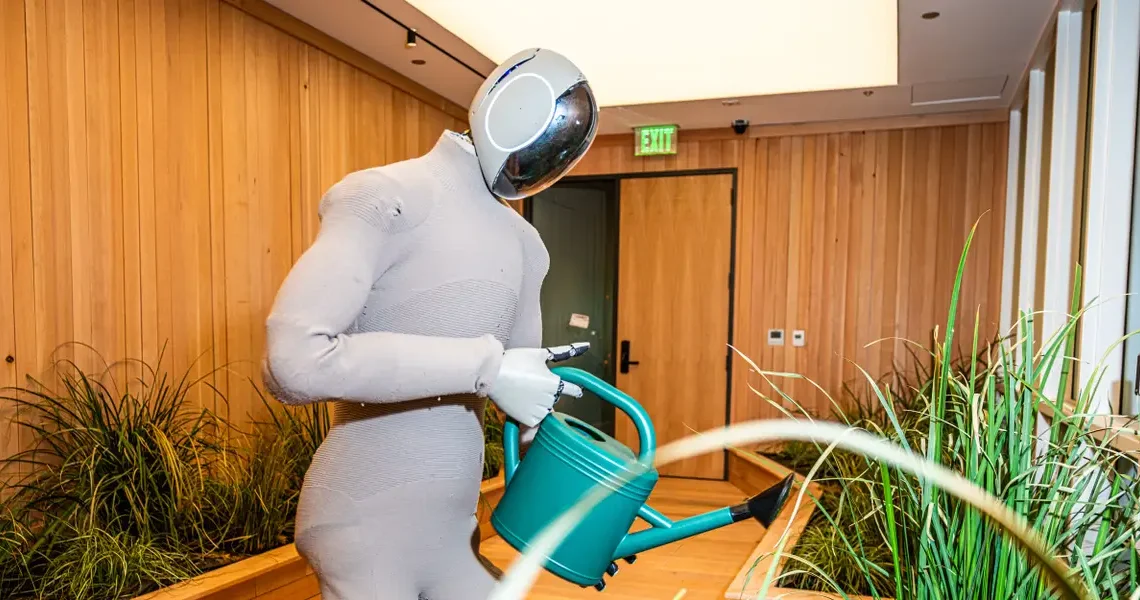
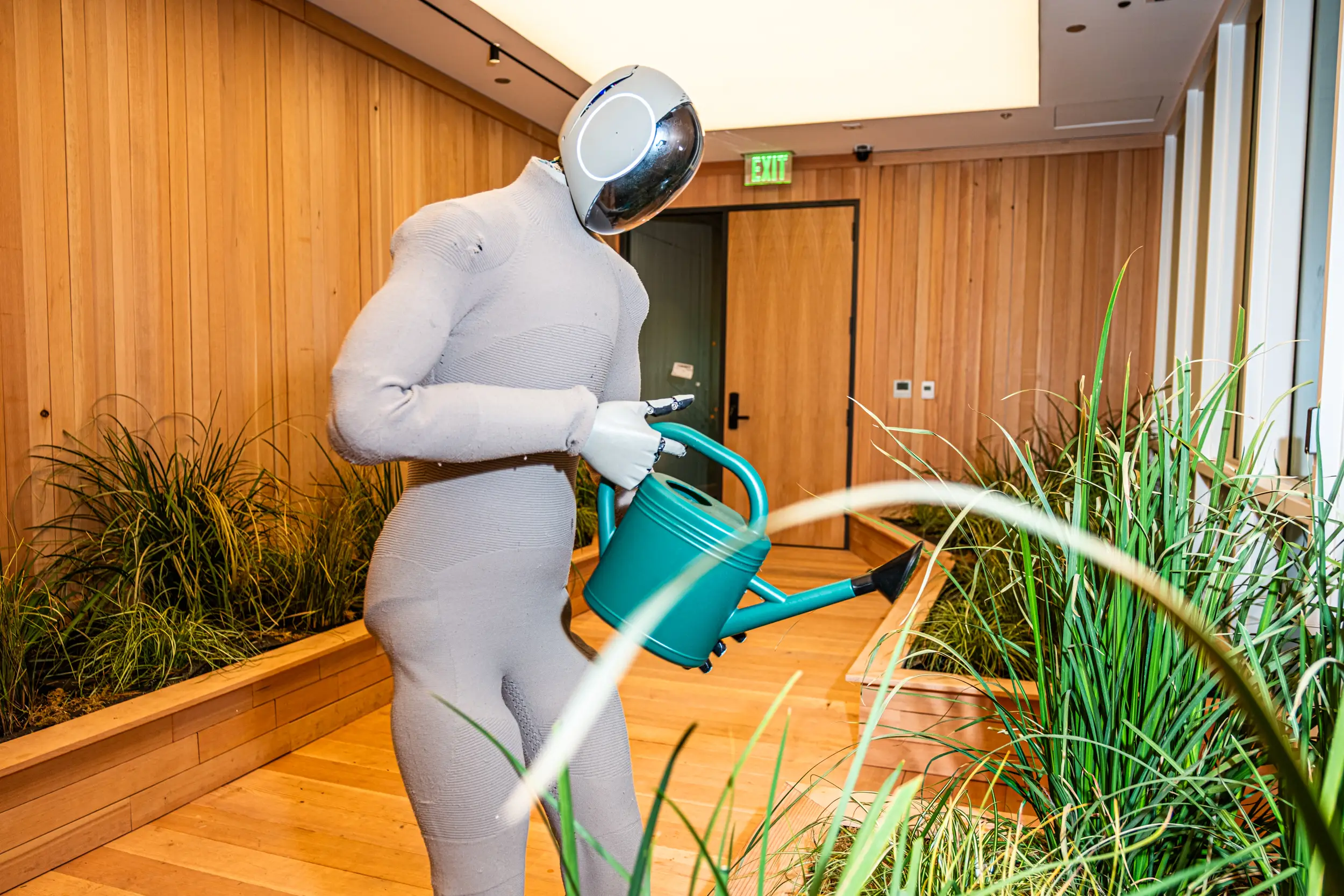
AI is taking another job from humans — training robots.
Tesla rival 1X launched a new AI model on Monday that the OpenAI-backed startup’s CEO said would allow the company to move away from using humans to train its humanoid robot, Neo.
Humanoid robot companies, including 1X, typically employ armies of human operators and data collectors to train their machines by having them perform tasks ranging from squatting to washing dishes while being recorded or wearing sensors.
1X CEO Bernt Børnich told Business Insider that his startup’s new “world model” would allow Neo to learn directly from video captured by the robot itself, rather than relying on data collected by human operators.
“Essentially, the world model does the same thing as the operator would do,” said Børnich, adding that he expected the update to improve Neo’s ability to generalize and tackle tasks it has not encountered before.
“The big unlock is essentially now that intelligence scales with the number of deployed robots, instead of the number of operators you have gathering data,” he said.
AI training has become an increasingly popular source of work, whether it’s improving robots or large language models like ChatGPT. In robot training, operators often use virtual reality headsets, motion-capture suits, and controllers to “teleoperate” the machines through simple tasks, providing data that trains the humanoid’s AI model to navigate the physical world.
A spokesperson for 1X said the new world model “significantly reduces” the company’s reliance on teleoperation, adding that data would likely largely be collected by the robots themselves in the future.
Robot operators have previously told Business Insider that the role is physically demanding and often tedious, with some working on Tesla’s Optimus saying they sustained injuries as a result. Positions are often advertised on a shift basis, with pay starting at $25 an hour at both Tesla and 1X.
1X is not the only company to shift its data collection strategy away from teleoperation.

Business Insider’s Grace Kay reported last August that Tesla had revamped its Optimus training strategy to rely on video rather than on data collected from humans wearing motion-capture suits and VR headsets.
Other robotics labs are also pursuing world models, which are AI models capable of simulating realistic environments and real-world physics, as they look for more high-quality data to train their humanoids.
Neo sets out on its own
1X’s Neo set the internet abuzz last October with a 10-minute video demo that showed the robot vacuuming, folding laundry, and unloading a dishwasher.
Neo is priced at $20,000 as a one-off payment or $500 a month subscription and is expected to ship this year — but the robotic helper comes with a catch.
Early adopters can expect Neo to be piloted by a remote human operator at least some of the time, to perform housekeeping tasks that the robot can’t do autonomously and collect further data to train the underlying AI models.
Børnich said it would be very clear when the Neo is being teleoperated and that 1X was taking all the necessary steps to protect user privacy. He compared Neo in teleoperated mode to inviting a human inside your home to help out.
1X, which raised $100 million in 2024 and has been backed by OpenAI and Samsung, intends to move away from teleoperation in customer environments, too. Børnich said that the company’s advances in its world model meant he expected Neo to be able to perform most tasks autonomously by the end of this year.
“I think sometime in 2026, we will be able to ship you something that is fully autonomous out of the box and does not actually require any human intervention except for yourself,” Børnich said.
The Norwegian executive added that 1X expected to produce over 10,000 robots this year and that the company “sold out in the first few days” following the viral demo.
A 1X spokesperson said customers previously had a narrow set of “hero” tasks that Neo could tackle autonomously, but that has now changed so that the robot will attempt all tasks without human support.
“Task execution may not always be perfect, and it may struggle at hard tasks, but it will learn over time,” they said.
Do you work in the robotics industry or have a tip? Contact this reporter via email at [email protected] or Signal at tcarter.41. Use a personal email address, a nonwork WiFi network, and a nonwork device; here’s our guide to sharing information securely.
Read the original article on Business Insider
The post An OpenAI-backed humanoid robot startup says it’s moving away from using humans to train its Optimus rival appeared first on Business Insider.