Things have not gone exactly the way President Donald Trump suggested they would following the ouster of Venezuelan strongman Nicolás Maduro.
The big oil companies that Trump promised would make a windfall by pumping in Venezuela are chafing at the massive costs and risks associated with overhauling its infrastructure. So much so that Trump lashed out at ExxonMobil following its CEO’s comment at a White House meeting that Venezuela is “uninvestable.” The president accused the company of “playing too cute” and said he is “inclined to keep Exxon out” of Venezuela.
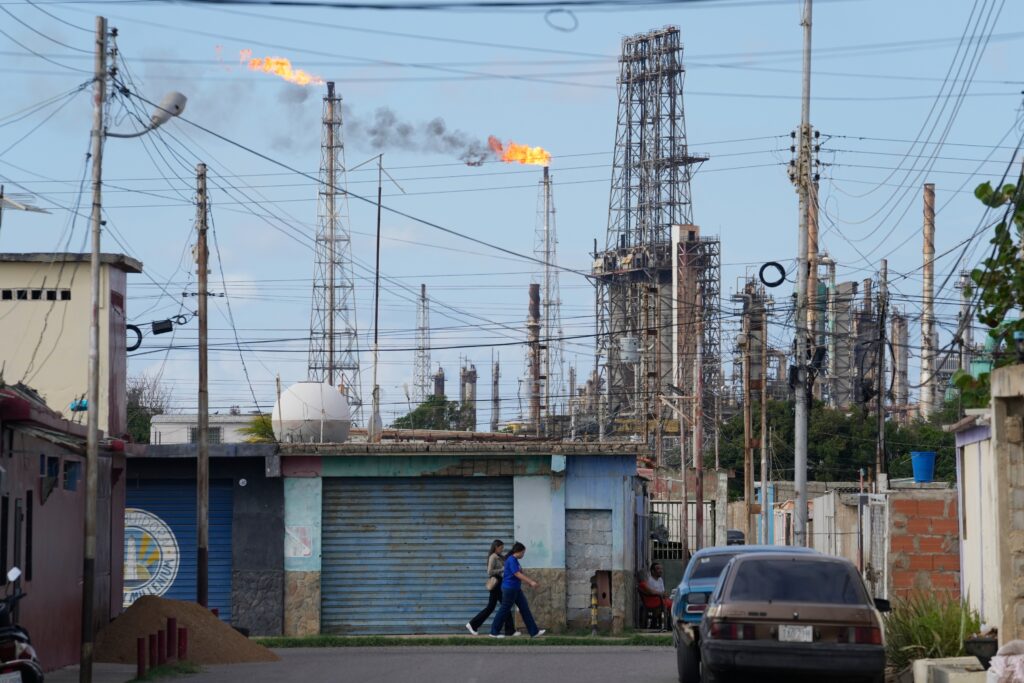
Other oil executives eyeing Venezuela are struggling to see a path for making money there when right now it can cost more to extract a barrel of Venezuela’s notoriously hard-to-refine crude than the companies can make selling it.
“The administration has had to learn you don’t go into Venezuela, turn a tap and 3 million barrels a day flow,” Bob McNally, founder of research firm Rapidan Energy Group, said from the stage of the American Petroleum Institute’s annual State of American Energy event this week. “It doesn’t happen like that.”
But make no mistake. There are industry players poised to make many millions off the United States’ recent incursion into Latin America, some of them with close ties to Trump and the GOP. Here is a look at them:
Paul Singer and Citgo
Hedge fund billionaire Paul Singer’s firm Elliott Investment Management has for years been buying distressed Venezuelan-owned assets in the U.S. at deep discounts. The firm is poised to convert them into control of highly strategic energy infrastructure, pending regulatory approval. One company acquired by an Elliott affiliate is Citgo, the Houston-based refining firm owned by Venezuela’s state oil company Petróleos de Venezuela (PDVSA). Citgo owns refineries in Illinois, Louisiana and Texas that are well-positioned to profit off the millions of barrels of Venezuelan oil that Trump says will be steered to U.S. refineries because it is a particularly heavy blend of crude that is difficult to process. Only certain refineries, like those run by Citgo, are equipped to handle it.
Amid U.S. sanctions, such refineries have reverted to processing other heavy crude from Canada and Mexico. The infusion of the cheap Venezuelan product will drive down the cost for all the oil they purchase, enabling the refineries to boost their profit margins by millions of dollars, industry analysts say.
While boosting profit margins of refineries was not necessarily central to the White House’s Venezuela plan, some of these operators are close to Trump. Singer has donated at least $10 million to Trump-aligned political committees. Other companies in the U.S. with complex refineries include Chevron, Valero Energy, Marathon Petroleum, Phillips 66 and ExxonMobil. Executives from these firms collectively donated at least $2.5 million to Trump-affiliated campaign committees in the 2024 election cycle, with most of it coming from Chevron board member John Hess.
Chevron
The oil major is the only U.S. firm that was still pumping in Venezuela when Maduro was captured in Trump’s military operation. Unlike competitors that have not been to the country in years, Chevron has been pumping crude and exporting it out of Venezuela under a special sanctions exemption granted by the federal government.
The company is positioned to expand its output by hundreds of thousands of barrels per day. That’s a small fraction of Chevron’s overall output but would add to the firm’s profits. The company’s stock price has jumped roughly 7 percent since the U.S. military operation.
In addition to the campaign contributions, Chevron gave $2 million to Trump’s inaugural fund, more than any other oil company.
SLB
Oilfield services companies are also among the best positioned to benefit from Trump’s plans for Venezuela. These are the contractors that do much of the work to extract oil: find the deposits, set up the rigs, drill, maintain the infrastructure, test for seismic issues and so on. Unlike the giant oil companies, they face a lower level of financial risk because they do not need to bring billions of dollars of investments to projects.
Houston-based SLB, formerly named Schlumberger, is the world’s largest oilfield services company. It is already partnered with Chevron in Venezuela. SLB’s stock has jumped some 14 percent since Maduro’s arrest. SLB chief executive Olivier Le Peuch was among the oil executives invited to the White House meeting last week. “We have knowledge of the subsurface like nobody else has,” he said there. “We have boots on the ground, capacity on the ground — $700 million of equipment value on the ground in Venezuela — ready to mobilize for all of our partners [and] customers.”
Other oilfield services firms are also angling for contracts in Venezuela, and rising stock prices suggest their shareholders are confident they will win them. Those firms include Halliburton, which GOP stalwart Dick Cheney led in the late 1990s before he was elected vice president, and Baker Hughes, a behemoth operating in more than 120 countries.
Analysts say the firms will enjoy a modest boost in business if contracts are spread among them. But it is also possible that the lion’s share will go to a single firm, in which case that company would probably see considerable financial gains.
Repsol
Madrid-based Repsol is not a U.S. oil company, but its considerable U.S. holdings earned it a seat at the White House meeting last week. More importantly, the company has active operations in Venezuela and is one of the few companies that would be capable of exporting tens of thousands of barrels from that country quickly.
Repsol’s positioning underscores a reality facing Trump: It is not necessarily the U.S. oil majors that are best equipped to carry out his plan to quickly stabilize Venezuela with oil revenue. Unlike ExxonMobil and ConocoPhillips — which both face shareholder pressure to proceed cautiously and many logistical constraints — companies like Repsol and Eni of Italy are ready to deliver in Venezuela, albeit in modest volumes.
They are joined by several lesser-known foreign companies based in Latin America and Europe that have kept boots on the ground in Venezuela and can start ramping up and expanding modest operations.
ExxonMobil
Yes, its CEO warned that Venezuela is currently uninvestable. And yes, it aggravated Trump so much that he proclaimed he might ban the firm from pumping there if it ultimately wants in. But Maduro’s ouster is a boon for ExxonMobil, not because of the oil in Venezuela, but because of the oil next door in Guyana. Exxon and its affiliates have invested more than $55 billion in pumping in Guyana, making it one of the largest oil investments in the world.
Maduro’s regime was a constant and considerable risk to the operation in Guyana, with the Venezuelan strongman claiming the oil belonged to his country. He repeatedly threatened the project, including sending naval vessels into Guyana’s exclusive economic waters as an intimidation measure.
While ExxonMobil may have irked Trump at the White House meeting, the oil giant and the administration have been closely aligned on Guyana, with the U.S. warning Maduro against interfering with the Exxon project. The company donated $1 million to Trump’s inaugural fund.
Hedge funds
In addition to Paul Singer, there are a host of lesser-known hedge fund executives angling to profit off the upheaval in Venezuela. The country is littered with decayed and neglected oil fields and infrastructure that are too minor for the big oil companies to invest in, but have the potential to generate attractive returns for small investor groups.
Their hedge funds are scouring the landscape for equipment and land they can take over for bargain basement prices, with plans to quickly renovate the assets and generate revenue from them. Many of these companies operate under the radar, unlike many of the big industry players that must report their activities to shareholders and financial regulators.
“It’s a massive gold rush,” Ben Cleary, a hedge fund manager at the investment firm Tribeca, told Bloomberg News. “Every bank is sending people in.”
Harold Hamm
The presence of the billionaire oil entrepreneur and Trump confidant at the White House meeting intrigued many in the industry. He is among the biggest of the U.S. “wildcatters” — oil prospectors who drill in frontier areas, taking big risks in hopes of a large payout. These companies generally don’t have the resources to deal with Venezuelan crude, much less the political and security risks of operating in that country. Many of the U.S. wildcatters are deeply frustrated by Trump’s Venezuelan policy, which threatens to flood the market with more foreign oil at a time when prices are so cheap here, they are struggling to make a profit off drilling at home.
Trump lavished praise on him and his business at the meeting, reminiscing on their friendship and making clear that Hamm has his ear when it comes to energy policy. The exchange cemented Hamm’s place as perhaps Trump’s most influential outside adviser when it comes to oil.
The post Here’s who is likely to profit from Trump’s Venezuela takeover appeared first on Washington Post.