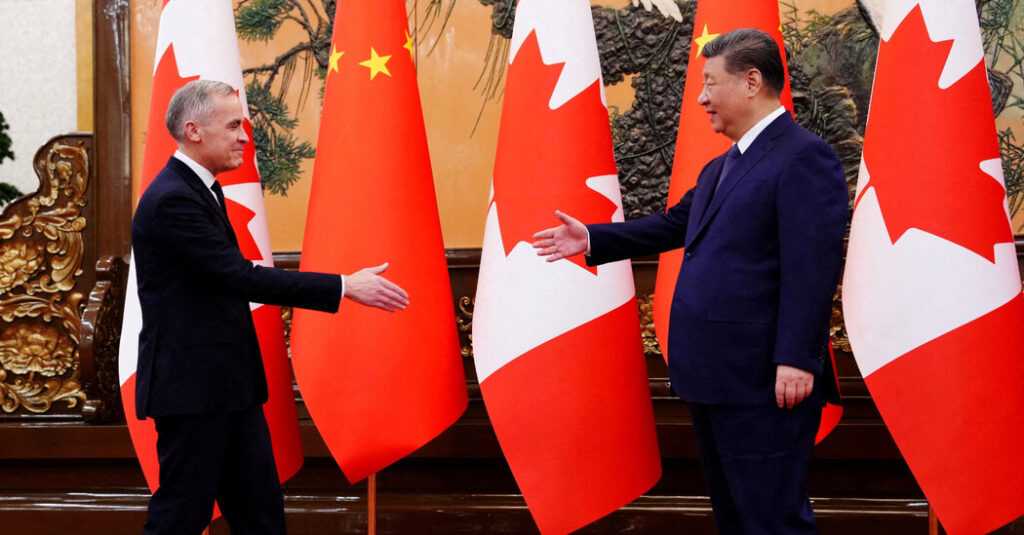
Canada will lower tariffs on some Chinese electric vehicles and China will do the same for Canadian canola products, a major shift in policy that was announced on Friday during a landmark state visit by Prime Minister Mark Carney of Canada to Beijing.
Mr. Carney announced that Canada will allow up to 49,000 Chinese electric vehicles into the Canadian market under a preferential tariff rate of 6.1 percent.
In 2024, at the behest of the Biden administration, Canada imposed a 100 percent tariff on Chinese electric vehicles.
While the new tariff changes are modest, they signal an important break with the United States as Canada seeks to urgently diversify its trading partners and reduce its reliance on the United States.
President Donald J. Trump has imposed on tariffs on some key Canadian exports like lumber, steel and autos. He has also threatened Canadian sovereignty, a shift Mr. Carney has described as a “rupture.”
Mr. Carney also announced on Friday that China would make a “considerable investment into Canada’s auto-sector” within the next three years as part of the agreement to lower tariffs on electric vehicles.
In exchange, Mr. Carney said that China will lower tariffs on Canadian canola seed to a combined rate of approximately 15 percent, down from about 85 percent, offering fast relief to a major Canadian agricultural sector.
The announcement came just after Mr. Carney met with President Xi Jinping of China in Beijing Friday, during a three-day state visit that both leaders hailed as a significant reboot in their nations’ previously frosty relationship.
“President Xi and I are announcing that Canada and China are forging a new strategic partnership,” Mr. Carney said.
Matina Stevis-Gridneff is the Canada bureau chief for The Times, leading coverage of the country.
The post Canada Breaks With U.S. to Slash Tariffs on Some Chinese Electric Vehicles appeared first on New York Times.